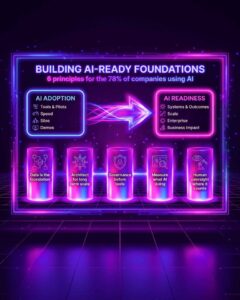
Today, almost every enterprise claims to be “using AI.”
Chatbots are live, copilots are in pilots, and leadership decks are full of AI roadmaps.
Yet when you look beyond the demos, a different story emerges.
Despite widespread adoption, only a fraction of organizations are seeing meaningful business impact from AI. Industry research consistently shows that while around 78% of companies report using AI, far fewer are able to scale it across the enterprise or clearly connect it to outcomes.
The challenge isn’t experimentation, it’s readiness. Without the right foundations, AI remains stuck in pilots rather than becoming a dependable part of how the business operates.
Adoption vs. Readiness
Adopting AI is relatively easy. Teams can deploy a tool, run a pilot, or integrate a model into an existing workflow within weeks.
Being AI-ready is different.
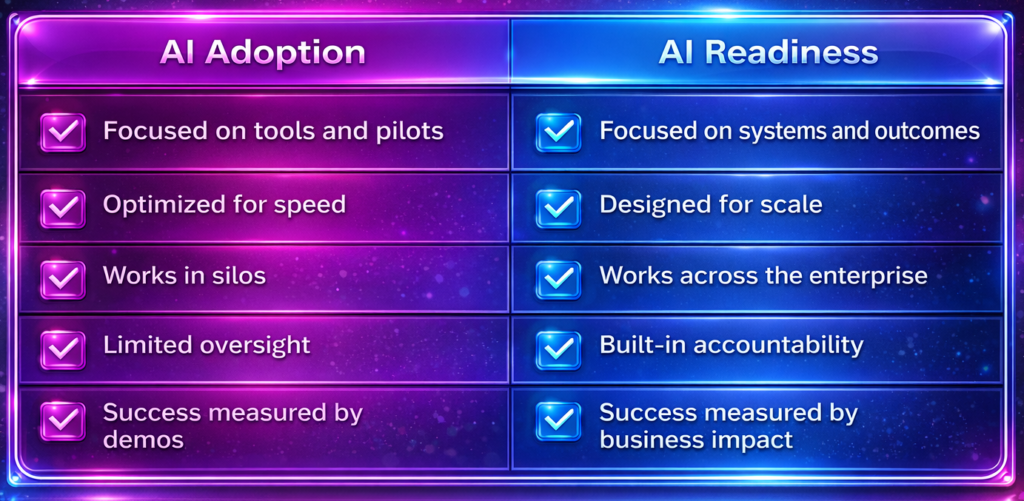
Most organizations operate on the left side of this table. The ones seeing sustained value deliberately move to the right, treating AI not as a feature to deploy, but as a capability to build.
The 6 Principles of AI Readiness
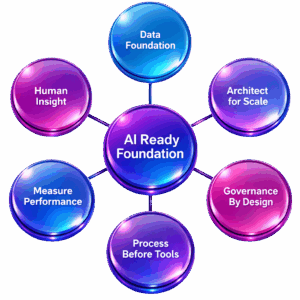
Organizations that successfully move from pilots to production share a common approach. They don’t treat AI as a collection of tools, but as an enterprise capability that needs clear foundations.
- Data Is the Foundation
AI value depends on data that is trusted, well-owned, and well understood. Fixing data issues after deployment is one of the most common reasons AI initiativesstall. - Architect for Long-Term Scale
Models and vendors will evolve. AI-ready organizations design systems that can adapt over time without constant rebuilds. - Governance by Design
Trust cannot be added later. Clear access controls, auditability, and accountability must be part of the design,not a post-deployment fix. - Process Before Tools
AI delivers impact only when processes change. Productivity gains come from redesigning how work happens, not simply adding AI on top. - Measure What AI Is Doing
Leaders need visibility into how AI behaves in real situations. If performance and decisionsaren’t observable, AI cannot be managed or improved. - Human Oversight Where It Counts
AI canassist and automate, but accountability remains human- especially for high-impact business decisions.
Applied together, these principles significantly reduce the risk of AI failures related to accuracy, reliability, and trust.
Leadership Reflection: From Pilots to Production
For CIOs and CTOs, the AI challenge has shifted. It’s no longer about proving that AI works, it’s about making it work consistently, safely, and at scale.
The organizations that succeed won’t be those that run the most pilots, but those that build the strongest foundations.
Before launching the next AI initiative, it’s worth asking:
Are we experimenting with AI or are we actually ready to scale it?