The Silent Crisis Every Enterprise Is Struggling With
When you ask any CIO or CTO today what keeps them up at night, surely, you’ll hear the same concern over and over:
“Our systems don’t speak to each other the way they should be speaking.”
Despite billions invested in cloud platforms, data lakes, integration tools, SaaS apps, and automation frameworks, 95% of IT leaders report that system integration is one of their biggest roadblocks to digital transformation.
- There is more data than ever.
- More tools than ever.
- More platforms than ever.
But ironically, enterprises are less connected than ever.
This silent integration crisis is costing enterprises millions, in delays, rework, and operational inefficiencies, and it’s happening even inside the most advanced digital organizations.
The Real Problem: Fragmentation Hiding in Plain Sight
Digital transformation made one thing very clear: enterprises don’t run on one system, they run on hundreds.
- CRM platforms
- Finance systems
- HR systems
- Cloud warehouses
- Lakehouses
- Customer apps
- Operational databases
- APIs
- Legacy systems
- Microservices
- Analytical dashboards
All comes with their own connectors, data formats, workflows, and governance rules.
While each system performs its job well, none of them were designed to operate as part of a unified whole process.
This is where the integration crisis begins.
The Symptoms Every IT Leader Knows Too Well:
- Data pipelines breaking when upstream systems change
- Redundant jobs running across multiple tools
- Multiple versions of the same business logic
- Slow onboarding of new systems
- Data duplication across warehouses, lakes, and application layers
- Endless reconciliation cycles
- Schema, API, and metadata inconsistencies
- Manual fixes becoming “normal”
- No single view of data lineage or workflows
Teams Spend More Time Orchestrating This Chaos Rather Than Delivering Innovation.
And the result?
All integration becomes the bottleneck for everything and analytics, AI, automation, compliance, and customer experience.
Why Current Traditional Approaches Are Failing
Enterprises have tried everything:
- ETL/ELT tools
- API gateways
- Middleware buses
- Custom scripts
- Workflow schedulers
- Microservices orchestration
- Data pipeline managers
The problem isn’t the lack of tools.
It’s definitely the lack of unified coordination.
Every tool solves a small piece of data issue, but no tool governs the end-to-end flow across the ecosystem.
This leads to:
- Local optimization, global dysfunction
- Patchwork architecture
- Poor visibility into cross-system workflows
- No central source of truth
- Manual dependency management
- Slow change adoption
In short:
Fragmented tools cannot orchestrate an integrated enterprise.
The Breakthrough: Unified Data Orchestration
This Unified Data Orchestration helps focus not on the entire end-to-end lifecycle of data.
Instead of each system running in its own, orchestration creates:
- One set of rules
- One control plane
- One view of data flows
- One way of managing dependencies
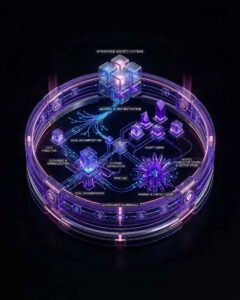
This process transforms the enterprise from a collection of scattered systems into a synchronized, intelligent, self-governing ecosystem.
How This Unified Data Orchestration Solves The Integration Crisis?
-
End-to-End Visibility Across All Data Flows
Most organizations will be unable to answer basic questions like:
- Where did this data come from?
- What pipeline produced this report?
- What systems will break if this schema changes?
Unified orchestration gives complete lineage, dependency mapping, and real-time observability.
Outcome:
Better control, fewer surprises, faster troubleshooting.
-
Automated Coordination Between Systems
Orchestration ensures:
- Pipelines run in the right order
- APIs trigger at the right time
- Workflows are resilient to failures
- Dependencies self-adjust based on conditions
No more babysitting integrations manually.
Outcome:
Lower operational overhead and fewer failures.
-
Standardized Business and Technical Logic
Instead of duplicating rules across 10 different tools:
- Transformations
- Quality checks
- Access controls
- Data contracts
- SLOs
These above are defined once and enforced everywhere.
Outcome:
Higher trust, consistency, and compliance.
-
AI-Assisted Optimization & Self-Healing
Modern orchestration platforms use AI to:
- Auto-scale jobs
- Reroute around failures
- Recommend schema updates
- Predict pipeline issues
- Apply automated corrections
Outcome:
Reliability without manual intervention.
-
Faster Change Adoption
New applications, APIs, and tools can plug into the ecosystem without months of integration work.
Outcome:
Faster onboarding, quicker innovation, and lower integration costs.
The Transformation in Numbers
“According to industry research, the data orchestration market is projected to grow significantly, highlighting rising demand for unified integration solutions.”
Organizations adopting Unified Data Orchestration report:
- 50–70% reduction in integration and maintenance effort
- 2× faster delivery of analytics and AI projects
- 80% fewer pipeline failures
- Complete audit-ready lineage across systems
- Stronger compliance posture
- Massive productivity gains across data engineering teams
This isn’t an incremental improvement; it’s a structural shift.
Why Unified Data Orchestration, Not More Tools, Is the Future
CIOs and CDOs are slowly recognizing a hard truth:
Integration cannot be solved by adding more tools.
It can only be solved by orchestrating them.
Unified orchestration is emerging as the new architectural backbone because it:
- Reduces complexity
- Accelerates delivery
- Improves reliability
- Enhances governance
- Powers real-time decisioning
- Enables AI, automation & analytics at scale
It is the missing layer the modern data stack never had.
The Edgematics Advantage: Unified Data Orchestration Built for Modern Enterprises
At Edgematics, we’ve seen firsthand how broken integration cripples’ business transformation.
That’s why we built the next generation of unified orchestration powered by:
🚀 PurpleCube.ai
Full-stack, unified data orchestration from engineering and automation and from ingestion to transformation to deployment.
🤖 Axoma
AI-powered orchestration that synchronizes workflows, enforces governance, activates metadata, and manages end-to-end dependencies across the enterprise.
Together, they do what legacy stacks cannot:
- Replace fragile pipelines with intelligent workflows
- Unify metadata, lineage, governance, and automation
- Provide one control plane for every system
- Reduce integration complexity at its source
This is the foundation of a truly connected enterprise.
The Way Forward
The integration crisis isn’t a temporary challenge; it’s a structural problem caused by fragmented modernization. Unified data orchestration is the future. It brings the order, automation, and intelligence enterprises desperately need.
IT leaders who embrace orchestration now will:
- Move faster
- Reduce costs
- Strengthen governance
- Unlock trusted AI
- Deliver real innovation
Because the real future of the digital enterprise isn’t defined by how many tools you have,
but by how well they work together.
And orchestration is the glue that makes it all possible.
Ready to Fix Your Integration Crisis?
Let’s build a resilient, unified, AI-enabled orchestration layer for your enterprise.
👉 Explore PurpleCube.ai – Unified data engineering platform
👉 Discover Axoma – AI-Powered orchestration for modern data ecosystems
The top 5% winning are making the move towards unified data and AI orchestration. But are you? Let’s decode your roadmap together, contact us.