The Million-Dollar Problem Hiding in Plain Sight
I’ll be honest with you. When I talk to enterprise leaders about their data infrastructure, most of them don’t immediately think “data silos” is their biggest problem. They’re worried about AI adoption, digital transformation, and customer experience. But here’s what I’ve learned after years in this industry: data silos are the silent killer lurking beneath all those other challenges.
Let me paint you a picture – Imagine running a restaurant where the kitchen has no idea what the waiters are serving, the inventory manager doesn’t know what the kitchen needs, and the accountant can’t see what’s flying off the shelves today. Sounds like a recipe for disaster, right? Yet that’s exactly how most organizations operate, not with food, but with their most valuable asset: data.
The numbers don’t lie. Gartner’s research shows that companies are hemorrhaging an average of $12.9 million annually because their data can’t talk to each other. These “data silos” aren’t just inconvenient. They’re actively sabotaging productivity, decision-making, and innovation across every department.
What Exactly Are Data Silos?
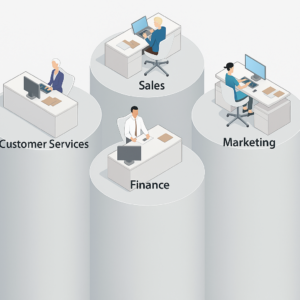
Think of data silos like those old filing cabinets scattered across different floors of a building, each one locked with a different key, and nobody’s quite sure who has which key anymore.
Here’s what it looks like in practice:
- Sales keeps customer data locked in their CRM
- Marketing runs campaigns from their own analytics platform
- Finance generates reports from a completely separate system
Each department is working fine in isolation. But together? They’re creating disconnected islands of insight that can never form a complete picture.
In simple terms: A data silo exists when information is stored separately and can’t flow freely across systems or teams. It’s data trapped in isolation when it desperately needs to be set free.
🔍 Why Do Data Silos Appear?
I’ve seen this pattern repeat itself at countless organizations. Data silos don’t appear overnight. They accumulate over time, and usually for understandable reasons:
-
Departmental Autonomy Gone Wild
Teams buy their own software independently. Marketing loves HubSpot, Sales swears by Salesforce, Finance won’t give up their legacy ERP. Before you know it, you’ve got a tech stack that looks like a patchwork quilt. Colorful, but not exactly functional.
-
The M&A Integration Nightmare
I’ve watched companies acquire smaller businesses and inherit their entire technology ecosystems. Legacy systems never get integrated because “we’ll do it later.” Spoiler alert: later never comes, and those systems become permanent fixtures.
-
Technology That Won’t Talk
Some systems are still running on technology from the early 2000s. They lack modern APIs, cloud support, or any reasonable way to connect with today’s tools. They’re digital dinosaurs, and they’re holding everything else hostage.
-
The “This Is MY Data” Culture
Here’s the uncomfortable truth: departments often guard their data like territorial animals. They see it as “their” data rather than the company’s data. This protectionism creates artificial barriers that hurt everyone in the long run.
The Real Cost of Broken Data
Let me break down what those millions in losses actually mean:
- Duplicated effort: Teams spending hours recreating reports that another department already has
- Slow decision-making: Executives waiting days for insights that should take minutes
- Missed opportunities: Customer signals going unnoticed because marketing can’t see what sales knows
- Innovation paralysis: Data scientists unable to access the data they need to build game-changing models
- Frustrated employees: Your best people wasting time on data archaeology instead of strategic work
But, here’s the good news: you don’t have to rebuild everything. You can modernize intelligently. This is exactly why we built Edgematics around three core principles to tackle the data silo problem:
1 Unify: Map, Govern, and Connect
We believe your data should speak one language. Our platform breaks down those departmental walls and brings your scattered data together into a single, coherent view. No more hunting across five different systems to answer one simple question.
But unification isn’t just about technology. It starts with understanding. We help you map your data landscape, so you know exactly:
- Which departments use which systems?
- Where customer information is stored?
- Who has access to what?
Then we help you establish governance rules before connecting anything. We work with you to agree on standards:
- Who owns different types of data?
- What are the quality standards?
- Who can access what information?
- How will you maintain security and privacy?
Finally, we connect your systems using PurpleCube AI and modern integration tools that link your databases and applications. Think of it as building bridges between those isolated filing cabinets. We leverage cloud platforms like Snowflake, Databricks, Google BigQuery, and Azure Synapse, along with integration tools like PurpleCube.ai and governance platforms like Erwin, Atlan, and Collibra.
When data is unified, you start identifying patterns you never knew existed. Sales trends correlate with marketing campaigns. Customer service issues predict churn before it happens. Finance finally understands what’s actually driving revenue.
2 Automate: Real-Time, Zero-Touch Integration
Here’s the thing. Manual data integration is not just tedious; it’s a losing battle. By the time your team manually exports, transforms, and imports data from one system to another, that data is already outdated.
We automate the data flows between your systems, so information moves in real-time without human intervention. Your CRM updates automatically sync with your analytics platform. Your inventory system talks directly to your forecasting tools. It just works, continuously, in the background.
This isn’t about replacing your team. It’s about freeing them from repetitive, soul-crushing tasks so they can focus on what actually matters: analyzing insights and making strategic decisions.
3 Activate: Make Data Easy to Use
Unified data sitting in a warehouse is just expensive storage. The real value comes when that data drives action. Our platforms PurpleCube AI and Axoma don’t just collect and organize your data. They activates it.
The final step is making unified data actually easy to use. Your teams can ask questions in plain English and get instant answers. No coding required. No waiting for IT to build custom reports.
We place insights directly in the hands of the people who need them, when they need them, in the format they need:
- Your sales team gets real-time customer intelligence
- Your executives get dashboards that actually answer their questions
- Your data scientists get clean, accessible data for machine learning models
- Your frontline managers get operational metrics they can act on immediately
What This Means For Your Business
When you eliminate data silos with the Edgematics approach, here’s what changes:
- Speed: Decisions happen in hours instead of weeks because everyone has instant access to the information they need
- Accuracy: One source of truth means no more conflicting reports or “which version is correct?” debates
- Agility: Your business can pivot quickly because everyone has the same information at the same time
- Innovation: Your team can focus on creating value instead of hunting for data or reconciling spreadsheets
- Empowerment: Non-technical users can self-serve their data needs without constantly bothering IT
The Bottom Line
Data silos aren’t a technical problem. They’re a business problem with a technical solution. Every day they persist; they’re costing you money, slowing you down, and giving your competitors an advantage.
At Edgematics, we’ve seen what happens when organizations finally tear down those walls. The transformation isn’t just in technology. It’s in how teams collaborate, how quickly decisions get made, and how confidently leaders can steer their companies forward.
The question isn’t whether you can afford to fix your data silos. It’s whether you can afford not to.
Let’s chat.