Table of Contents
Executive Summary
The way enterpriss manage, move, and derive value from data has changed fundamentally. What once required purpose-built, vendor-supplied platforms can now be achieved through a new generation of open, composable technologies, while many enterprise needs continue to benefit from the reliability and support of established proprietary solutions.
It is a vision about choice, control, and architectural clarity. The most resilient data platforms we see today are not purely open source nor purely proprietary, they are deliberately designed, combining the best of both worlds based on what each layer of the architecture genuinely demands.
For business leaders, this shift represents an opportunity to reduce dependency on single vendors, lower long-term costs, and build platforms that can evolve alongside the business. For technical teams, it opens the door to greater flexibility, stronger community innovation, and architectures that are no longer constrained by licensing boundaries.
This whitepaper is intended as a practical guide for organisations at any stage of their data journey, whether evaluating a first modern platform, rearchitecting a legacy estate, or looking to introduce open standards alongside existing investments
Modern Data Requirements
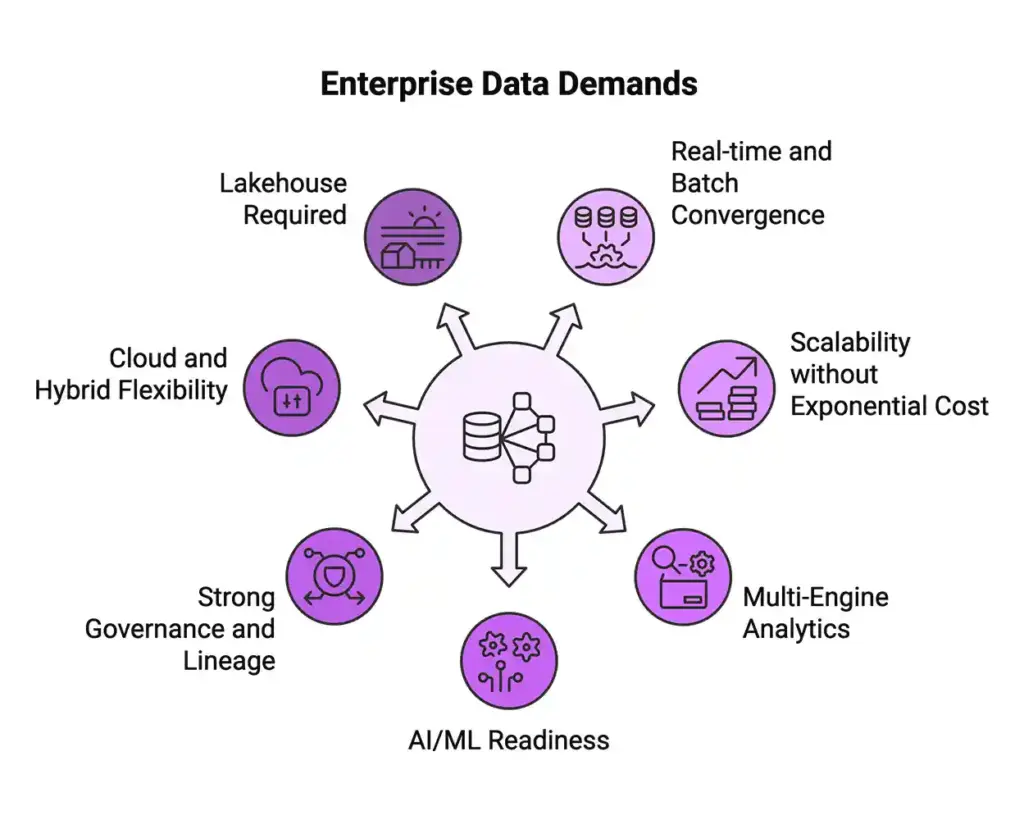
These demands are not new, but the urgency has intensified. Organisations are processing more data, from more sources, at greater speed than ever before, and majority legacy platforms are not designed for this reality.
The convergence of open-source innovation and mature enterprise technology means organisations can now architect platforms that deliver on all of these demands, if they make the right choices at each layer.
No single technology or vendor has it all. The organisations getting this right are adopting a composable, best-fit approach, drawing on open-source strengths where they are most powerful, and proprietary solutions where enterprise-grade support genuinely matters.
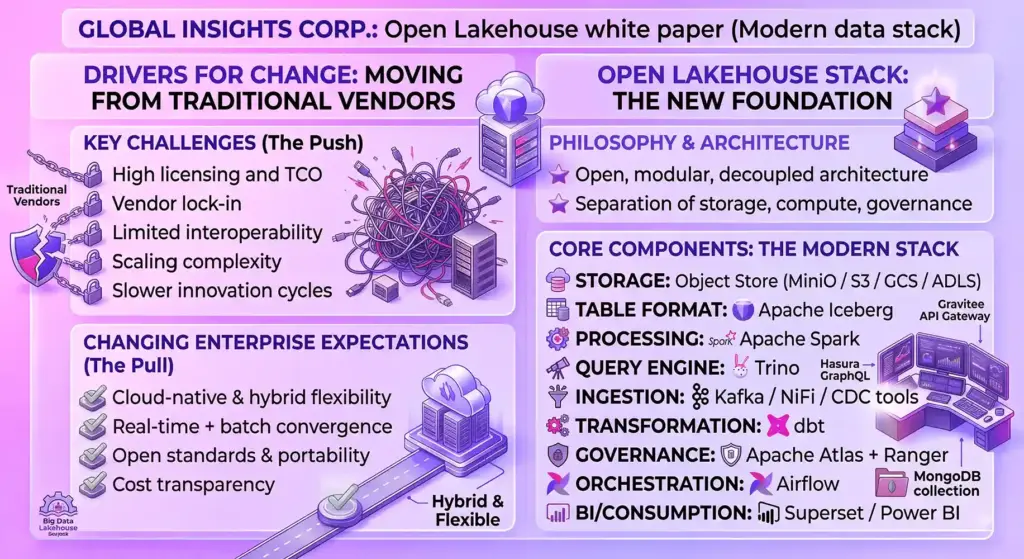
This raises a critical question: why are so many organisations now reconsidering their existing vendor relationships, and what is driving the shift?
Why Organizations are Moving Away from Traditional Vendors (Legacy Systems)
Why Opensource technologies are a Game Changer
Challenges of Tradition Data Lake
- No ACID guarantees
- Data inconsistency
- Poor performance
- Lack of schema governance
Opensource Capabilities
- ACID transactions at scale
- Schema evolution & partition evolution
- Time travel & versioning
- Hidden partitioning
- Engine interoperability
Business Impact
- Reliable analytics
- Reduced data engineering effort
- Faster query performance
- Hidden partitioning
- Multi-engine flexibility
Value Delivered at Every Layer
Business benefits
- Reduced Total Cost of Ownership (TCO)
- Elimination of vendor lock-in
- Faster time-to-market
- Scalability and flexibility
- Future-ready AI/ML enablement
Technical Benefits
- Decoupled architecture (storage vs compute)
- Multi-engine support
- High performance at scale
- Open standards and interoperability
- Observability and governance built-in
Use Case 1 – Telecom (Abstracted)
Context
- Multiple source systems (BSS/OSS, network, CRM)
- High data volumes (10M+ records/day)
- Batch + near real-time requirements
Challenges
- Siloed data platforms
- Long batch windows
- Limited real-time insights
Lakehouse Solutions
- Unified ingestion (batch + streaming)
- Iceberg-based storage
- Trino for low-latency analytics
Outcomes
- Reduced batch window
- Real-time analytics enablement
- Improved data governance
Use Case 2 – Banking (Abstracted)
Context
- Regulatory reporting + customer analytics
- Structured + semi-structured data
Challenges
- Data duplication across systems
- Governance and lineage gaps
- Slow reporting cycles
Solution
- Unified governed data platform
- Atlas + Ranger for governance
- Iceberg for auditability (time travel)
Outcomes
- Faster regulatory reporting
- Improved data lineage
- Enhanced risk analytics
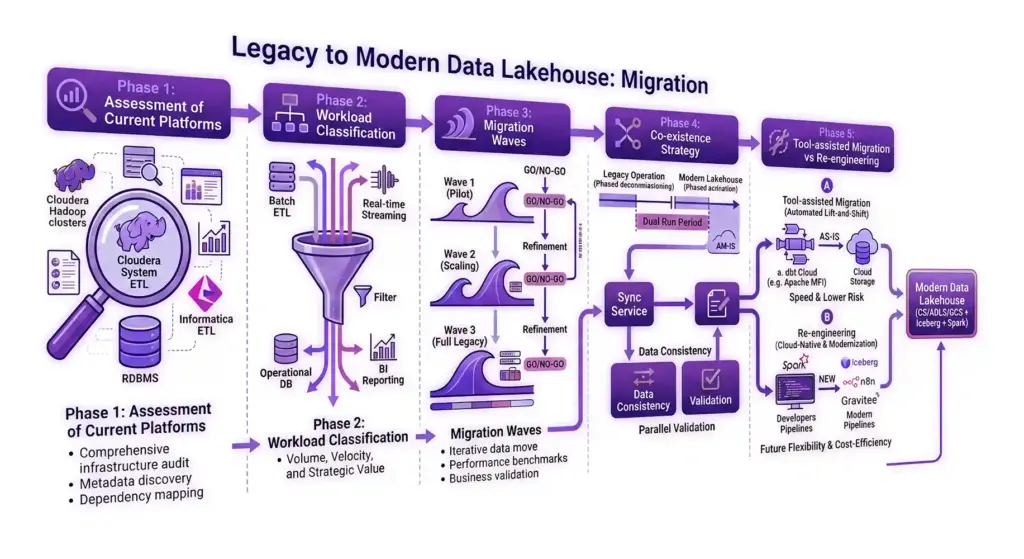
Migration Approach
Migration Approach
- Assessment of current platforms
- Workload classification
- Migration waves
- Co-existence strategy
- Tool-assisted migration vs re-engineering
Key Design Principles
- Open standards first
- Modular and extensible
- Cloud-agnostic
- Security by design
- Observability-first architecture
Call To Action
- Why now is the right time
- Strategic advantage of open Lakehouse
- How organizations can start their journey
Building the Right Data Architecture for You
Every organisation’s data landscape is different. Legacy investments, regulatory constraints, team capabilities, and growth ambitions all shape what the right architecture looks like in practice. There is no universal blueprint.
At Edgematics Group, we work with clients to design the right data architectures that turn data into business value. We evaluate open-source and proprietary options on their merits, weighing total cost of ownership, operational complexity, ecosystem maturity, and strategic fit.
Our engagements begin with an honest assessment of your current data journey: what is working, what is constraining growth, and where architectural debt is accumulating. From there, we help you chart a migration path that is phased, low-risk, and tied to measurable business outcomes.
Whether you are looking to modernise a Hadoop estate, evaluate a move to a cloud-native lakehouse, introduce real-time data capabilities, or simply gain clarity on your options, we bring the technical depth and industry perspective to help you make confident decisions.
The right architecture is not the most modern one, it is the one that serves your business best. We are here to help you find it. Write to us at www.edgematics.ai/contact-us for a strategic consultation call.
Author