Table of Contents
Executive Summary
Artificial intelligence is moving fast. In the span of a few years, it has gone from innovation experiment to boardroom mandate reshaping how enterprises think about productivity, decision-making, automation, and competitive advantage.
Yet the gap between AI ambition and enterprise-scale value remains stubbornly wide.
The reason is not the models. Access to AI capability is no longer a constraint. The real bottleneck is what the models have to work with: enterprise data that is fragmented, ungoverned, poorly understood, or disconnected from the business context that makes it meaningful.
At the same time, data management is being transformed. Traditional approaches built for reporting, warehousing, and historical analytics are no longer adequate for organizations that expect their data to power AI agents, copilots, automated decisions, and real-time intelligence.
The conclusion is unavoidable: AI strategy and data strategy are no longer separate agendas. They are one.
This paper explores why that convergence is happening now, what it demands from enterprise architecture and operating models, and what business and technology leaders must do to build the foundations that make AI-generated value real, repeatable, and trustworthy.
1. The Market Reality: Broad Adoption, Uneven Value
The enterprise AI conversation has changed fundamentally. AI is now present in boardroom priorities, investment plans, hiring decisions, and technology roadmaps across virtually every sector.
But presence is not the same as value.
McKinsey’s 2025 State of AI research shows that AI use is widening significantly 88% of respondents reported regular use in at least one business function, up from 78% the year before. Yet the same research makes clear that most organisations remain in experimentation or pilot phases, still searching for the path from proof of concept to scaled, measurable enterprise impact.
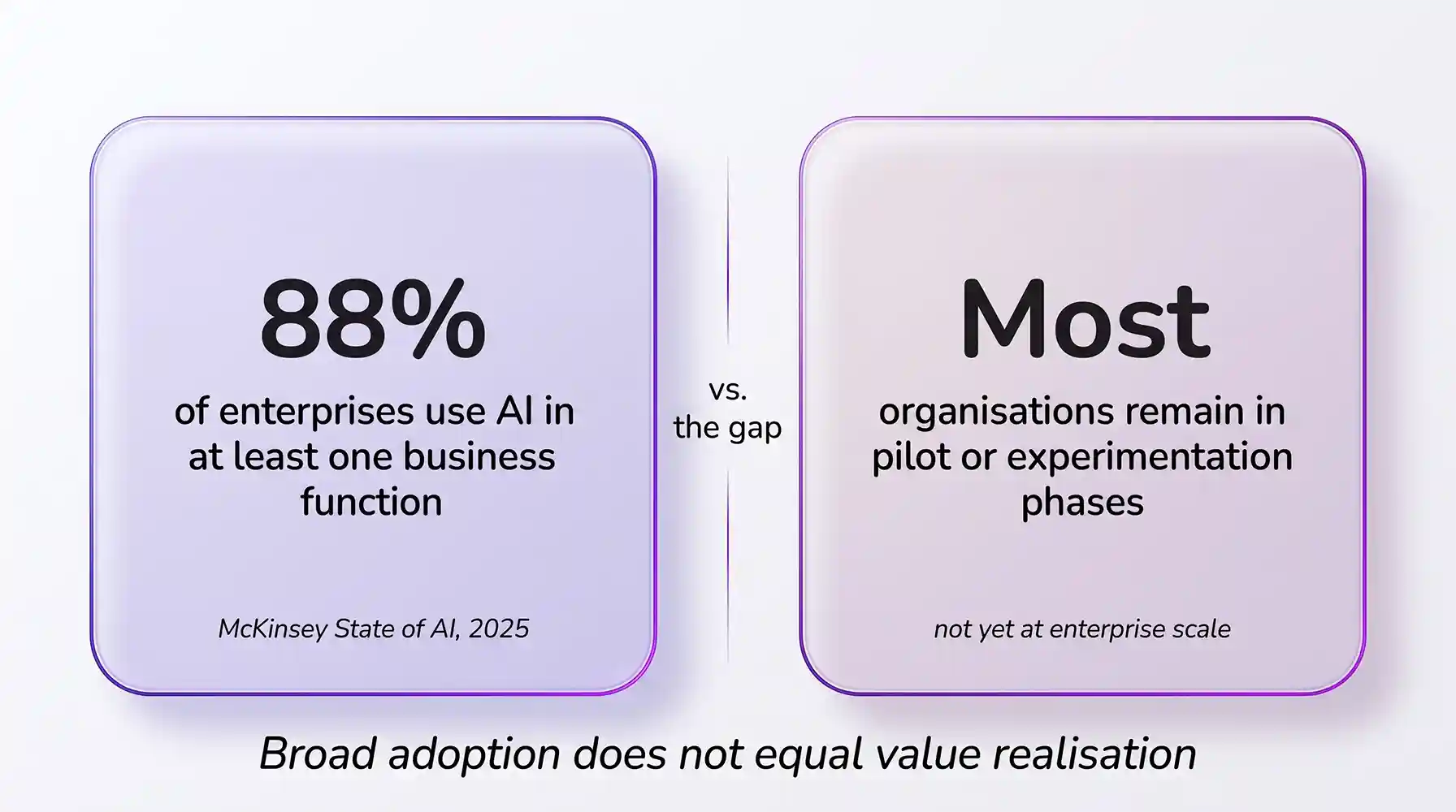
This is the central paradox of the current AI moment: organisations are using AI more, but many are not yet operationalising it with the trust, governance, and reliability that real business value requires.
The problem, in most cases, does not sit with the AI. It sits with the data underneath it.
Building trusted, governed, AI-ready data foundations is where the real work of enterprise AI begins and where most organisations are underinvested. The path from experimentation to enterprise-scale impact requires a deliberate, structured approach to what sits beneath the model.
2. Data Is Enterprise Knowledge Not Just Infrastructure
Before the conversation about AI and data management can be productive, it is worth being precise about what data actually is.
In most organisations, data is treated as an IT asset: databases, pipelines, dashboards, systems of record. That framing is technically accurate and strategically limited.
A more useful definition is this:
Data is the accumulated knowledge of the enterprise what the organisation knows about its customers, operations, markets, products, risks, people, and decisions. It is institutional memory, made accessible.
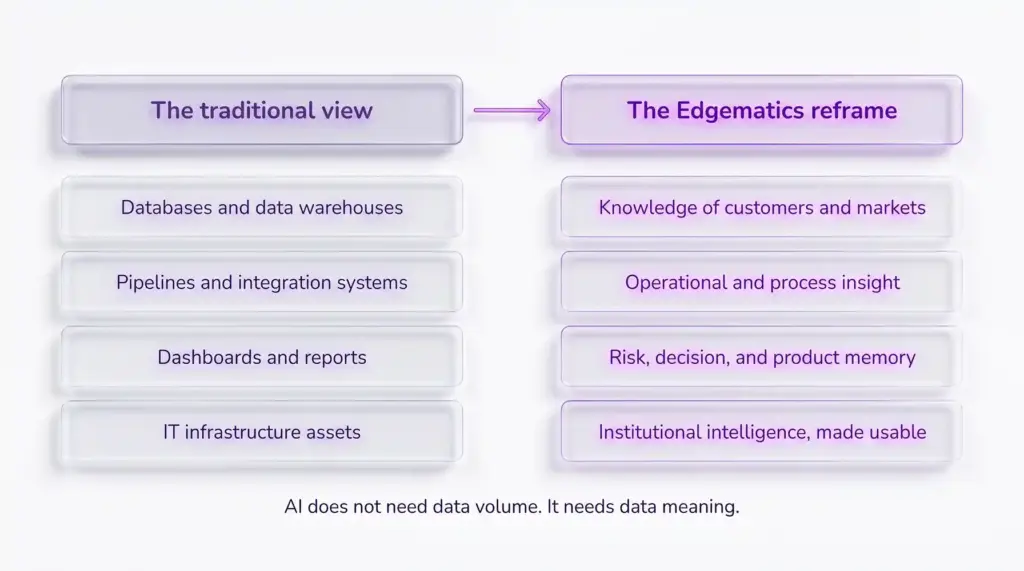
When data is understood this way, the priorities shift. Data management is no longer about storing and moving information. It becomes about how an enterprise captures, governs, understands, and trusts its own knowledge over time.
This distinction matters enormously for AI. AI systems do not simply need data volume. They need data meaning. They need context. They need knowledge that reflects the actual operating reality of the business, not just the technical state of its systems.
3. Why AI and Data Management Can No Longer Work in Isolation
For years, AI and data management were treated as separate disciplines. AI belonged to data science and innovation teams. Data management belongs to engineering, governance, and compliance functions.
That separation is no longer viable.
AI depends on data management to become trustworthy. Without governed, contextual, high-quality data, AI outputs may sound compelling but fail to reflect business reality. This is especially critical in generative AI and retrieval-augmented generation architectures, where models must ground their responses in proprietary enterprise content. Without a well-governed, well-structured knowledge layer, those responses will be plausible rather than reliable.
Data management depends on AI to become intelligent at scale. AI is increasingly the mechanism by which enterprises classify, enrich, summarise, monitor, and activate their data. The modern data platform is no longer serving only analysts and reporting teams. It must now serve copilots, agents, orchestration workflows, and autonomous decision systems.
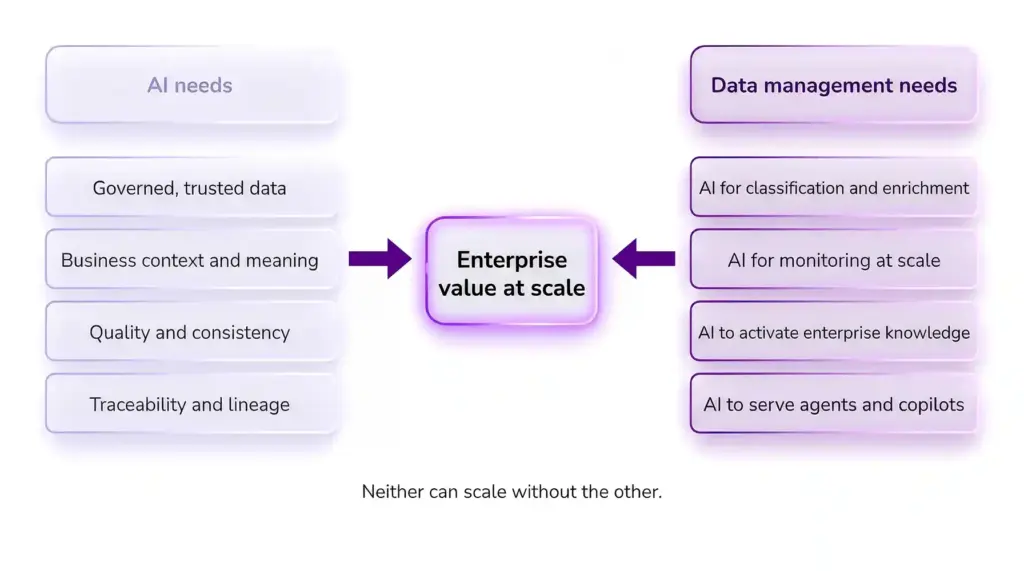
The result is a new enterprise reality: neither can scale without the other.
4. From Data Platforms to Enterprise Knowledge Platforms
Traditional data platforms were built for integration, storage, and analytics. Those capabilities remain essential. But they are no longer sufficient.
In the AI era, the enterprise needed a platform that can turn fragmented, siloed data into governed, contextual, AI-ready knowledge. That is a fundamentally different design target.
The knowledge platform of the AI era must answer not just “where is the data?” but a more demanding set of questions:
- What does this data mean, and is that meaning consistent across the business?
- Who owns it, and who is accountable for its accuracy?
- Can it be trusted and how do we know?
- Who is permitted to use it, under what conditions?
- Is it current enough for the decision at hand?
- What policies and regulations apply?
- Can AI use it safely and traceably?
- Can business users act on it with confidence?
The market is moving from traditional data platforms toward enterprise knowledge platforms. Organisations that make that transition deliberately will build AI that compounds in value. Those that don’t will find themselves repeatedly rebuilding foundations rather than scaling impact.
5. Why AI Pilots Stall Before Production
Many AI initiatives look promising in controlled environments. The use case is narrow, the data is curated, and the stakeholder group is limited. The demo works.
Production is different.
When AI moves into real enterprise operations, the full complexity of the organisation becomes visible. Data sources are fragmented across business units. Definitions vary by team and function. Legacy systems restrict access. Ownership is contested. Governance is inconsistent and compliance requirements tighten. Data quality issues surface at scale.
This is why so many AI initiatives stall after proof of concept not because the AI failed, but because the data environment was never ready to support it.
IBM research has highlighted the growing business impact of poor data quality as organisations rely more heavily on real-time analytics and AI. Quality issues, it notes, are now a significant priority for senior operations leaders with a reflection of how foundational data quality has become to AI outcomes in production environments.
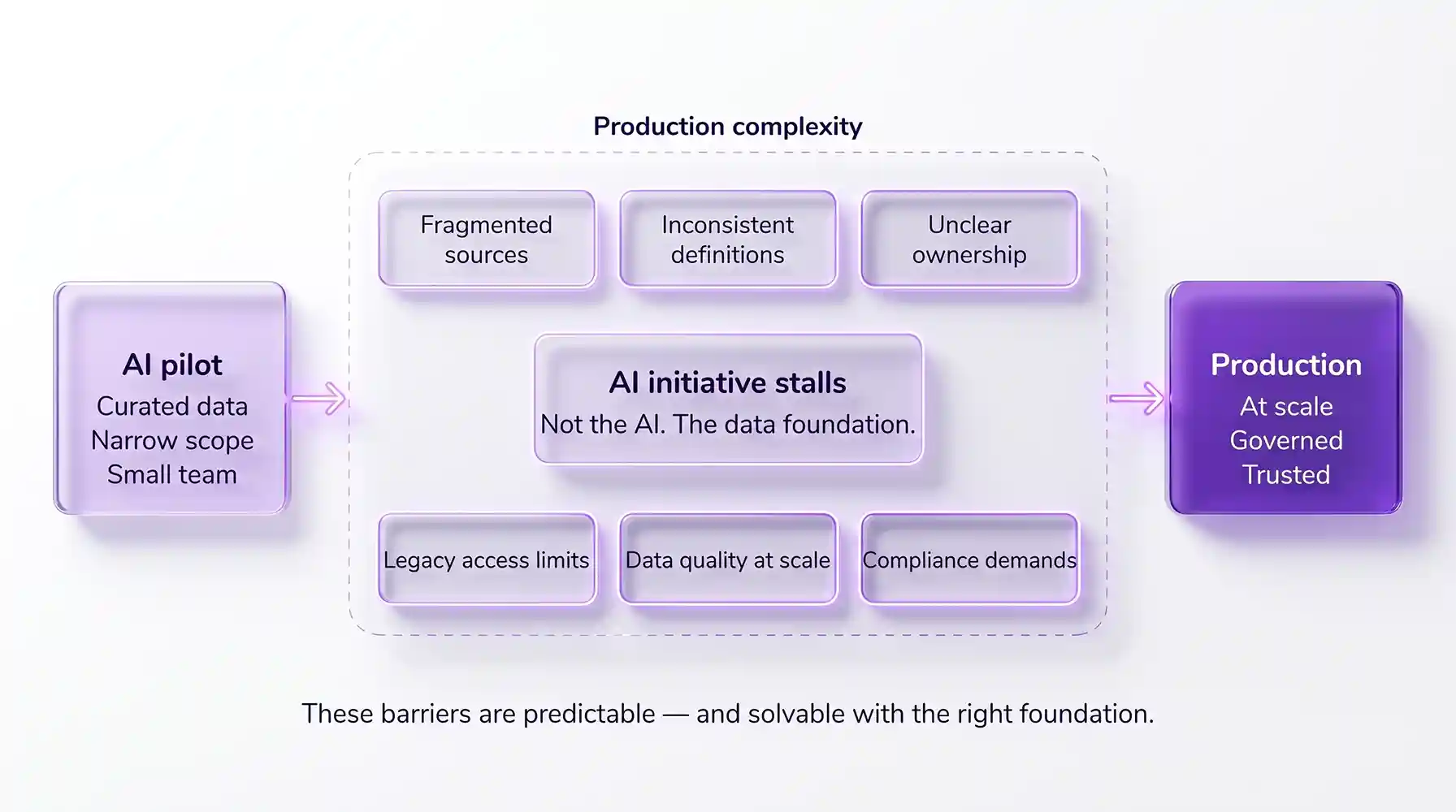
In enterprise deployment, speed alone is not enough. AI must be dependable. Dependability is built on governed, contextual, high-quality data. That foundation does not emerge by accident. It has to be designed.
6. Governance Is an AI Accelerator, not a Constraint
Governance has long been treated as a control function necessary, but it is slow. In the AI era, that framing is not just outdated. It is dangerous.
Governance is what makes AI scale possible.
An organisation that cannot explain where its AI inputs came from, how outputs were generated, what policies apply, or who is accountable for a decision cannot deploy AI with confidence regardless of how capable the underlying model is. Without governance, the more powerful the AI, the greater the risk.
NIST’s AI Risk Management Framework reflects the growing importance of managing AI risk through structured governance, responsible implementation, and alignment across the full AI lifecycle. For enterprise leaders, that means governance must move from a final checkpoint to an embedded design principle present in architecture, workflows, operating models, and business accountability from the start.
Boards are no longer asking only whether their organisations are experimenting with AI. They are asking whether AI outputs can be trusted, whether decisions are explainable, whether risks are managed, and whether the investment is creating measurable value. Understanding why CDOs are putting data engineers at the centre of governance programs is part of that answer.
Governance answers those questions. It is not the opposite of innovation. It is the condition that allows innovation to scale.
"Successful change in AI won't be led by IT, but needs to be seen as a business transformation led by the operational leaders thinking about how do we want the business to operate."
David Doherty, Consultant CIO and Technology Advisor
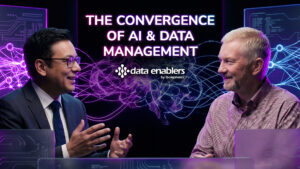
Data Enablers Episode 6: The Convergence of AI and Data Management.
7. Business Ownership of Data Is Not Optional
A persistent reason data and AI initiatives underperform is ambiguous ownership.
In many organisations, data responsibility defaults to IT. But IT cannot define business truth. It can build pipelines and enforce controls. It cannot determine what a “customer” means in the context of a specific product line, or what a “churn risk score” should represent to a regional sales team.
The business owns the meaning. The business owns the context. The business owns the outcomes that depend on the data.
Technology teams enable access, integration, quality, security, and scale. But business domains must own definitions, accountability, and use cases. If they do not, trust gaps accumulate and AI adoption slows because no one is willing to act on outputs they cannot explain or verify.
A practical model for this is what we call federated execution with centralised trust: business domains own the context, interpretation, and use cases relevant to their function, while the enterprise provides a common framework for governance, metadata standards, policy enforcement, security, and interoperability.
This model keeps ownership where understanding lives, while ensuring that the enterprise operates from a shared, trustworthy foundation.
8. The AI-Ready Data Management Framework
Moving from AI experimentation to enterprise value requires a coherent framework, not just better tools. The following eight principles define what that looks like in practice.
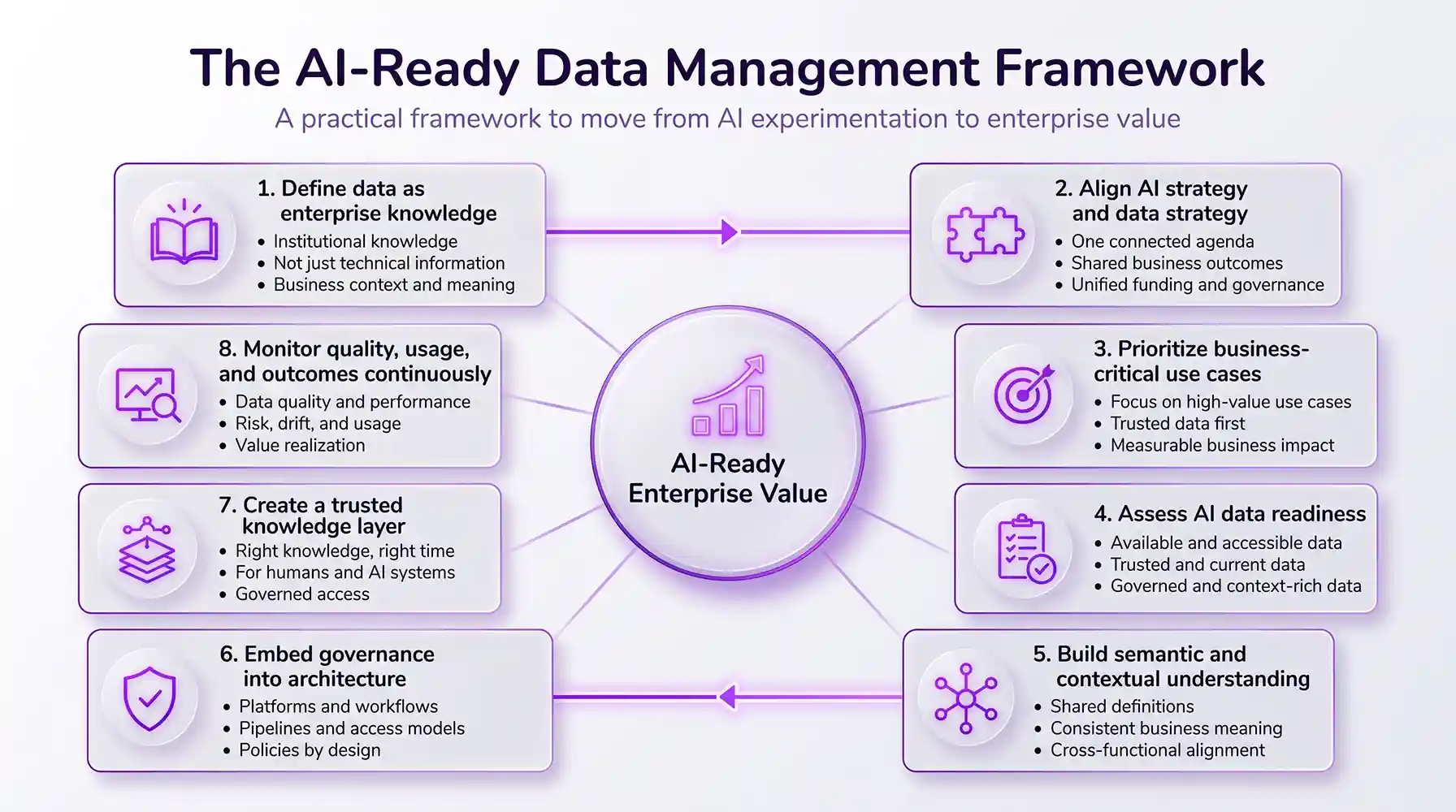
1. Define data as enterprise knowledge.
Treat data as the institutional knowledge of the business. That reframe drives better decisions about what to govern, what to make accessible, and what AI systems need to be reliable.
2. Align AI strategy and data strategy.
These cannot be separate investment agendas with separate sponsors and separate roadmaps. They must be connected through shared business outcomes and joint accountability.
3. Prioritise business critical use cases.
Start where trusted data and measurable business values intersect. Build the foundation there, prove it, then extend.
4. Assess AI data readiness before scaling.
Before deploying AI at scale, evaluate whether the underlying data is available, trusted, current, governed, accessible, and sufficiently contextual for the use case.
5. Build semantic and contextual understanding.
Integration alone is not enough. Data must be understood consistently across functions with shared definitions, common metadata, and business meaning that survives the journey from source to AI input.
6. Embed governance into architecture.
Governance must be designed into platforms, access models, workflows, retrieval systems, and AI pipelines not bolted on after deployment.
7. Create a governed knowledge layer.
Enterprises need a layer that allows humans, applications, copilots, and AI agents to access the right knowledge at the right time, with appropriate controls and full traceability.
8. Monitor quality, performance, and value continuously.
AI-ready data management is not a project. It is an operating capability. Data quality, model performance, access patterns, drift, compliance, and value realisation all require ongoing attention.
9. The Edgematics Perspective
The convergence described in this paper is not a future trend. It is the current operating reality for enterprises that are serious about moving from AI experimentation to AI-driven business value.
At Edgematics, this convergence is the centre of everything we do.
Our Data Engineering and Governance practice exists to build the kind of data foundations that make AI trustworthy at scale automated, governed, lineage-aware, and semantically consistent across the enterprise. Our AI and ML practice turns AI ambition into production reality, through strategy, MLOps, and deployment that is built for reliability rather than just demonstration. And our Agentic AI practice helps enterprises move beyond individual models toward orchestrated AI systems that can operate autonomously across complex business workflows.
Underpinning all of these are two platforms built specifically for these challenges.
PurpleCube AI, our unified data orchestration platform is designed to simplify complex data engineering, integration, and governance challenges at scale, and to make data AI-ready without the multi-quarter runway that legacy tooling demands.
Axoma is our Agentic AI orchestration platform built to help enterprises deploy, manage, and coordinate AI agents across business functions, with enterprise-grade security, compliance controls, and the governance architecture that makes autonomous AI accountable rather than opaque.
The Edgematics position is straightforward: enterprises do not need more isolated AI experiments. They need a connected data and AI foundation governed, contextual, and built for production that can support business value at the scale the moment demands.
10. What Leaders Should Do Now
For CEOs, CIOs, CDOs, CAIOs, and transformation leaders, the path forward is clear.
Treat AI as an enterprise system, not a model problem.
The model is one component. The operating environment around it data quality, governance, access, context, ownership determines whether it creates value or creates risk.
Bring data and AI leadership together.
These functions need shared goals, shared metrics, and shared accountability. Separate roadmaps produce separate results.
Start with the data behind priority use cases.
Before scaling AI into a business-critical process, ask: is the underlying data trusted, current, governed, and meaningful? If not, fix that first.
Make ownership explicit.
Business domains must own the meaning and accountability for their data. Technology must provide the infrastructure for scale and control. Neither can substitute for the other.
Design governance for speed, not just compliance.
Governance should be the architecture that makes confident deployment possible, not the process that slows it down.
Build for production from the start.
AI should be architected for reliability, observability, security, and measurable impact. Pilot-grade foundations do not scale.
Conclusion: The Future Is Trusted Intelligence
The convergence of AI and data management is one of the defining transitions in enterprise technology not because it is technically complex, but because it requires organisations to change how they think about both.
AI brings intelligence. Data management brings trust, context, control, and memory. Neither is sufficient on its own.
Organisations that pursue AI as a standalone technology initiative will struggle to move beyond pilots. Organisations that treat data management as a back-office discipline will fail to activate the institutional knowledge that makes AI genuinely valuable.
The enterprises that pull ahead will be those that bring AI and data together as one transformation agenda building trusted knowledge foundations, embedding governance at scale, connecting business ownership with technology enablement, and moving from experimentation to operational intelligence.
The future of enterprise AI will not belong to whoever has access to the most capable models. It will belong to whoever has the most trusted, governed, contextual, and usable enterprise knowledge.
That is the real convergence of AI and data management.
Ready to assess your AI data readiness? Talk to an Edgematics expert.
Author