TL;DR:
- Building trusted data foundations involves creating a unified, governed, and AI-ready architecture that ensures data integrity, compliance, and accessibility for decision-making. It requires clear ownership, continuous automated trust scoring, and integration of frameworks like metadata-driven data fabrics and governance-as-code, which support regulatory requirements and enterprise agility. Successful implementation starts with assessing data maturity, defining governance policies, deploying automated tools, and fostering organizational accountability to sustain trust over time.
Building trusted data foundations is the process of creating a unified, governed, and AI-ready data architecture that guarantees data integrity, compliance, and accessibility for strategic decision-making. For enterprise leaders in regulated industries, this is not a background IT concern. It is the precondition for every AI initiative, every audit, and every decision made at speed. Frameworks like the Quest Trusted Data Management Platform, metadata-driven data fabrics, and governance-as-code have redefined what “trusted” actually means: not assumed, but measured, assigned, and continuously verified. The standard industry term for this discipline is data governance, and building trusted data foundations is its most complete, end-to-end expression.
What are the essential components of building trusted data foundations?
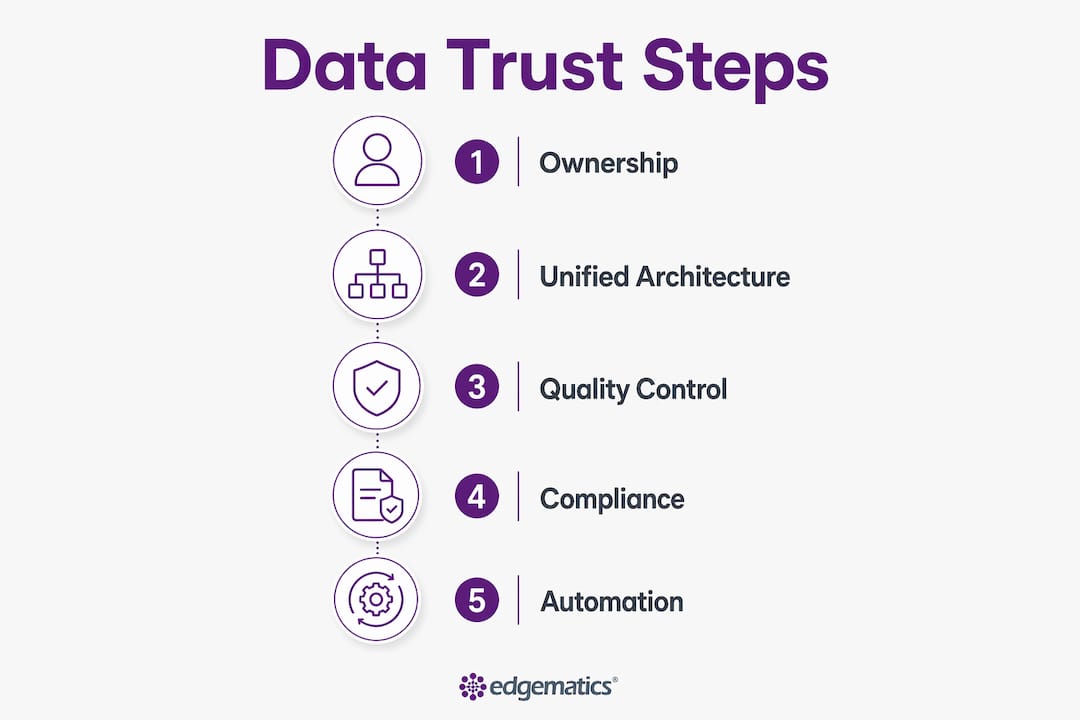
Trusted data requires a unified architecture that stores data once, assigns clear ownership, and embeds controls at the point of creation. Copying data across systems multiplies risk and erodes accountability. The goal is a single, governed source of truth that every downstream system and AI model can rely on.
Three organizational roles form the backbone of any trustworthy data program:
- Data owners hold business accountability for specific data domains, from patient records in healthcare to transaction logs in banking.
- Data stewards manage quality standards, enforce definitions, and resolve conflicts between data consumers.
- Data engineers build and maintain the pipelines that carry data reliably from source to consumption layer.
Establishing clear data ownership is the most overlooked step in building data trust. Without named owners, quality problems have no one to fix them and compliance gaps have no one to close them.
On the technical side, metadata-driven data fabrics unify disparate sources in a logical layer without physically moving data. They use automation and embedded governance to provide secure, federated access across the enterprise. This architecture is particularly valuable in regulated industries where cross-border data movement triggers compliance obligations.
| Prerequisite | Why It Matters |
|---|---|
| Unified data architecture | Eliminates redundant copies and enforces a single governed source of truth. |
| Named data owners and stewards | Creates accountability for quality, compliance, and issue resolution. |
| Metadata-driven fabric | Enables federated access without physically relocating sensitive data. |
| Governance-as-code | Embeds compliance policies into pipelines at data creation, not retroactively. |
| Automated trust scoring | Tracks data reliability across quality, lineage, and governance dimensions in real time. |
How do you build trusted data foundations step by step?
A structured sequence separates organizations that achieve durable data trust from those that cycle through failed governance programs. The following six steps reflect how leading enterprises in finance, healthcare, and telecommunications actually execute this work.
- Assess your data maturity and gaps. Catalog existing data assets, identify ownership voids, and score current quality levels. You cannot govern what you have not mapped. Tools like data catalogs from providers such as Alation or Collibra give you the lineage visibility needed to start this assessment honestly.
- Define and enforce data governance policies. Translate regulatory requirements (HIPAA, GDPR, Basel III) into concrete data handling rules. Assign stewards to each policy domain. Policies without owners are aspirations, not controls.
- Deploy an automated data product factory. Automated data product factories deliver governed, AI-ready data up to 54% faster than traditional methods. That speed advantage compounds over time as more data products are produced with embedded quality checks rather than manual review cycles.
- Embed data quality and trust scoring in pipelines. Trusted data is a measurable, dynamic state tracked by trust scores across quality, governance completeness, and timeliness. Scoring at the pipeline level means problems surface before they reach analysts or AI models, not after.
- Implement semantic layers and standardized metrics. A semantic layer translates raw data into consistent business definitions. “Revenue” means the same thing in the finance dashboard as it does in the executive report. This consistency is what makes data trust scalable across business units.
- Establish end-to-end data lineage and observability. Data cataloging, observability, and discoverability accelerate troubleshooting and improve transparency across the data lifecycle. When an anomaly appears in a model output, lineage tools let you trace it to the exact source transformation within minutes, not days.
Pro Tip: Run trust scoring on your three most business-critical data domains first. Demonstrating measurable improvement in those domains builds executive confidence faster than any governance roadmap presentation.
What are the biggest pitfalls in establishing data governance?
Most data governance programs fail not because of bad technology, but because of predictable organizational and design errors. Recognizing these patterns early saves significant remediation cost.
- Treating trust as a one-time project. Data changes constantly. A dataset that scores well today can degrade within weeks as source systems evolve. Trust must be re-evaluated continuously through automated scoring, not declared at program launch and forgotten.
- Fragmented data silos and legacy tool sprawl. Organizations running 15 or more disconnected data tools face compounding integration debt. Each new tool adds a new trust boundary. Unified data orchestration addresses this by consolidating data flows under a single governed layer.
- Retroactive compliance remediation. Applying privacy and security controls after data has already been created is expensive and often incomplete. Governance-as-code embeds security and privacy policies directly into CI/CD pipelines, making compliance proactive rather than reactive. This is especially critical for organizations operating under cross-border data restrictions.
- Sacrificing agility for control. Governance frameworks that require manual approval for every data access request create bottlenecks that push teams toward shadow IT. The right balance automates routine approvals and reserves human review for high-risk access patterns.
This principle matters because it reframes governance as an engineering discipline, not a compliance checkbox. Organizations that internalize it build programs that survive leadership changes and technology cycles.
How do modern frameworks and tools compare for data trust?
Choosing the right combination of platforms and approaches is a strategic decision. No single tool covers every dimension of trusted data management. The table below compares four leading approaches across the dimensions that matter most to regulated enterprises.
| Approach | Key Strength | Compliance Fit | AI Readiness | Trade-off |
|---|---|---|---|---|
| Quest Trusted Data Management Platform | Automated data product factory with embedded trust scoring | High, built-in governance controls | Native, produces AI-ready data products | Commercial licensing cost |
| Lifebit metadata-driven data fabric | Federated access without data movement | Very high, designed for cross-border regulated data | Strong, supports distributed AI workloads | Requires harmonized metadata standards |
| Governance-as-code (CI/CD embedded) | Policy enforcement at data creation | Proactive compliance for DevOps-oriented teams | Integrates with ML pipelines natively | Demands engineering maturity to implement |
| Open-source toolchains (Apache Atlas, Great Expectations) | Flexibility and community support | Moderate, requires custom policy layers | Possible with significant integration work | High internal build and maintenance cost |
Assembling a harmonious toolset rather than relying on a single technology is the defining characteristic of mature data fabric implementations. The Quest platform excels at speed and automation. Lifebit’s federated model suits organizations where data cannot leave specific jurisdictions. Governance-as-code works best when data engineering teams already operate within CI/CD workflows. Open-source options give maximum flexibility but demand the most internal capability. For most regulated enterprises, the answer is a governed combination of two or three of these approaches, integrated through a unified data fabric layer.
Trusted data is the foundational shared asset enabling all AI projects, not a prerequisite for just one initiative. That framing changes the investment calculus entirely. The cost of building trusted foundations is not justified by a single use case. It is justified by every AI model, every regulatory report, and every executive decision that depends on reliable data going forward.
Key takeaways
Building trusted data foundations requires unified architecture, assigned ownership, and continuous automated trust scoring to deliver durable compliance and AI readiness.
| Point | Details |
|---|---|
| Ownership before technology | Assign data owners and stewards before selecting platforms; accountability cannot be automated. |
| Automate trust scoring | Track quality, lineage, and governance completeness in real time to catch degradation early. |
| Governance-as-code for compliance | Embed privacy and security policies in CI/CD pipelines to prevent retroactive remediation. |
| Toolset over single platform | Combine Quest, Lifebit, or governance-as-code approaches based on your regulatory and AI requirements. |
| Trust is continuous | Data trust is a dynamic state that must be re-engineered as data, systems, and regulations evolve. |
What we have learned building data trust in regulated enterprises
At Edgematics, we have worked with organizations where data governance programs were technically sound but organizationally hollow. The technology was in place. The policies were documented. Yet analysts still did not trust the numbers in their dashboards, and data engineers spent more time fielding quality complaints than building new capabilities.
The pattern we see repeatedly is this: organizations invest in platforms before they invest in clarity. They buy a data catalog before they have decided who owns the data. They deploy quality monitoring before they have defined what “good” looks like for each domain. The technology then surfaces problems that no one has the authority or mandate to fix.
What actually works is starting with a small number of high-value data domains, assigning real owners with real accountability, and building trust scoring around those domains first. The wins are visible, the ownership model is proven, and the organization develops the muscle memory to scale. Speed matters too. Regulated industries face pressure from both regulators and AI adoption timelines. The 54% speed advantage that automated data product factories deliver is not just an efficiency metric. It is the difference between an AI initiative that launches in a competitive window and one that misses it.
We also believe that transparency is underrated as a governance tool. When data consumers can see lineage, understand quality scores, and trace a metric back to its source, they stop questioning the data and start using it. That cultural shift, from skepticism to confidence, is the real measure of a trusted data foundation.
How Edgematics helps you build a trusted data foundation
Edgematics works with enterprise leaders in regulated industries to design and deliver data engineering and governance programs that produce measurable, auditable data trust. Our work spans unified architecture design, governance-as-code implementation, automated trust scoring, and AI-ready data product delivery. We bring end-to-end capability across data engineering, governance, and AI/ML integration, so your organization does not have to stitch together disconnected specialists. If you are assessing where your data foundation stands today, our data maturity assessments give you a clear, prioritized view of gaps and next steps. Let’s connect.
FAQ
What is a trusted data foundation?
A trusted data foundation is a unified, governed data architecture where data is stored once, ownership is assigned, quality is continuously scored, and compliance controls are embedded at the point of data creation.
How does governance-as-code support compliance?
Governance-as-code embeds security and privacy policies directly into CI/CD pipelines, enforcing compliance automatically at data creation rather than requiring retroactive remediation after data has already been processed.
What roles are required to build data trust?
Three roles are critical: data owners who hold business accountability, data stewards who manage quality standards, and data engineers who build and maintain reliable pipelines.
How fast can automated data product factories deliver results?
Automated data product factories deliver governed, AI-ready data up to 54% faster than traditional methods by embedding quality checks and governance controls directly into the production process.
What is the difference between a data fabric and a data warehouse?
A data fabric unifies disparate data sources in a logical layer without physically moving data, using metadata and automation to provide governed access. A data warehouse physically consolidates data into a single repository, which creates movement and replication risk in regulated environments.