TL;DR:
Data transformation converts raw, heterogeneous data into clean, structured formats that support reliable analytics, governance, and AI. Over 80% of big data management challenges trace back to poor data quality at the transformation layer. Getting transformation right is not a backend convenience. It is the governance requirement that determines whether your AI produces outputs worth acting on or outputs that erode trust across the organisation.
Why Transformation Is the Layer Most Enterprises Underinvest In
Every enterprise AI initiative depends on what happens before the model sees a single data point. Raw data arrives fragmented across systems, inconsistently formatted, missing key labels, and carrying schema drift that nobody has documented. No amount of model sophistication compensates for what enters the pipeline uncleaned.
Data transformation is the structured process of reshaping, cleaning, enriching, and validating data so it becomes fit for analysis, reporting, and machine learning. It sits between raw ingestion and downstream business value, and it is the layer where most data quality problems are either caught or allowed to compound silently into production.
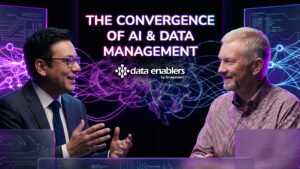
The consequence of getting this wrong is not just inaccurate dashboards. It is AI models trained on corrupted features, compliance audits that cannot trace a record to its source, and business users who stop trusting outputs because they have been burned by bad data one too many times. As Episode 6 of the Data Enablers Podcast, The Convergence of AI and Data Management, makes clear, AI and data management are no longer separate organisational priorities. The quality of your data management practice, including how rigorously you govern transformation, directly determines the ceiling of what your AI programme can achieve. Governance is no longer a control function it is a growth enabler, and transformation is where that shift becomes most visible.
The Core Operations Every Enterprise Transformation Pipeline Needs
Effective transformation is not a single step. It is a sequence of operations, each addressing a specific quality or structural problem in raw data.
Standardisation and normalisation align numeric features to comparable ranges before they enter ML models or aggregation pipelines. Min-max scaling and z-score normalisation are the most common techniques, but the choice of method must follow a data distribution analysis first. Applying z-score normalisation to a heavily skewed distribution compresses the variance the model depends on.
Data cleaning removes duplicates, imputes missing values, and corrects format inconsistencies. This is where data cleaning methods directly affect the credibility of every downstream report and model output. A missed duplicate in a customer record creates two different churn scores for the same person.
Discretisation and aggregation convert continuous variables into categorical bins or roll transactional records into daily or weekly summaries. These operations reduce noise and make patterns learnable for ML models that would otherwise overfit to granular variation.
Feature construction derives new attributes from existing data. Calculating customer lifetime value from purchase history, or network fault probability from historical alarm patterns, creates the signal that raw transactional data does not directly contain.
Encoding and pivoting convert categorical fields to numeric representations for analytical engines and reshape wide tables into long formats where needed. Without these steps, many ML frameworks simply cannot ingest the data.
Dimensionality reduction through techniques like PCA reduces high-dimensional datasets to their most informative components, cutting compute cost without sacrificing analytical signal.
Edgematics’ Data Engineering and Governance practice builds these operations into production-grade pipelines with 200+ pre-built connectors, real-time change data capture, and infrastructure-as-code that keeps transformation logic version-controlled and auditable.
Pro Tip: Choose transformation methods based on data distribution first, not tooling preference. Profile your data before writing a single transformation rule.
ETL, ELT, and Streaming: Choosing the Right Architecture
Where transformation executes depends on your architecture pattern, and the choice has real consequences for latency, compliance posture, and AI readiness.
ETL (Extract, Transform, Load) applies transformation before data lands in the warehouse. This suits regulated environments where data must be clean and conformed at rest, including legacy financial systems and environments with strict PII handling requirements. The trade-off is that transformation logic must be defined upfront, which slows iteration.
ELT (Extract, Load, Transform) loads raw data first, then transforms inside the warehouse or lakehouse. Cloud-native platforms favour this pattern because compute is elastic and storage is cheap. ELT supports faster experimentation but requires stronger governance over what raw data is stored and who can access it before transformation completes.
Streaming transformation applies logic to data in motion, event by event or micro-batch by micro-batch. This is the architecture for fraud detection, network monitoring, and real-time customer personalisation. Latency is measured in milliseconds, and reliability controls become critical because a failed message in a real-time pipeline is a live exposure, not a recoverable batch error.
Lambda architecture runs batch and streaming transformations in parallel. Batch handles high-volume historical reprocessing; streaming handles low-latency operational feeds. The trade-off is operational complexity, since two code paths must be maintained consistently.
For enterprises carrying legacy ELT pipeline debt, Edgematics’ AI-powered Migration Toolkit cuts migration time and cost by 50 to 70% across source and target platforms, removing the infrastructure bottleneck that prevents organisations from modernising their transformation layer without multi-year re-platforming projects.
Schema management is a critical concern across all patterns. As source systems evolve, schemas change. Transformation pipelines that lack schema evolution handling break silently, producing corrupt outputs without raising alerts. Version-controlled transformation logic combined with CI/CD pipelines catches schema drift before it reaches production.
Governance Is Not a Compliance Overlay. It Is Engineering Discipline.
The most expensive transformation failures are not technical. They are governance failures: pipelines that produce different results on different runs, records that cannot be traced to their source, and PII that reaches analytical layers it was never meant to reach.
Four engineering principles make transformation governable at enterprise scale.
Determinism and idempotence mean that re-applying the same transformation on the same inputs always yields the same output. Pipelines that produce different results on reruns are ungovernable and will fail any compliance audit that depends on reproducibility.
Data lineage and audit trails mean that every transformed record traces back to its source. Without lineage, compliance audits fail and trust in data outputs collapses. Edgematics builds lineage tracking into every data engineering engagement as a first-class architecture concern, not an afterthought. Our Data Engineering and Governance capabilities include automated lineage tracking that records every transformation without manual logging, and AI-driven cataloguing that cuts data discovery time by 70%.
PII masking and encryption enforce compliance by masking personally identifiable information in log streams and applying field-level encryption before data reaches analytical layers. In telecom and financial services environments, this is a regulatory requirement at the transformation layer, not a downstream consideration. Edgematics has delivered this capability across multiple telecom data transformation programmes, including the work with a leading UK fibre network provider: Elevating Data Quality for Telecom Data Transformation.
Version control and observability mean transformation logic lives in Git, is reviewed in pull requests, and is tested in staging before promoting to production. Pipelines that skip this discipline accumulate silent errors that surface months later in board-level reports. PurpleCube AI enforces this natively, with automated pipeline management, schema evolution handling, and embedded observability that keeps transformation reliable as data volumes and complexity grow.
Pro Tip: Treat transformation logic like application code. Store it in Git, review it in pull requests, and test it in staging. Pipelines that skip this discipline surface their errors in production where they are most expensive to fix.
How to Monitor Transformation Pipelines With SLIs and SLOs
Monitoring is where most enterprise transformation programmes underinvest, and where the cost of that underinvestment becomes most visible at scale.
Three SLIs cover the majority of pipeline failures before they affect downstream consumers: transformation success rate, processing latency, and schema validation failure rate. Tracking these three metrics catches most problems at the pipeline level rather than the business decision level.
| Metric | Batch Pipelines | Streaming Pipelines |
|---|---|---|
| Latency target | Hours to days | Milliseconds to seconds |
| Schema validation | Pre-run validation | In-stream validation |
| Error response | Rerun failed jobs | Dead-letter queue routing |
| Observability method | Job-level logging | Distributed tracing |
Error budget burn rates tell you how fast a pipeline is consuming its reliability allowance. When burn accelerates, it triggers incident response before SLOs breach. Automated testing, metadata tracking, and distributed tracing complete the observability stack.
Collaborative ownership across data engineering and platform SRE teams is essential. Data engineers own transformation logic. Platform SREs own pipeline reliability. Defining SLIs and SLOs for each pipeline, including error budgets, creates shared accountability that prevents the “not my pipeline” dynamic that delays incident response.
Where Transformation Creates Direct Business Value
The business impact of well-engineered transformation is concrete and measurable across the industries Edgematics serves.
Customer 360 profiles in retail and telecoms. Feature engineering pipelines normalise and join customer attributes from CRM, billing, and behavioural systems into unified profiles. These profiles power personalisation engines and churn prediction models. Edgematics applied this approach in a retail data quality engagement: Scaling Data Quality for a Leading Retail Giant.
PII masking in log streams for telecoms. Operators processing billions of call detail records daily apply field-level masking during transformation to meet GDPR and regional privacy regulations. Edgematics has delivered this capability across multiple telecom programmes, ensuring that governance requirements are enforced at the pipeline layer rather than patched downstream.
Banking data governance and compliance. Transformation pipelines that enforce standardised schemas and lineage tracking across cross-border operations give regulated banks the audit-ready data infrastructure that compliance teams and regulators require. Edgematics delivered this for a major pan-American bank: Data Governance Centre of Excellence for a Leading Pan-American Bank.
ML feature pipelines for AI readiness. Transformation failures in feature engineering degrade model accuracy directly. A missing normalisation step or an incorrect join key produces training data that teaches a model the wrong patterns. For teams building AI at scale, transformation quality is not a data engineering concern — it is the direct determinant of model reliability. The insight Building Trust in Data: The Essential Role of Quality and Orchestration covers this connection in depth.
Key Takeaways
| Point | Details |
|---|---|
| Quality is the foundation | Over 80% of big data challenges stem from poor data quality that transformation directly addresses. |
| Architecture choice matters | ETL, ELT, and streaming each suit different latency and compliance requirements. Choose based on your use case, not your existing tools. |
| Governance is engineering | Lineage, idempotence, and PII masking must be designed into pipelines from the start, not added as compliance overlays afterward. |
| Monitor with SLIs and SLOs | Track success rate, latency, and schema validation failures to catch pipeline failures before they reach the business. |
| Transformation enables AI | Raw data cannot feed ML models directly. Clean, structured, reproducible transformation outputs are the prerequisite for AI accuracy and trust. |
Transformation as a Product, Not a Project
The organisations that struggle most with data quality are not the ones with the worst technology. They are the ones that treated transformation as a one-time migration project rather than a managed, continuously maintained capability.
They rebuild the same pipelines, rediscover the same quality failures, and re-explain the same data discrepancies to the same stakeholders, year after year. The teams that get ahead treat transformation as a product. They version their logic, define SLOs, track lineage, and assign ownership. They also accept that automation handles the repeatable work, but human judgment still governs the edge cases. A pipeline that masks PII correctly 99.9% of the time still needs a human review process for the cases that fall outside the rule set.
The shift toward integrated DataOps and platform engineering models, where transformation logic sits alongside application code in the same CI/CD system, closes the gap between data engineering and platform teams. Organisations investing in this model now carry a compounding advantage as AI workloads scale.
Edgematics Group
How Edgematics and PurpleCube AI Support Enterprise Transformation
Edgematics designs and delivers transformation pipelines built for governance, scale, and AI readiness across North America, the UK, and the Middle East. Our Data Engineering and Governance practice covers ETL/ELT architecture, lineage, data quality management, and compliance frameworks for complex enterprise environments.
PurpleCube AI is our unified data orchestration platform, built to automate and govern transformation pipelines at enterprise scale. It handles schema evolution, metadata tracking, and observability natively, with GenAI embedded throughout for natural language pipeline management and AI-driven quality enforcement. For enterprises evaluating their current data and AI maturity before committing to a transformation programme, the Data and AI Maturity Assessment provides an evidence-based starting point across all five capability dimensions.
Book a Discovery Call to start the conversation.
FAQ
What is data transformation in simple terms?
Data transformation is the process of converting raw data into a clean, structured format ready for analysis or machine learning. It includes cleaning, normalising, enriching, and validating data before it reaches downstream systems.
What is the difference between ETL and ELT?
ETL transforms data before loading it into a warehouse, suiting regulated environments where data must be clean at rest. ELT loads raw data first and transforms it inside the warehouse, suiting cloud-native architectures where compute is elastic and faster iteration is a priority.
Why does data lineage matter in transformation pipelines?
Without lineage, you cannot trace a transformed record back to its source, which makes compliance audits unreliable and debugging nearly impossible. In regulated industries, lineage is a governance requirement, not an optional feature.
How do batch and streaming transformations differ?
Batch transformation processes large volumes of data at scheduled intervals, suiting high-throughput workloads where latency tolerance is high. Streaming transformation processes data continuously with millisecond latency, suiting real-time use cases like fraud detection or network monitoring where delayed processing creates live exposure.
How does data transformation support AI and machine learning?
Raw data cannot be used directly in ML models without cleaning and structuring. Transformation pipelines produce the normalised, validated, reproducible feature sets that determine model accuracy. Transformation failures at the feature engineering stage directly degrade model performance, making pipeline quality the primary determinant of AI reliability.