TL;DR:
Legacy ETL pipelines fail silently, resist change, and block the analytics capabilities enterprises need to compete. ETL modernisation replaces brittle batch pipelines with cloud-native, orchestrated architectures through a clear sequence: assess, architect, select tools, migrate in phases, validate rigorously, then monitor continuously. AI now accelerates every phase of that sequence.
Why Legacy ETL Is a Liability, Not Just a Technical Inconvenience
Legacy ETL pipelines accumulate debt quietly. They fail silently when upstream schemas change. Also, they resist modification because business logic is buried in undocumented SQL written by engineers who left years ago. They block analytics and AI initiatives by sitting between raw data and the cloud-native infrastructure those initiatives depend on.
The cost of leaving legacy ETL in place is not just operational. Every AI initiative that depends on data those pipelines produce inherits their quality problems, their latency constraints, and their governance gaps. Consequently, modernisation is not a technical nicety. It is a prerequisite for any organisation that wants AI to deliver production-grade outcomes.
ETL modernisation follows a clear sequence: assess existing systems, select a target architecture, choose the right platform, execute a phased migration, validate data integrity rigorously, and monitor continuously after cutover. AI now compresses the most labour-intensive parts of every phase. However, the sequencing discipline matters as much as the technology.
Phase 1: Assess Your Existing ETL Systems Honestly
Assessment is where most modernisation projects either build momentum or stall. The goal is a complete, honest inventory of what exists before committing to what you want.
Building Your Pipeline Inventory
Start by cataloguing every pipeline: its source systems, transformation logic, scheduling frequency, downstream consumers, and SLA requirements. Pay particular attention to pipelines that run without documentation. Institutional knowledge locked in a single engineer’s head is a dependency as fragile as any legacy codebase.
Apply five evaluation criteria to each pipeline. Complexity covers how many transformation steps, branching conditions, and source joins it contains. Performance identifies where bottlenecks sit — destination-layer issues like poor indexing and inefficient batch inserts are frequently the culprit, not the extraction logic. Maintainability determines whether the code is version-controlled and testable. Compliance identifies whether the pipeline handles PII, PHI, or other regulated data and what masking or audit logging is in place. Data quality evaluates whether validation checks exist at ingestion and how schema changes are handled today.
The Gap Analysis That Surfaces Hidden Risk
Gather pipeline source code, scheduling configs, data dictionaries, upstream schema documentation, historical run logs, and existing data quality reports. Where documentation is absent, run profiling tools against source and target datasets to reconstruct what each pipeline actually does versus what it was supposed to do.
This gap analysis surfaces the most dangerous legacy patterns: hardcoded credentials, undocumented business rules embedded in SQL, and full-table refreshes running on tables that have grown by an order of magnitude since the pipeline was first written.
Edgematics’ Data and AI Maturity Assessment gives leadership an evidence-based view of where the data engineering estate stands before any migration commitment is made, preventing the estimation errors that derail later phases.
Phase 2: Choose the Right Architecture Before Writing a Single Line of Code
The architectural choice between ETL, ELT, and streaming is the decision with the longest tail. Getting it wrong before writing migration code costs months of rework.
Modern ELT loads raw data directly into a cloud warehouse like Snowflake or Databricks, then transforms it using the warehouse’s own compute. This is the default for modern analytics because cloud warehouse compute handles transformation more efficiently than row-by-row processing in a dedicated ETL engine.
Modern ETL retains the transform-before-load sequence but runs on managed cloud services. It remains the right choice when data requires heavy masking or anonymisation before entering the warehouse, when transformations are too complex for SQL, or when the risk of a full rewrite is unacceptable and re-platforming existing logic is the safer first step.
Streaming processes data event by event using tools like Apache Kafka or Amazon Kinesis. It suits latency-sensitive use cases — fraud detection, real-time network monitoring, clinical alerting — rather than general batch replacement. Over-engineering a streaming pipeline for a workload that does not need sub-second latency is one of the most common and expensive architecture mistakes in modernisation programmes.
Phase 3: Select the Right Cloud Platform for Your Workload
Platform selection shapes your cost structure and operational model for the next several years. Four platforms dominate enterprise modernisation projects.
| Platform | Best Fit | Key Strength |
|---|---|---|
| AWS Glue | AWS-native shops, Python and Spark teams | Serverless Spark, generative AI for troubleshooting |
| Azure Data Factory | Microsoft ecosystem, SSIS migration | Intent-driven mapping, up to 88% cost savings with Azure Hybrid Benefit |
| Google Cloud Data Fusion | GCP-native, low-code teams | Visual pipeline builder, Vertex AI integration |
| Databricks | ML-heavy workloads, unified analytics | Native ML, Delta Lake, lakehouse architecture |
AWS Glue suits teams already running workloads on AWS who want serverless Spark without managing clusters. Azure Data Factory is the natural choice for organisations migrating from SQL Server Integration Services. Google Cloud Data Fusion offers a visual, low-code environment for teams without deep Spark expertise. Databricks consolidates data engineering, analytics, and machine learning into a single lakehouse architecture with Delta Lake providing ACID transactions and schema enforcement.
Pro Tip: Before finalising platform selection, run a proof-of-concept migration on your three most complex pipelines. Edge cases in transformation logic surface faster in practice than in architecture reviews.
Edgematics’ Data Engineering and Governance practice works across all four platforms, unifying data orchestration with automated quality validation and real-time pipeline monitoring that keeps migration work and post-cutover operations reliable from the first sprint.
Phase 4: Migrate in Phases Using the Four Rs
The four migration paths each carry a different risk and cost profile. Choosing the wrong one for a given pipeline is one of the most common reasons modernisation projects run over budget.
Rehosting moves existing ETL servers to cloud infrastructure without changing the pipelines. This is a data centre exit, not a modernisation. All underlying problems travel with you.
Re-platforming migrates existing logic to a managed cloud service. Code changes are required, but a full rewrite is not. The primary gain is operational: server management and patching disappear. This is the right first step for organisations facing regulatory deadlines or M&A integration pressure.
Refactoring restructures pipeline code for better performance and maintainability without changing its external behaviour. Breaking a monolithic script into modular tasks orchestrated by Apache Airflow is a typical example.
Replacing decommissions the legacy pipeline entirely and builds a cloud-native solution from scratch. Reserve this for the most critical or broken pipelines where incremental fixes cannot unlock the required business capability.
Migrate your lowest-risk, highest-volume pipelines first. The operational confidence you build there pays dividends when you tackle the complex, business-critical ones.
For organisations carrying significant legacy ELT pipeline debt, Edgematics’ AI-powered Migration Toolkit cuts migration time and cost by 50 to 70% across source and target platforms, making phased migration operationally feasible without multi-year timelines.
Phase 5: Validate Rigorously Before Cutover
Execution without a validation framework is the fastest way to destroy trust in your data platform. The migration process needs structure at every phase.
The Parallel Run Is Non-Negotiable
Deploy the new pipeline to production while keeping the legacy system running. Compare outputs systematically: row counts, checksums, aggregate totals, and business-level KPIs. Build automated discrepancy detection scripts before you start the parallel run, not after. Scripts that compare source and target record counts, flag checksum mismatches, and alert on unexpected nulls catch problems in hours rather than days.
Migration Readiness Criteria Before Cutover
Four conditions must be true before you decommission any legacy pipeline. Zero open data discrepancy tickets. Load test results within SLA thresholds. Rollback procedure documented and tested. Downstream consumers confirmed on the new pipeline.
Decommission the legacy pipeline only after the parallel run confirms 100% data integrity across a defined validation window. Switching from full-table refreshes to incremental loading or change data capture can additionally reduce pipeline runtime by 80 to 95%, making the parallel run period significantly cheaper to operate.
Governance Must Be Built In, Not Retrofitted
Governance neglect is the failure mode with the longest tail in ETL modernisation. A flexible ELT architecture exposes raw data broadly, creating compliance and security risk if access controls are not built into the architecture from the start.
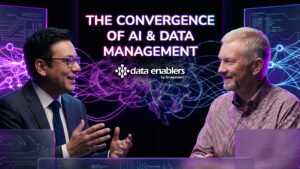
This is exactly the dynamic that Episode 6 of the Data Enablers Podcast, The Convergence of AI and Data Management, addresses. The episode makes the case that AI and data management have converged and that governance is now a growth issue, not a control function. Organisations that treat governance as a compliance checkbox end up rebuilding their data management programmes within 18 months. Those that embed it into the architecture from the start move faster. For any data engineering leader navigating a modernisation programme, it reframes the governance conversation in commercial terms that resonate with executive sponsors as well as compliance teams.
In regulated industries, raw PII cannot sit unmasked in a target warehouse even temporarily. Build policy-as-code for access control and automated data masking from day one. Edgematics’ Data Engineering and Governance practice embeds lineage tracking, automated quality validation, and GDPR, CCPA, HIPAA, and SOX compliance frameworks directly into pipeline architecture, ensuring governance is a pipeline property rather than a downstream consideration.
Pro Tip: Build policy-as-code for access control and data masking before your first production pipeline runs. Governance retrofitted onto a live ELT architecture is expensive, incomplete, and often fails the first audit it faces.
How AI Accelerates Every Phase of ETL Modernisation
AI is not replacing ETL engineers. It is compressing the time required for the most labour-intensive parts of modernisation.
Code generation tools produce initial pipeline translations from legacy SQL or procedural scripts, which engineers then review and refine rather than write from scratch. Azure Data Factory’s intent-driven mapping automates copy activity configuration by inferring column relationships from source and target schemas. AWS Glue’s generative AI troubleshooting surfaces root causes for Spark job failures with suggested fixes, cutting debugging cycles from hours to minutes.
However, AI tools miss context-specific edge cases that only appear in production data. Always have an engineer validate generated output against the original business logic before promoting to production. AI handles the repetitive, pattern-matching work. Engineers handle the decisions that require judgment.
Phase 6: Monitor and Optimise Continuously After Cutover
The work does not end at cutover. Post-modernisation operations require a different monitoring posture than legacy ETL, because cloud-native pipelines fail differently and cost more when they run inefficiently.
Observability from day one means instrumenting every pipeline with logging, alerting, and lineage tracking at build time. Retrofitting observability into production pipelines is expensive and error-prone.
Incremental loading and change data capture deliver the most impactful runtime reductions after migration, often in the 80 to 95% range for high-volume tables. After cutover, audit every pipeline that still runs as a full-table refresh and evaluate whether CDC is feasible for that source.
Cost governance means setting budget alerts on cloud compute spend. In ELT environments, a single poorly written query on a large table generates significant unexpected cost. Query optimisation reviews should form a regular part of the data engineering team’s operating rhythm.
Schema change management requires building schema change detection into the ingestion layer so that upstream changes trigger alerts rather than silent data corruption downstream.
Key Takeaways
| Point | Details |
|---|---|
| Architecture choice is the highest-stakes decision | Choosing between modern ETL, ELT, or streaming determines cost structure and performance ceiling for years. |
| Parallel runs are non-negotiable | Running new and legacy pipelines simultaneously is the only reliable way to confirm 100% data integrity before cutover. |
| Governance must be built in from day one | Access control, data masking, and lineage tracking designed into the architecture prevent compliance exposure in ELT environments. |
| AI accelerates but does not replace engineers | Generative AI tools compress migration timelines but require engineer validation against original business logic. |
| Incremental loading delivers the biggest gains | Switching from full-table refreshes to change data capture can cut pipeline runtime by 80 to 95%. |
What We Have Learned From ETL Modernisation Programmes
The organisations that struggle most are not the ones that chose the wrong cloud platform. They are the ones that underestimated their refactoring debt and treated governance as a post-migration concern.
Pipelines accumulate undocumented business logic over years, and that logic only becomes visible when the migration breaks something downstream. Modular pipeline design, where each transformation step is a discrete and testable unit, makes this complexity manageable. Teams that plan for this upfront finish on time. Teams that discover it mid-migration do not.
The most useful framing for senior leaders is this: ETL modernisation is a capability build, not a one-time project. The cloud-native pipeline architecture built in the migration programme becomes the foundation for AI workloads in the programmes that follow. That framing helps boards and executives understand why phased investment with governance embedded from the start produces better returns than a single large-budget migration.
Edgematics Group
How Edgematics Supports ETL Modernisation
Edgematics works with enterprise data teams across North America, the UK, and the Middle East to design and deliver ETL modernisation programmes that reduce risk and build AI-ready foundations. Our Data Engineering and Governance solutions cover ETL/ELT architecture, pipeline migration, data quality management, lineage, and compliance frameworks. AI and Machine Learning practice connects the modernised pipeline foundation to production-grade models and analytics workflows. Our Data Strategy practice defines the right migration path before any infrastructure investment is committed. For enterprises evaluating their current pipeline estate, the Data and AI Maturity Assessment provides an evidence-based starting point across all five capability dimensions.
Book a Discovery Call to start the conversation.
FAQ
What does ETL stand for?
ETL stands for Extract, Transform, and Load: the process of pulling data from source systems, transforming it to meet target schema requirements, and loading it into a data warehouse. Modern architectures often reverse the last two steps, loading raw data first and transforming it inside the warehouse — a pattern known as ELT.
Is ETL outdated?
Traditional on-premise ETL is largely obsolete for new builds, but the ETL pattern itself remains valid when executed on cloud-native services like AWS Glue or Azure Data Factory, particularly when data requires masking or complex transformation before entering the warehouse.
Will AI replace ETL engineers?
AI accelerates ETL work rather than replacing it. Platforms like AWS Glue and Azure Data Factory use generative AI to automate code generation, Spark troubleshooting, and intent-driven mapping, but engineers remain responsible for validating outputs and managing pipeline logic.
What are the best cloud ETL tools in 2026?
The leading cloud-native platforms for ETL and ELT workloads are AWS Glue, Azure Data Factory, Google Cloud Data Fusion, and Databricks. Each supports hybrid ETL, ELT, and streaming processing with varying strengths in AI integration, governance, and cost model.
How long does ETL modernisation take?
Timeline depends on pipeline complexity, refactoring debt, and the migration path chosen. Re-platforming programmes typically take four to eight months. Full re-architecting programmes for enterprise-scale environments span twelve to eighteen months. A comprehensive assessment before scoping reduces estimation errors significantly.