Data management has become too complex for teams to rely on manual intervention at every stage.
Customer, financial, operational, product, and analytical data now moves across applications, warehouses, cloud platforms, APIs, files, and AI systems. When teams still depend on spreadsheets, manually triggered jobs, isolated quality checks, and repeated reconciliation, the cost is not limited to engineering effort. Delays affect decision-making, data quality, governance, and the ability to put data to work.
That is why enterprises increasingly look to automate data management across the full lifecycle.
The goal is not to automate everything simply because automation is available. The goal is to identify the repetitive, high-volume activities where automation improves reliability, reduces intervention, and gives teams more time to focus on higher-value work.
A mature approach combines orchestration, automated ingestion and transformation, data quality controls, metadata capture, master data reconciliation, observability, and increasingly, AI-assisted workflows. The strongest implementations also keep governance and human oversight close to the processes being automated.
TL;DR
- Automate data management where repetition creates operational cost or risk, rather than automating every process indiscriminately.
- Data ingestion, transformation, orchestration, quality, metadata, master data, and AI-assisted workflows form the core automation opportunities.
- Automation should be built around clear ownership, quality expectations, recovery mechanisms, and governance.
- Poor data does not become better through automation. It simply moves faster, which makes quality controls essential.
- Human review still matters for ambiguous identity matches, high-impact changes, and decisions that require business context.
- Edgematics combines data engineering, governance, unified orchestration, data quality, and AI capabilities through platforms such as PurpleCube AI and Axoma.
1. Automate Data Ingestion
Data ingestion is one of the most obvious places to begin.
Enterprise data often arrives from operational databases, SaaS applications, APIs, files, event streams, and third-party systems. When teams rely on manual exports, scheduled file handling, or custom scripts that require constant intervention, even simple changes can create operational delays.
Automation can make the movement of data more predictable.
Change Data Capture can identify changes at the source and move only what has changed. Event-driven integrations can trigger workflows when something actually happens. API workflows can automatically retry transient failures rather than requiring an engineer to rerun a process manually.
The important principle is to match the ingestion pattern to the source.
Stable internal systems may work well with scheduled or CDC-based flows. Highly variable external sources may need stronger retry logic, validation, fallback handling, and monitoring.
Before you automate data management, define the expectations around freshness, completeness, and timeliness. Automation without those expectations simply moves data faster without telling you whether the result is good enough.
For organisations dealing with many systems, PurpleCube AI provides a unified orchestration environment with a broad connector ecosystem designed to bring disparate sources into governed data workflows. PurpleCube AI documentation describes more than 150 plug-and-play connectors spanning SaaS applications, databases, file systems, and other enterprise sources.
2. Automate Data Transformation
Once data enters the environment, transformation becomes the next major opportunity.
Traditional transformation processes often evolve into long chains of manually maintained scripts. Over time, business logic gets duplicated, dependencies become difficult to trace, and even minor changes require significant engineering effort.
Automation changes that model.
Declarative transformation patterns allow teams to define what the resulting dataset should look like while the platform manages execution. Version control can then bring transformation logic into the same engineering practices used for application development.
This improves more than developer productivity.
When transformation logic is versioned, tested, and consistently deployed, teams gain greater confidence in what changed and why.
Automated transformation should also include validation. A workflow should not simply transform data and publish the result. It should be able to determine whether the result satisfies the conditions required by downstream consumers.
That distinction becomes particularly important when the transformed data feeds customer experiences, financial reporting, operational decisions, or AI systems.
3. Automate Data Orchestration
Transformation answers what should happen to data.
Orchestration answers when it should happen, in what order, under which dependencies, and what should happen if something goes wrong.
This makes orchestration the control layer connecting multiple automated tasks.
A well-designed orchestration workflow can:
- Trigger tasks based on time or events
- Check upstream dependencies
- Retry failed operations
- Prevent downstream execution when requirements are not met
- Trigger backfills
- Route incidents
- Monitor workflow performance
- Track execution history
The difference between scheduling and orchestration matters here.
A scheduler asks whether it is time to run a task.
An orchestration layer asks whether the conditions for that task have been satisfied.
That becomes critical in complex enterprise environments where one dataset may depend on multiple sources and several downstream processes.
Edgematics’ Data Engineering & Governance capabilities bring orchestration into a broader environment that includes data integration, quality, metadata, lineage, and governance.
PurpleCube AI extends that approach with unified orchestration and GenAI embedded across the data engineering lifecycle. Its platform is designed to automate complex pipelines, optimise data flows, and connect orchestration with data quality, metadata, and governance.
4. Automate Data Quality
Automation is only valuable when the data being moved can be trusted.
Data quality checks should therefore become part of the pipeline rather than a separate activity performed after data reaches a downstream system.
Useful automated checks can include:
- Schema conformity
- Required-field completeness
- Duplicate detection
- Validity rules
- Referential integrity
- Unexpected null rates
- Distribution changes
- Business rule validation
The advantage is not simply speed.
Automated quality controls create consistency. The same rule can run repeatedly without depending on whether someone remembers to check a dataset.
They also create an opportunity to catch issues earlier.
A failed validation at ingestion is generally easier to address than an incorrect number discovered in an executive report several days later.
This is one of the areas where PurpleCube AI’s Data Quality capabilities become especially relevant. The platform documentation describes automated data quality assessment and improvement alongside orchestration and analytics capabilities.
The principle is simple:
Do not automate the movement of data without automating the controls that determine whether it should move.
5. Automate Metadata and Lineage
As data environments grow more complex, knowing what the data means becomes almost as important as moving it.
Teams routinely ask:
Where did this number come from?
Which source produced it?
Who owns the dataset?
What transformation changed it?
Which downstream systems depend on it?
Without automated metadata and lineage capture, answering these questions can require manual investigation across pipelines, documentation, and individual team knowledge.
Metadata automation changes this by capturing information as workflows run.
The result can include:
- Source and destination relationships
- Ownership information
- Transformation history
- Dataset definitions
- Data classifications
- Pipeline dependencies
That creates a more transparent environment and makes troubleshooting, governance, and compliance easier to manage.
It also has an important effect on trust.
When teams can trace a number back to its source and understand how it changed, they can spend less time questioning the origin of the data and more time using it.
PurpleCube AI uses active metadata across its architecture to support discovery, lineage, governance, and intelligent automation. The platform documentation also describes agents that continuously monitor and optimise data pipelines using this metadata context.
6. Automate Master Data Management
Master data management creates another major opportunity for automation, particularly in customer, product, supplier, and account data.
The challenge is identity.
The same customer may appear in multiple systems under slightly different names, addresses, identifiers, or contact details. The same product may also appear with inconsistent descriptions or codes across business units.
Automation can help match, standardise, enrich, and reconcile those records.
However, this is one area where full automation should be approached carefully.
High-confidence matches can often be processed automatically.
Low-confidence matches should be routed for human review.
That distinction matters because an incorrect automated merge can create a new data quality problem that is more difficult to detect than the original duplication.
A useful customer data management approach therefore combines automated matching with confidence scoring, lineage, and human-in-the-loop review.
Edgematics’ perspective on Customer Data Management: Build the Trust Layer First explores this issue through the lens of customer trust, identity resolution, governance, and continuous quality.
The objective is not to remove humans from the process.
It is to reserve human attention for the decisions where judgment actually adds value.
7. Automate Data Management With AI
The final layer moves beyond rule-based automation.
AI can assist teams with tasks such as:
- Anomaly detection
- Rule generation
- Metadata creation
- Data profiling
- Natural language interaction with data
- Issue investigation
- Correction recommendations
- Workflow optimisation
This is where data management begins to move from automation based purely on predefined instructions toward more adaptive systems.
AI can recognise patterns that are difficult to express through fixed rules. It can also reduce the effort required to investigate large volumes of data issues.
But the same principle applies here as everywhere else.
AI should not become a substitute for data strategy or governance.
A model can suggest that two records represent the same customer. A person may still need to approve the merge.
An AI system can identify unusual pipeline behaviour. An engineer may still need to determine whether the anomaly is expected.
An intelligent system can recommend a correction. Governance may still determine whether that correction can be applied automatically.
This is why human oversight remains an important design principle even as automation becomes more sophisticated.
What Connects These Seven Forms of Automation?
It is tempting to treat the seven methods as separate technology initiatives.
They are more useful when treated as connected layers.
Automated ingestion brings information into the environment.
Transformation prepares it.
Orchestration coordinates it.
Data quality evaluates it.
Metadata explains it.
Master data management creates consistency around important entities.
AI helps teams and systems respond intelligently to what the data reveals.
The strongest environments connect these capabilities rather than allowing every function to operate independently.
That is also why choosing an orchestration platform based only on scheduling features can create problems later. The broader data environment needs a control layer that understands quality, metadata, governance, and dependencies.
Why Governance Must Come Before Full Automation
The biggest mistake organisations can make is assuming automation automatically creates control.
It does not.
If a bad rule is automated, the bad rule runs consistently.
If unreliable data is ingested automatically, unreliable data spreads faster.
If a flawed master data rule merges the wrong records, the resulting error can propagate across multiple systems.
That makes governance a prerequisite for responsible automation.
At a minimum, teams should define:
- Data ownership
- Quality expectations
- Access controls
- Data contracts
- Retention requirements
- Exception handling
- Human approval points
- Audit trails
The supplied source makes the same point directly: automation cannot compensate for broken source data, and controls such as contracts, metadata, access management, audit logs, and testing gates need to sit underneath automated workflows.
Edgematics’ Layers of Data Governance explores how governance can become an operational capability across data, analytics, automation, and AI.
How Should You Decide What to Automate First?
Not every process deserves automation.
A useful prioritisation model considers four questions.
Is the task repeated frequently?
High-volume, repetitive processes generally provide more automation value than occasional tasks.
Is the current process creating measurable friction?
Look for manual reconciliation, recurring incidents, delayed reports, or significant engineering effort.
Is the process stable enough to automate?
Unstable processes with constantly changing requirements may require process redesign before automation.
What happens if the automation is wrong?
High-impact processes need stronger validation, monitoring, and human approval than low-risk administrative tasks.
A good first automation candidate usually combines high repetition, clear rules, visible business value, and manageable risk.
That is more useful than simply selecting the process that appears most technically interesting.
How Edgematics Helps Automate Data Management
Edgematics approaches data automation as a connected capability rather than a collection of disconnected scripts.
Through Data Engineering & Governance, organisations can address the engineering and governance requirements around integration, transformation, metadata, lineage, data quality, and enterprise data operations.
At the platform level, PurpleCube AI brings unified data orchestration together with GenAI and active metadata. The platform is designed to automate complex data pipelines, connect multiple data sources, improve data quality processes, and support analytics and AI workloads from the same environment.
For workflows that move beyond conventional automation, Axoma provides an enterprise agentic AI layer. Its role is not simply to execute actions autonomously. It brings governance and control into AI driven workflows so organisations can determine where agents can act independently and where human intervention remains necessary.
This creates a progression:
Automate repetitive work → monitor what happens → introduce intelligence → keep governance in control.
That progression is important because automation should reduce operational friction without creating a new category of risk.
Where Data Management Meets Intelligent Automation
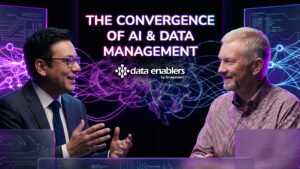
The question of how data management and AI should evolve together is also explored in Data Enablers, Edgematics’ podcast series.
The episode The Convergence of AI and Data Management examines why AI and data management can no longer be treated as separate enterprise priorities.
That becomes particularly relevant as organisations move beyond automating individual pipeline tasks and start introducing AI into data engineering, quality management, governance, and operational workflows.
The interesting question is not whether AI can automate more.
It is where intelligence should sit within the data lifecycle, and where organisations still need explicit control and accountability.
For data leaders considering the next stage of automation, the conversation provides a useful perspective on why stronger data management and AI capabilities need to evolve together.
What Does Good Data Management Automation Look Like?
A mature automated data environment should make several things easier without making accountability harder.
Teams should spend less time:
- Restarting failed jobs
- Reconciling duplicate records
- Searching for data lineage
- Running repetitive quality checks
- Moving data between systems manually
- Investigating avoidable pipeline failures
At the same time, they should gain greater visibility into:
- What data is moving
- Where it came from
- Whether it meets quality expectations
- Who owns it
- What depends on it
- What happens when something changes
That combination is the real value of data management automation.
It is not simply about reducing human involvement.
It is about using human involvement where it matters most.
A Practical Starting Point
Enterprises considering how to automate data management should resist the urge to automate the entire estate immediately.
Begin with one pipeline or workflow where the business impact is clear.
Measure the current manual effort.
Document the dependencies.
Define quality and freshness expectations.
Automate the stable parts.
Build monitoring and recovery into the process.
Then measure the result.
The next opportunity should be selected based on evidence from the first one, not on the number of features available in a platform.
This approach also gives leadership a much clearer answer to an important question:
What did automation actually improve?
The answer should be visible in reduced manual effort, more reliable data delivery, faster issue resolution, better quality, or stronger business responsiveness.
About Edgematics
At Edgematics, we see data management automation as an enabler of something larger than operational efficiency.
It creates the conditions for people to spend less time maintaining data and more time using it.
That aligns with the three principles that shape our work:
Customer Centricity. Operational Excellence. Competitive Advantage.
Customer Centricity means data should ultimately improve how organisations understand and serve their customers.
Operational Excellence means repetitive work should be automated where it can be made more reliable and measurable.
Competitive Advantage means trusted data should help organisations make better decisions, develop new capabilities, and use AI more effectively.
PurpleCube AI brings these ideas into the data engineering environment through unified orchestration, GenAI, active metadata, data quality, and intelligent automation. Axoma extends the model into governed agentic workflows.
The technology matters.
But the bigger objective is simpler:
Build data operations that work reliably enough for the business to stop managing the plumbing and start using the data.
FAQ
What are the main ways to automate data management?
The seven major areas are data ingestion, transformation, orchestration, data quality, metadata and lineage, master data management, and AI-assisted data management.
What should an organisation automate first?
Start with a stable, repetitive workflow where the business impact is visible and the consequences of failure are manageable. Measure the current manual effort before introducing automation.
Can data quality be fully automated?
Many repetitive quality checks can be automated, including schema validation, completeness checks, duplication detection, and anomaly monitoring. However, ambiguous or high-impact data decisions may still require human review.
How does data orchestration support automation?
Orchestration coordinates dependencies, scheduling, validation, retries, monitoring, and recovery across multiple data tasks. It provides the control layer that allows individual automated processes to work as one workflow.
Can AI automate data management?
AI can assist with anomaly detection, rule generation, metadata creation, profiling, investigation, recommendations, and workflow optimisation. Governance and human oversight remain important for ambiguous or high-impact decisions.
What is the role of metadata in data automation?
Metadata provides context about data sources, ownership, transformations, relationships, and usage. Automated metadata capture makes lineage and governance more practical as data environments become more complex.
Does automating data management eliminate the need for data engineers?
No. Automation changes where engineers spend their time. Instead of repeatedly managing manual data processes, engineers can focus more on architecture, reliability, governance, new data products, and higher-value automation.