The five highest-impact ways to automate data management are ingestion and movement, cleaning and validation, transformations and modeling, scheduled report refreshes, and anomaly detection with orchestration. Done right, each layer compounds: fewer manual errors, faster data availability, consistent metrics across teams, lower operating cost, and earlier detection when something breaks. The order matters. Start small, secure each layer before automating the next, then expand.
TL;DR:
- Automate data ingestion using incremental extraction, with appropriate architecture choices for batch, streaming, or hybrid patterns based on data freshness needs.
- Implement automated validation to catch errors early, deciding whether to reject, quarantine, or auto-correct records based on data policy and risk.
- Use modular, version-controlled transformation frameworks with CI/CD standards to ensure accurate, auditable metrics and downstream model stability.
- Match report refresh cadence to business needs, prioritizing incremental updates and automating versioning while avoiding unnecessary full reloads.
- Deploy orchestration and observability tools to manage dependencies, alert on schema changes, and escalate SLA breaches, ensuring reliable, governed data pipelines.
Automate Data Ingestion and Movement
Ingestion is where most enterprise data programs bleed hours. Connectors pulling from CRM systems, billing platforms, or network telemetry should use incremental extraction, meaning timestamps or change-tracking cursors that pull only new or modified records instead of re-scanning entire tables. That single shift is what separates a pipeline that runs in minutes from one that runs for hours.
The architecture choice depends on how fresh the data needs to be. Batch, streaming, and hybrid patterns each solve a different problem: batch suits nightly finance reconciliations, streaming suits fraud detection or network fault alerts, and hybrid often wins for commercial teams that need near real time customer data without streaming infrastructure everywhere.
- Use MERGE or upsert logic instead of blind inserts to avoid duplicate records on reruns
- Authenticate connectors with scoped service accounts, not shared credentials
- Trigger ingestion from your orchestration layer rather than ad hoc cron jobs
Pro Tip: Build idempotency into ingestion from day one. Retrofitting it after a duplicate-record incident costs far more than designing for it upfront.
How Do You Automate Data Cleaning and Validation?
Automated validation catches what manual review misses at scale: null checks on required fields, range checks on numeric values, referential integrity between tables, and type checks that flag a string where a date belongs. These four checks alone catch the majority of downstream reporting errors before they reach a dashboard.
The harder decision is policy. Do you reject bad records outright, quarantine them for review, or apply auto-correction rules for known patterns? Regulated industries generally quarantine first and automate the fix only once a rule has proven reliable across several cycles.
- Reject records that fail referential integrity checks; these usually indicate a broken upstream contract
- Quarantine ambiguous records (missing optional fields, borderline values) for human review
- Auto-fix only well-understood, low-risk issues like whitespace or casing inconsistencies
Route every validation failure into an alert tied to a remediation workflow, not just a log file nobody reads. Edgematics’ playbook on automating data pipelines with built-in quality walks through how to wire these checks into production without slowing ingestion down.
Automate Transformations and Modeling
Transformation logic is where inconsistent metrics get born, and it’s the layer most enterprises automate too fast. Modular, declarative frameworks that build small, testable models are far easier to audit than one monolithic SQL script that nobody fully understands two years later. Declarative transformation frameworks make CI/CD and peer review practical at scale, because a change to one model doesn’t ripple silently into ten others.
Version control isn’t optional here. Every transformation deployed to production should pass through a CI/CD gate with unit tests on the logic, integration tests against sample data, and quality checks before promotion, matching the production-readiness standards Databricks outlines for modern pipelines.
- Freeze and socialize metric definitions before scheduling a model, not after stakeholders start disagreeing on the numbers
- Use dependency graphs so downstream models only run after upstream ones succeed
- Promote models through staging before they touch production dashboards
Pro Tip: Treat a metric definition change like a schema change. It needs the same review and version history, or your quarter-over-quarter comparisons quietly stop meaning anything.
How Often Should Dashboards and Reports Refresh?
Refresh cadence should match business need, not habit. A revenue dashboard reviewed weekly doesn’t need hourly refreshes burning warehouse compute; a network fault dashboard used for real-time triage does. Matching cadence to actual use is one of the simplest ways to cut both cost and noise.
Stagger heavy refresh jobs so they don’t collide during peak hours, and lean on warehouse-native incremental refresh instead of full-table rebuilds wherever the platform supports it. Incremental processing and autoscaling have been shown to cut compute costs dramatically compared to fixed-size clusters running full reloads on a schedule.
- Tier refresh frequency by business criticality: real time, hourly, nightly, weekly
- Automate report versioning and delivery, keeping an audit trail of what shipped when
- Avoid full refreshes as a default; reserve them for schema changes or data corrections
Automate Anomaly Detection, Monitoring, and Orchestration
Orchestration is the layer that makes the other four reliable. It manages dependencies, retries failed tasks, and enforces SLAs so a late upstream feed doesn’t silently corrupt a downstream report. Without it, every pipeline failure becomes a manual fire drill.
Observability should include SLA monitoring and schema-change alerts that route directly into on-call procedures, not just a dashboard someone checks once a day. Anomaly detection on business metrics, like a sudden 40% drop in daily transactions, catches problems that a purely technical health check would miss entirely.
- Log every pipeline run with enough detail to reconstruct what happened during an incident
- Alert on schema changes immediately; these are the most common silent pipeline killer
- Escalate automatically when an SLA breach persists past a defined threshold
Stripe and Databricks both stress the same point: observability and alerting need to exist before go-live, not get bolted on after the first outage. A pipeline with no alerting doesn’t fail loudly. It fails quietly, and you find out when a business leader questions a number in a board deck.
Implementation Roadmap: Rolling Out These Five Automations Incrementally
Trying to automate all five areas simultaneously is how transformation projects stall. A sequenced rollout gets value faster and keeps risk contained at each step.
- Audit first. Identify the manual, repetitive, error-prone tasks costing your team the most hours. Stripe’s guidance is to start with the most frequent pain point, often ingestion or backup processes, because early wins fund the rest of the program.
- Lock in version control and CI/CD before anything runs in production. No transformation or pipeline change should reach a production schedule without passing automated tests first.
- Add validation and transformation automation incrementally, instrumenting logging and alerts at each new step rather than waiting until the whole pipeline is built.
- Define KPIs before you scale further: data freshness, error rate, mean time to recovery, and cost per processed byte. These numbers tell you whether automation is actually working or just moving the manual effort somewhere less visible.
- Document ownership and lineage for every pipeline and model. When something breaks at 2 a.m., the on-call engineer needs to know who owns the fix without hunting through Slack history.
- Review on a fixed cadence. Test changes in staging, roll out with feature flags where possible, and retire automations that no longer match business needs.
Pro Tip: Resist the urge to automate a metric nobody has agreed on yet. Automation makes a wrong number travel faster, not more correct.
Edgematics’ data quality automation playbook breaks this sequence down further for teams that want a narrower starting scope before scaling company-wide. Teams managing complex source-system integrations, particularly during M&A data migration or legacy system consolidation, often find the audit step alone surfaces problems worth fixing before any automation begins. A related resource on ERP-WMS integration is a useful reference for operators wrestling with phantom inventory and system cutover risk during that audit phase.
Edgematics Perspective: Common Pitfalls and Where Agentic Automation Helps
The failure pattern we see most often isn’t technical ambition outrunning capability. It’s governance outrunning nothing at all. Teams automate a metric before anyone agrees on its definition. They skip idempotency because the first version “just needs to work,” then spend a quarter untangling duplicate records after a retry storm. They build pipelines with logging but no alerting, so the first sign of trouble is a commercial director asking why last month’s churn number doesn’t match this month’s.
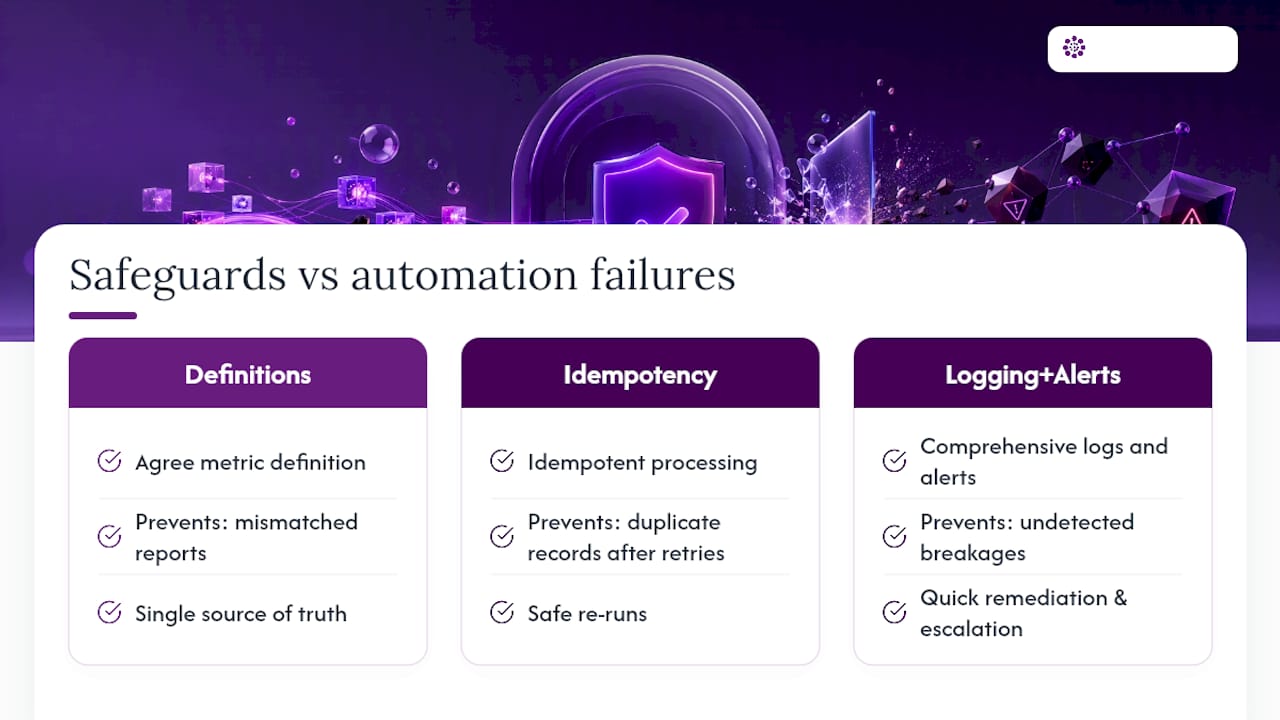
Governed agentic automation changes the calculus here. Rather than a human manually triggering remediation after an alert fires, a well-designed agentic layer, like the orchestration Axoma provides, can execute approved remediation steps within defined guardrails, log every action for lineage, and escalate only what genuinely needs human judgment. That’s a meaningfully different risk profile than unmonitored scripts running on cron jobs.
Our honest guidance: build internal capability for the automations your team runs daily, and bring in specialist partners when the stakes involve regulatory exposure, heterogeneous legacy systems, or a scale of AI-accelerated analytics your current team hasn’t operated at before.
— Edgematics Group
How Edgematics Can Help Accelerate and Govern Your Data Automation
Most enterprises don’t fail at automation because the technology is hard. They fail because nobody owns the governance layer once ten pipelines become a hundred. Governance is built in from the start, so audit trails, lineage, and access controls aren’t a retrofit six months after go-live.
Our Data Engineering & Governance work covers the architecture, ETL/ELT pipelines, cataloging, and compliance frameworks that turn the five automation areas above into something an auditor can actually trust. For organizations ready to move beyond scripted automation, Agentic AI built on Axoma handles autonomous remediation and workflow orchestration with enterprise governance baked in, not bolted on. And A unified orchestration platform can unify ingestion, transformation, and monitoring, so teams aren’t stitching together separate tools.
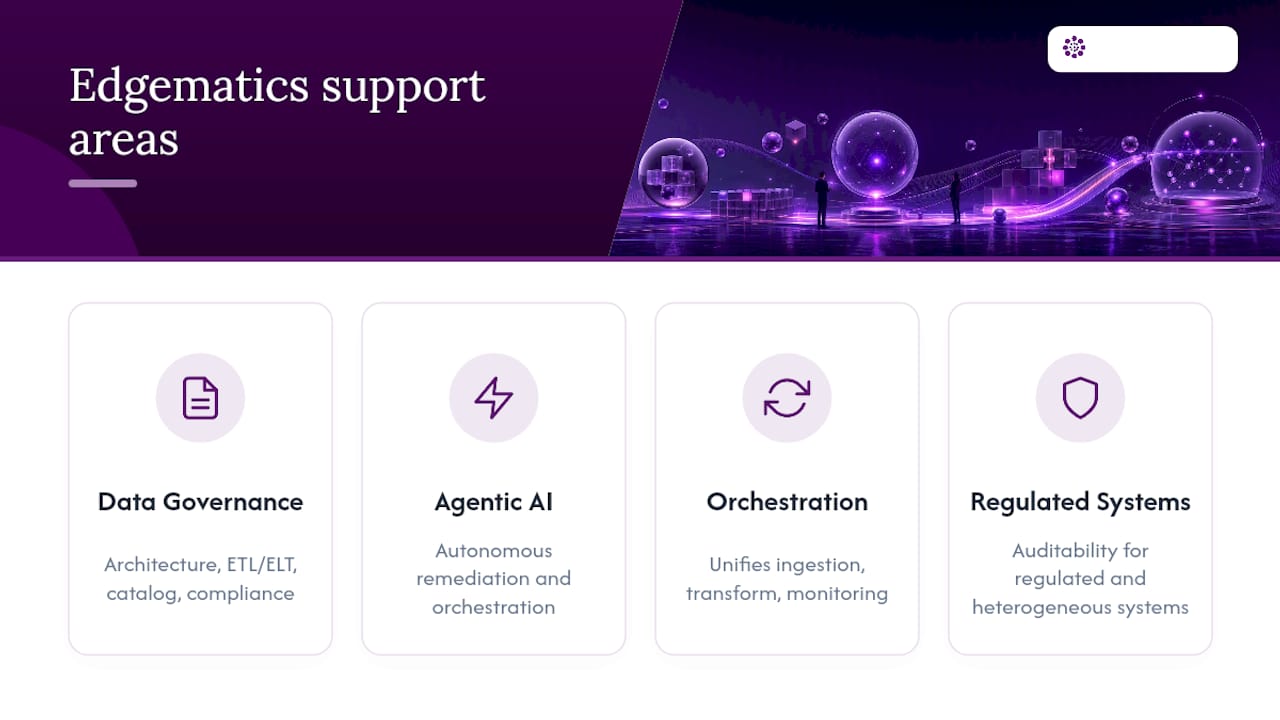
This fits particularly well for regulated industries and organizations running heterogeneous systems after an acquisition or fibre network expansion, where auditability isn’t optional. If this resonates with where your team is right now, we’d welcome a conversation about what a governed rollout could look like for you. Visit Edgematics to see how our solutions map to your current stack.
Sources
- Automation in Data Analytics: A Business Guide | Stripe
- Data Pipeline Best Practices: Architecture, Modern Pipelines, and Deployment | Databricks Blog
- Idempotent pipelines: build once, run safely forever
FAQ
What Are the Five Ways to Automate Data Management?
The five core areas are data ingestion and movement, cleaning and validation, transformations and modeling, scheduled report refreshes, and anomaly detection with orchestration. Each layer builds on the reliability of the one before it.
Why Is Idempotency Important in Data Automation?
Idempotent writes, typically implemented with MERGE or upsert logic keyed to a unique business ID, prevent duplicate records when a pipeline retries after a failure. Without it, a single network hiccup can double count transactions across an entire day’s data.
Should We Automate Everything at Once or Start Small?
Start small. Audit your most frequent, error-prone manual tasks first, automate that single layer with proper version control and observability, then expand once it’s stable.
Does Edgematics Offer Data Automation Consulting?
Yes. Edgematics provides Data Engineering & Governance services and the PurpleCube AI and Axoma platforms for organizations automating data management with enterprise governance built in. Pricing is available on request through the Edgematics site.
How Do You Measure Whether Data Automation Is Working?
Track data freshness, error rate, mean time to recovery, and cost per processed byte. If these metrics improve while manual intervention drops, the automation is delivering real value rather than just moving the work somewhere less visible.