Legacy ETL migration is rarely just a matter of moving pipelines from one platform to another. Behind every enterprise pipeline sits transformation logic, business rules, joins, lookups, dependencies, parameters, and years of operational knowledge. Recreating that logic manually can turn what looks like a technology upgrade into a long and expensive engineering programme.
The Edgematics whitepaper on AI powered ETL pipeline migration highlights the scale of this challenge. Manual migration can take 2 to 4 weeks for a simple pipeline, 4 to 8 weeks for a medium pipeline, and 8 to 16 weeks for complex pipelines. Reported manual error rates range from 15% to more than 60% depending on complexity.
The question, therefore, is not whether enterprises should modernise legacy ETL. It is how they can do it without allowing migration effort, business logic risk, and validation requirements to overwhelm the programme.
TL;DR:
- Legacy ETL migration becomes difficult when every pipeline has to be manually reverse engineered and rebuilt.
- The biggest migration risks extend beyond coding to undocumented business logic, inconsistent implementations, scarce legacy skills, and incomplete documentation.
- AI can change the migration model by interpreting pipeline logic rather than simply replacing one syntax with another.
- Edgematics uses a Universal Intermediate Representation, AI powered translation, batch orchestration, human review, and automated audit trails to industrialise pipeline migration.
- In measured migration programmes documented by Edgematics, the toolkit achieved 80 to 90% time reduction, 60 to 70% cost reduction, 3x productivity gain, and 60 to 80% error reduction compared with manual migration.
The Problem With Legacy ETL Migration
Enterprise ETL environments rarely become complex overnight. They evolve gradually.
A pipeline created years ago may have passed through multiple engineers, several business requirements, and numerous production changes. Over time, transformation rules become embedded in the pipeline itself. Documentation may no longer reflect the implementation, and the person who originally built the workflow may no longer be available.
When that environment needs to move to a modern platform, organisations often default to manual reimplementation. Engineers inspect the existing workflow, understand what it is doing, recreate the logic in the target platform, test the result, fix discrepancies, and repeat the process pipeline by pipeline.
That approach is understandable. It is also difficult to industrialise.
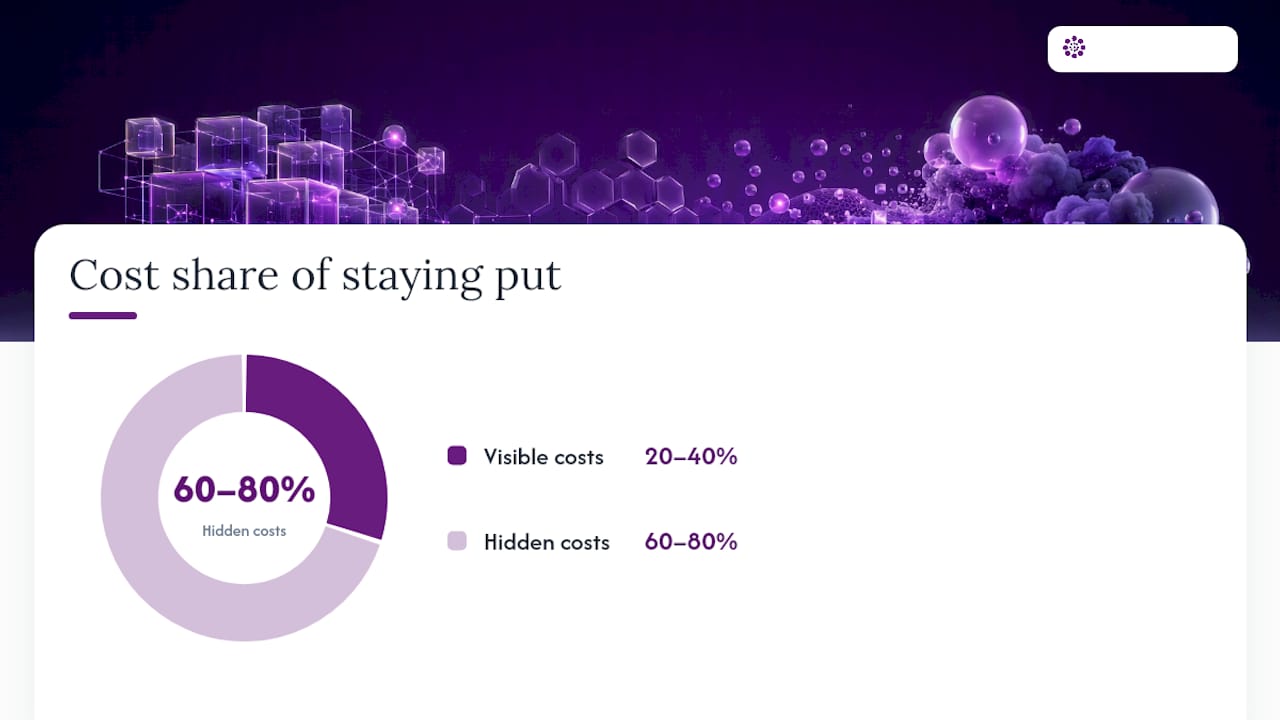
The whitepaper identifies several hidden costs associated with manual migration, including specialist talent scarcity, undocumented business logic being lost in translation, inconsistent coding standards between teams, and a lack of reusable migration assets.
The result is that every migration can start to feel like a new engineering project.
Why Manual Rebuilding Does Not Scale
The time required for migration increases sharply as pipeline complexity increases.
A simple pipeline may take several weeks to rebuild manually. Medium pipelines can require more than a month, while complex pipelines can extend to several months. At enterprise scale, where organisations may have hundreds or thousands of pipelines, the problem is no longer one difficult migration. It becomes a portfolio management challenge.
And the problem is not simply time.
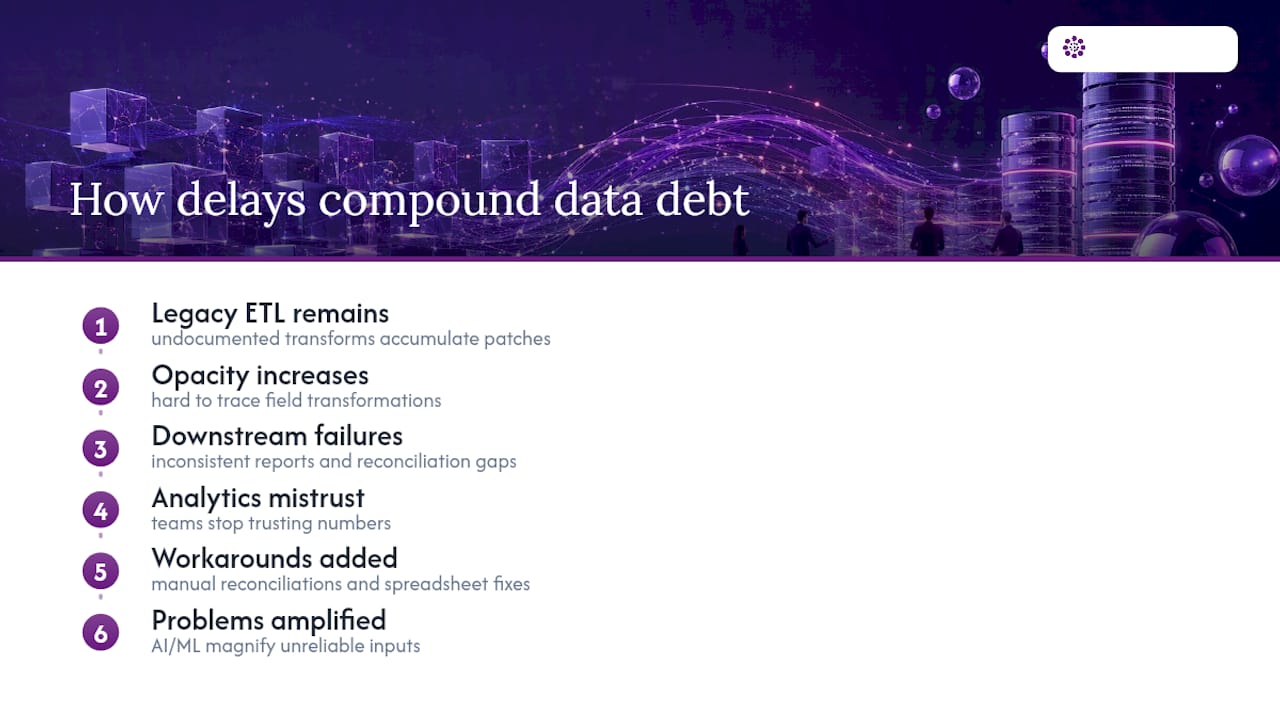
Manual translation also introduces variation. Two engineers may interpret the same legacy logic differently. One may implement a transformation using a native function in the target platform, while another may recreate it through multiple steps. Both implementations may technically work, but their behaviour, maintainability, and performance can differ.
This becomes particularly important when the pipeline contains complex business rules, aggregations, lookup conditions, workflow dependencies, or custom transformations.
The Real Migration Challenge Is Understanding Logic
Moving ETL technology is fundamentally a logic translation problem.
A pipeline is more than source code or configuration. It represents how an organisation processes data.
That includes the sequence of transformations, relationships between datasets, business rules, control flow, dependencies, and assumptions embedded within the workflow.
A basic syntax conversion approach can therefore be misleading. Replacing one function with another does not automatically preserve the meaning of the original transformation.
The Edgematics approach addresses this by parsing pipelines into a formal representation of their underlying logic. Its toolkit uses Abstract Syntax Tree processing to deconstruct pipelines into logical components such as joins, transformations, lookups, aggregations, business rules, and control flow.
That distinction is important because successful migration depends on preserving what the pipeline does, not simply reproducing how it was written.
The Hidden Risk: Losing Business Context During Migration
The technical migration itself is only one part of the risk.
A legacy pipeline may contain years of business decisions that were never formally documented. A particular lookup may exist because of an operational exception. A transformation may reflect a reporting rule agreed between finance and operations years ago. A workflow dependency may exist because another system requires data in a particular sequence.
When engineers rebuild these pipelines manually, those details have to be discovered and interpreted again.
This is one reason migration programmes often require experienced engineers who understand both the source platform and the organisation’s data environment. It also explains why knowledge concentration becomes a serious risk when only a small number of specialists understand the legacy estate.
Modernisation should therefore preserve not only technical logic, but also traceability around how that logic was translated.
Why AI Changes the Migration Model
AI introduces a different way to approach the problem.
Instead of asking engineers to manually recreate every pipeline, an AI powered migration system can analyse pipeline structures, interpret transformation intent, map source components to target constructs, and identify areas where confidence is low.
That changes the engineer’s role.
Rather than spending most of their time rewriting predictable pipeline logic, engineers can focus their attention on exceptions, ambiguous mappings, business specific rules, and validation.
The Edgematics whitepaper describes this as context aware translation. The toolkit analyses the semantic intent of transformations, business rules, lookup conditions, aggregation logic, and control flow rather than treating the pipeline as simple text.
The difference is substantial.
Automation is not being used simply to generate more code. It is being used to reduce the amount of repetitive interpretation required from migration teams.
What an AI Powered ETL Migration Approach Requires
AI alone does not make migration reliable.
A production migration approach needs several layers working together.
1. A Common Representation of Pipeline Logic
Point to point translators become increasingly difficult to maintain as the number of source and target platforms increases.
Edgematics addresses this through a Universal Intermediate Representation.
Instead of building a separate translator for every source to target combination, the toolkit first converts the source pipeline into a canonical representation. Target specific output can then be generated from that representation.
This means the core translation framework is not tightly coupled to a single ETL vendor and can be reused for future target platforms.
This is particularly relevant for enterprises that expect their data estate to continue changing after the current migration programme is complete.
2. AI That Understands Pipeline Structure
The next requirement is the ability to interpret complex pipeline logic.
The Edgematics toolkit uses Abstract Syntax Tree processing to represent the pipeline as a logic graph. This preserves dependencies, precedence, and data flow relationships before translation occurs. Multi AI engine support is then used for context aware translation and confidence based selection.
The objective is not to automate everything indiscriminately.
The objective is to automate the predictable work while creating a mechanism for identifying where human intervention is actually necessary.
3. Batch Orchestration for Large Pipeline Portfolios
Enterprise migration programmes rarely involve ten carefully selected pipelines.
They can involve hundreds or thousands.
The Edgematics toolkit is designed for bulk ingestion and parallel workflow processing, including pipeline files stored across enterprise storage environments. Processing paths can also vary based on pipeline complexity.
This changes migration from a sequence of individual engineering tasks into a coordinated pipeline processing operation.
Visibility is equally important. Progress tracking and status analytics provide information on migration throughput and execution status rather than forcing teams to manage the programme through disconnected spreadsheets and manual updates.
Human Review Still Matters
One of the most important principles in AI powered migration is knowing what should not be automated without review.
Some pipeline components are straightforward. Others contain ambiguous mappings, complex business rules, or logic where the consequences of an incorrect translation could be significant.
The Edgematics model uses human in the loop validation for these cases.
The toolkit automatically processes the higher confidence elements while routing low confidence mappings to migration engineers. Review happens at the property level rather than requiring engineers to manually inspect entire pipelines. Pre translation validation also identifies structural issues before conversion begins.
This creates a more practical balance between automation and control.
The aim is not to remove engineers from the migration process.
It is to make their expertise more targeted.
Visibility Is Part of the Migration, Not an Afterthought
A migration that produces working pipelines but cannot explain how those pipelines were translated is difficult to govern.
For that reason, documentation and auditability need to be part of the migration architecture itself.
The Edgematics toolkit automatically generates component mapping reports, translation documentation, status analytics, warnings and recommendations, and an immutable audit trail covering ingestion, translation, human review, approval, and export.
That becomes particularly important in regulated environments where organisations need to demonstrate how data processing logic changed between systems.
It also creates practical value for engineering teams. Future maintainers can understand what was translated, why decisions were made, and where human intervention occurred.
What Does AI Powered ETL Migration Look Like in Practice?
The migration pipeline follows five stages.
Source Ingestion
Pipeline files are collected from enterprise storage and processed in batches, allowing migration teams to work with large pipeline portfolios rather than individual files.
AST Parsing
Each pipeline is decomposed into its logical components, including transformations, joins, lookups, business rules, aggregations, and control flow.
AI Translation
The logical components are translated into constructs native to the target platform using context aware AI processing.
Human in the Loop Review
Low confidence mappings are surfaced for targeted engineering review, with decisions captured as part of the audit process.
Output and Reporting
Validated pipelines are exported to the target format, accompanied by migration documentation, mapping information, status analytics, and audit records.
This model creates a clear division between machine processing and human judgement.
The Performance Case for Automation
The strongest argument for AI powered migration is not that it sounds more modern. It is that the operating model can materially change.
According to Edgematics’ measured production outcomes, the toolkit delivered 80 to 90% time reduction, 60 to 70% cost reduction per migration, 3x productivity gain, and 60 to 80% error reduction compared with manual re coding.
The results also vary by pipeline complexity.
For simple pipelines, the whitepaper reports 80 to 90% time savings and 60 to 70% cost savings. Medium pipelines show 65 to 80% time savings and 50 to 65% cost savings. Complex pipelines show 50 to 65% time savings and 40 to 55% cost savings.
These figures are important because enterprise migrations are not homogeneous. A migration strategy needs to account for complexity rather than assuming every pipeline can be automated to the same degree.
Where AI Powered Pipeline Migration Fits Best
There are several situations where this approach becomes particularly relevant.
Organisations replacing an ageing ETL platform can use automated migration to reduce the effort required to move an existing portfolio.
Post merger environments can use it to consolidate multiple ETL estates into a common target architecture. The whitepaper specifically identifies disparate platform consolidation after acquisitions as a use case.
Cloud modernisation programmes can also benefit when organisations are moving from on premises ETL environments toward cloud native architectures involving technologies such as PurpleCube AI, AWS Glue, Azure Data Factory, or Databricks.
For large pipeline estates, the value becomes even more pronounced because batch capable orchestration allows multiple pipelines to be processed systematically rather than relying on linear growth in engineering headcount.
AI Does Not Replace Data Engineering Expertise
There is a temptation to frame AI migration as an alternative to experienced data engineers.
That is not the model described by Edgematics.
The more useful approach is to combine automation with engineering judgement.
AI can handle repeatable translation tasks. Engineering teams remain responsible for validating business critical logic, reviewing ambiguous mappings, understanding target architecture requirements, and confirming that migrated pipelines behave as intended.
This distinction is reflected in Edgematics’ human in the loop model, where automation handles the high confidence majority while complex or low confidence elements are routed to specialists.
The result is not less expertise.
It is more focused use of expertise.
Why Edgematics for Legacy ETL Modernisation
This is where the migration problem connects directly to Edgematics Group.
Edgematics combines data engineering experience with an AI powered migration toolkit designed around the realities of enterprise data estates.
Its Data Engineering & Governance practice covers architecture, ETL and ELT pipelines, data quality, cataloguing, lineage, and compliance. For organisations undertaking broader data modernisation, this enables the migration programme to be considered as part of the wider data architecture rather than as an isolated platform replacement.
Edgematics’ Data Engineering & Governance provides the broader capability around the migration itself.
The toolkit adds a specialised automation layer to that capability by combining Universal IR architecture, AI translation, orchestration, human validation, and migration reporting.
Edgematics also brings practical enterprise ETL experience to the process. The whitepaper states that its teams have delivered ETL and data integration projects for more than two decades and that the toolkit was built around failure patterns observed in manual migration projects.
That combination matters.
Migration automation is most useful when it understands both the technology and the operational realities surrounding it.
From ETL Migration to Modern Data Architecture
Modernising an ETL platform should not be viewed as simply replacing one tool with another.
The destination should be an environment where data pipelines are easier to govern, easier to maintain, more observable, and better suited to analytics and AI workloads.
This is why ETL migration increasingly sits alongside broader data architecture modernisation.
For enterprises planning that wider shift, Edgematics’ perspective on building AI ready data architecture provides a useful next layer of context. Migration is one part of the equation. The architecture surrounding the migrated pipelines determines how much value the organisation can extract from them afterwards.
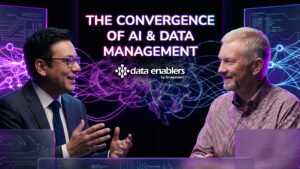
The relationship between AI and data management is becoming equally important. Edgematics explores this convergence in its Data Enablers podcast on the convergence of AI and data management, particularly as organisations move toward data environments designed to support both analytics and increasingly automated decision making.
A Better Way to Think About Legacy ETL Migration
The old model of migration is straightforward:
Find the pipeline.
Understand the pipeline.
Rewrite the pipeline.
Test the pipeline.
Repeat.
That approach works when the estate is small.
At enterprise scale, it becomes difficult to sustain.
AI powered migration introduces a different model:
Parse the logic. Translate the logic. Validate the exceptions. Document the result. Repeat systematically.
The difference is not just speed. It is the ability to apply a consistent migration framework across a much larger pipeline portfolio while preserving human oversight where it matters.
That is the shift taking place in legacy ETL modernisation.
The future of pipeline migration is not simply more automation. It is structured automation combined with semantic understanding, engineering judgement, and governance.
Conclusion
Legacy ETL migration has traditionally been constrained by manual re coding, specialist dependency, business logic risk, and the sheer number of pipelines involved.
AI changes what is possible by moving migration automation beyond syntax conversion toward understanding pipeline structure and transformation intent.
Edgematics brings that model together through its AI powered Data Pipeline Migration Toolkit. Universal IR architecture provides a reusable translation framework. AI powered logic translation handles repeatable migration work. Batch orchestration supports large pipeline estates. Human in the loop validation preserves engineering oversight. Automated reporting and audit trails provide visibility and governance.
For enterprises preparing to modernise legacy ETL, the question is increasingly not whether migration can be automated, but how much of the work can be automated without compromising logic, control, or confidence in the result.
FAQ
What Is Legacy ETL Migration?
Legacy ETL migration is the process of moving existing data pipelines from an older ETL platform to a modern target platform while preserving the underlying transformation logic, dependencies, business rules, and expected outputs.
Why Is Manual ETL Migration So Time Consuming?
Manual migration requires engineers to understand and rebuild pipelines individually. The Edgematics whitepaper reports manual durations ranging from 2 to 4 weeks for simple pipelines to 8 to 16 weeks for complex pipelines.
Can AI Completely Automate ETL Migration?
Not every migration decision should be automated. The Edgematics approach automates higher confidence translation while routing ambiguous or low confidence mappings to engineers for review.
What Is Universal Intermediate Representation in ETL Migration?
Universal Intermediate Representation is a canonical representation of pipeline logic that separates the source platform from the target platform. This allows the same translation framework to support multiple future target technologies rather than creating a new point to point translator for every combination.
Which ETL Migration Scenarios Can Edgematics Support?
The whitepaper identifies Informatica PowerCenter to Qlik Talend migration, cloud native modernisation, post merger data estate consolidation, and large pipeline portfolios as key use cases.
How Does Edgematics Reduce Migration Risk?
Edgematics combines AI translation with pre translation validation, targeted human review, automated documentation, status tracking, and an immutable audit trail. This allows organisations to automate migration while retaining visibility and control.
About Edgematics
Edgematics Group helps enterprises modernise data and AI environments through Data Strategy, Data Engineering & Governance, AI and Machine Learning, Agentic AI, Intelligent Process Automation, and Data Enterprise Applications.
Its AI powered Data Pipeline Migration Toolkit brings together enterprise data engineering expertise and intelligent automation to help organisations modernise legacy ETL environments with greater speed, consistency, and governance.
Book a Discovery Call
Discuss your legacy ETL environment with Edgematics and explore how AI powered pipeline migration can reduce manual effort while preserving the logic and controls your organisation depends on.