Enterprise data operations are becoming too complex to manage through disconnected tools and manual intervention.
Data now moves across cloud platforms, legacy applications, APIs, operational systems, analytical environments and AI workloads. Every new source introduces dependencies. Every new pipeline creates another point of failure. Every new AI use case increases the importance of having reliable and governed data underneath it.
That means the next stage of enterprise data operations cannot be about automation alone.
The real opportunity is to combine automation with intelligence.
Pipelines should not only move data. They should detect anomalies, validate quality, understand dependencies, capture lineage, monitor execution and support remediation. Data quality should not sit at the end of the process. Governance should not exist in a separate system. AI should not operate without the context and controls required to act safely.
This is where Edgematics brings its capabilities together.
PurpleCube AI provides the unified data orchestration layer across ingestion, pipelines, metadata, lineage, observability, governance and data quality. Axoma extends that environment with governed agentic AI for intelligent triage, reasoning and workflow execution.
The result is a more connected approach to enterprise data operations, where data moves automatically, quality is continuously assessed and AI can help determine what should happen next.
TL;DR
- Enterprise data operations are moving from scheduled data movement toward intelligent, continuously monitored workflows.
- PurpleCube AI connects ingestion, orchestration, transformation, metadata, lineage, observability, governance and data quality.
- PurpleCube AI Data Quality Studio brings AI-powered rule generation, continuous monitoring, duplicate detection, adaptive learning, quality scoring and guided correction into the data lifecycle.
- Axoma adds governed agentic AI for incident triage, reasoning, remediation and workflow execution.
- Edgematics combines its products with data engineering and governance expertise to help enterprises automate operations without sacrificing data trust or control.
Why Enterprise Data Operations Need AI
Traditional data operations depend heavily on people.
An engineer checks whether a pipeline completed.
A data steward investigates a quality issue.
An analyst reconciles conflicting numbers.
A developer fixes a transformation after an upstream schema changes.
A support team discovers a failure because a business user reports that yesterday’s dashboard is wrong.
That operating model becomes increasingly difficult as data environments grow.
More sources create more pipelines. More pipelines create more dependencies. More dependencies create more potential points of failure.
At the same time, enterprises expect data teams to deliver faster analytics, broader self-service and increasingly sophisticated AI applications.
Adding more manual oversight does not solve that problem.
Enterprise data operations need systems that can understand more of what is happening within the data environment and automate the parts of the process that are predictable, repetitive and rules-driven.
AI can help identify anomalies, interpret patterns, support root-cause analysis and recommend next actions.
Automation can execute defined workflows.
Governance can determine what the system is allowed to do.
This combination is what makes intelligent enterprise data operations possible.
From Data Movement to Intelligent Data Operations
The traditional pipeline model can be summarized simply:
Ingest.
Transform.
Load.
But enterprise environments now need more.
The data should be validated as it moves.
The pipeline should be observable.
Metadata should be captured.
Lineage should be maintained.
Quality should be scored.
Anomalies should be identified.
Incidents should be routed.
Known issues should be remediated where appropriate.
AI should have access to the context required to support those decisions.
This turns a pipeline into an operating workflow.
For Edgematics, that distinction is important. The objective is not simply to automate more steps. It is to create an environment where orchestration, quality, governance and AI work together.
The Data Engineering & Governance capability at Edgematics provides the engineering and governance layer required to support that environment across complex enterprise data estates.
PurpleCube AI: The Intelligent Data Orchestration Layer
The modern enterprise data stack often contains a separate tool for almost everything.
One platform handles ingestion.
Another handles orchestration.
Another manages quality.
A catalog manages metadata.
A different tool handles lineage.
Another system provides monitoring.
AI then gets added on top.
Each capability may work individually. The operational problem is the coordination between them.
PurpleCube AI is designed to reduce that fragmentation by bringing major data operations capabilities into a unified orchestration environment.
Enterprise Data Connectors
Enterprise data comes from databases, applications, APIs, files, cloud services and legacy environments.
PurpleCube AI provides connectors that help bring heterogeneous sources into managed workflows without building a separate integration pattern for every source.
This makes the integration layer more reusable and easier to govern.
Automated Data Ingestion
Once data sources are connected, ingestion can be orchestrated through managed workflows and event-driven processes.
That allows new data to trigger the appropriate processing instead of forcing every workload into rigid schedules.
For operational environments where freshness matters, this can reduce unnecessary waiting between data creation and data availability.
Pipeline Orchestration
PurpleCube AI manages pipeline execution and dependencies within the broader data environment.
That includes workflow sequencing, dependency management, triggers and retries.
Instead of relying on disconnected scripts and scheduling logic, teams gain a more centralized view of how enterprise data flows operate.
ELT Workflow Automation
Modern data environments increasingly rely on ELT patterns to manage transformation.
PurpleCube AI brings orchestration around these workflows so transformation logic can operate as part of a broader, observable and governed process.
The value is not simply automating a transformation.
It is knowing where that transformation sits within the enterprise data flow and what depends on it.
Metadata and AI-Powered Cataloguing
Automation becomes more useful when the system understands the data it is operating on.
PurpleCube AI supports metadata management and AI-powered cataloguing so teams can discover datasets, understand context and work with data more efficiently.
That metadata also becomes useful for downstream automation and AI-assisted operations.
End-to-End Lineage
Lineage provides the connection between data assets.
When something changes upstream, lineage helps determine what may be affected downstream.
When a quality incident occurs, lineage provides context around impacted reports, datasets and processes.
This makes incident investigation more targeted and gives AI systems additional information when they need to reason about a data issue.
Observability
Pipeline automation without observability simply creates faster failures.
PurpleCube AI brings operational visibility into the broader orchestration environment, helping teams understand pipeline health, data behaviour and anomalies as part of the same workflow.
This is the difference between a pipeline that runs and an operation that can be managed.
Data Quality Should Run Inside the Data Pipeline
A successful pipeline does not necessarily produce trustworthy data.
A source system can introduce duplicate records.
A critical field can suddenly become incomplete.
A schema can change.
An upstream application can introduce unexpected values.
A transformation can execute successfully but still produce a business-critical data issue.
If quality checks happen only after the data reaches the warehouse or reporting layer, the organization is discovering problems too late.
Edgematics’ PurpleCube AI Data Quality Studio takes a different approach.
Data quality becomes part of the pipeline lifecycle.
AI-Powered Quality Rule Generation
Building data quality rules manually across large enterprise datasets creates significant effort.
Data Quality Studio uses AI-powered rule generation to help identify relevant validation logic based on observed data patterns and business requirements.
This allows teams to reduce repetitive rule creation while still maintaining control over which rules are used.
The result is a quality layer that can be introduced faster and extended more efficiently.
Continuous Data Quality Monitoring
Data quality is not a one-time exercise.
A dataset can be healthy today and problematic tomorrow.
Source systems change. Business processes evolve. New patterns appear.
Continuous monitoring allows quality deterioration to be identified as it happens rather than waiting for downstream users to report it.
With Data Quality Studio, quality monitoring becomes part of ongoing enterprise data operations.
Duplicate Detection and Management
Duplicate records can create inconsistencies across customer data, operational records and analytics.
They can also affect downstream AI models that assume records represent unique entities.
Data Quality Studio provides duplicate detection and management capabilities so organizations can identify and manage these issues within the broader quality workflow.
Adaptive Learning
Static rules are useful, but enterprise data changes continuously.
Adaptive learning allows the quality process to incorporate patterns from approved corrections and previous observations.
That creates a feedback loop where quality operations can become more responsive over time.
The objective is controlled improvement, not uncontrolled autonomous change.
Quality Scoring
Enterprise environments can generate thousands of individual quality checks.
That does not necessarily make it easier to understand the overall condition of a dataset.
Quality scoring helps organizations evaluate the health of important data assets and prioritize attention.
It also creates a simpler way to communicate data health to business stakeholders who do not need to interpret every technical alert.
Guided Correction and Issue Collaboration
Detection alone does not create better data.
The organization needs to resolve the issue.
Data Quality Studio supports guided correction and issue collaboration so data teams, stewards and business stakeholders can work through identified problems in a structured process.
The lifecycle becomes:
Detect.
Investigate.
Correct.
Validate.
Learn.
Monitor.
This makes data quality an operational process rather than a periodic cleanup activity.
From Pipeline Monitoring to Intelligent Remediation
The next step after monitoring is deciding what should happen when something goes wrong.
Consider a pipeline where an upstream source changes its schema.
A traditional monitoring system may generate an alert.
A more intelligent environment can do more.
It can identify the affected pipeline.
It can inspect the metadata.
It can use lineage to determine downstream impact.
It can compare the event against previous incidents.
It can identify whether the issue matches a known pattern.
It can recommend a remediation.
For a low-risk, predefined situation, it can trigger an approved response.
For a higher-impact situation, it can escalate the issue for human review.
This is where enterprise data operations begin moving from automated execution toward intelligent intervention.
Axoma: Bringing Agentic AI Into Data Operations
Axoma extends the Edgematics approach into governed agentic AI.
Rather than treating AI as a separate assistant sitting outside data operations, Axoma enables agents to operate within defined enterprise workflows.
Its PRAL loop, Perceive, Reason, Act and Learn, creates a model for structured agentic execution.
An agent can perceive a pipeline anomaly.
It can reason over metadata, lineage and historical context.
It can determine an appropriate next action.
It can execute an approved workflow.
Then it can learn from the outcome.
For enterprise environments, governance is essential.
Axoma includes capabilities such as Compliance-by-Design, multi-LLM orchestration across 25+ LLMs, goal bounding, kill switches, zero-trust security and emergent risk protocols.
These controls help ensure agentic automation operates within clearly defined boundaries.
That changes the conversation around enterprise AI.
The objective is not maximum autonomy.
It is useful autonomy within an enterprise control framework.
Why PurpleCube AI and Axoma Work Together
PurpleCube AI provides the data context.
Axoma provides the agentic intelligence.
That combination creates a more complete operating model.
Imagine a quality anomaly appearing in a critical dataset.
PurpleCube AI detects the issue.
Data Quality Studio identifies the deterioration.
Metadata provides context.
Lineage identifies downstream impact.
The orchestration layer tracks the affected workflow.
Axoma evaluates the situation.
The agent determines whether it matches a known issue.
A governed remediation can then be recommended or executed.
The outcome is recorded.
The data is validated again.
This creates a closed operational loop.
Instead of:
Detect → Alert → Human Investigation
The model becomes:
Detect → Understand → Decide → Act → Validate → Learn
That is the larger opportunity behind AI-powered enterprise data operations.
Metadata, Lineage and Quality Give AI the Context It Needs
AI becomes more useful when it has context.
An agent that knows only that a pipeline failed has limited ability to determine what should happen next.
An agent that knows the affected dataset, its lineage, metadata, previous incidents, data quality history and downstream consumers has a much stronger operating context.
This is why data management capabilities matter to AI.
Metadata is not just documentation.
Lineage is not just a governance artifact.
Data quality is not just a compliance exercise.
Together, they provide the context that allows intelligent automation to operate more effectively.
This is also why the relationship between AI and data management is becoming increasingly important.
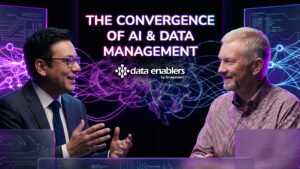
Data Enablers, Edgematics’ podcast series, explores this convergence in “The Convergence of AI and Data Management”. The discussion looks at why AI and data management can no longer operate as separate enterprise conversations, particularly as AI moves closer to real operational workflows.
Governance Has to Be Part of Automation
More automation creates more decisions happening through software.
That makes governance more important, not less.
Access controls need to operate within automated workflows.
Important actions need traceability.
Data lineage needs to remain available.
Remediation needs appropriate approval mechanisms.
Agentic systems need defined boundaries.
A governed data operation therefore needs to answer four questions:
What happened?
Why did it happen?
What action was taken?
Who or what was authorized to take it?
PurpleCube AI provides governance across the data environment, while Axoma extends those principles into agentic workflows.
This creates a model where governance does not sit outside automation.
Governance becomes part of the automation itself.
Reducing Data Operations Tool Sprawl
One of the biggest operational challenges for enterprise teams is not a lack of technology.
It is the accumulation of too much technology.
A separate tool for ingestion.
A separate orchestration platform.
A separate quality platform.
A separate catalog.
A separate lineage system.
A separate monitoring platform.
A separate AI layer.
Every additional system introduces more integrations, security configurations, monitoring requirements and operational dependencies.
That is why unified orchestration matters.
PurpleCube AI brings together orchestration, connectors, metadata, lineage, observability, quality and governance within one environment.
Edgematics explores this broader shift through its perspective on what modern data orchestration should actually deliver, including the growing importance of connecting pipeline execution with quality and operational control.
Automating the Data Lifecycle, Not Just the Pipeline
The real opportunity is larger than automated pipelines.
The complete data lifecycle can be automated and connected.
Source systems create data.
Connectors ingest it.
Orchestration manages the workflow.
Transformation makes it usable.
Data Quality Studio validates it.
Metadata captures context.
Lineage connects dependencies.
Observability monitors behaviour.
Governance controls access and action.
Axoma can support intelligent triage and governed remediation.
Analytics and AI consume the resulting trusted data.
That creates a complete operating loop.
The more connected these stages are, the less manual coordination is required between them.
What AI-Powered Data Operations Mean for Engineering Teams
For data engineering teams, the biggest benefit is not simply fewer tasks.
It is better allocation of engineering effort.
Manual pipeline maintenance can consume time that would otherwise go toward new data products and business use cases.
Repeated data quality checks can be automated.
Routine incident triage can be supported by AI.
Pipeline dependencies can be centrally managed.
Lineage can reduce investigation time.
Metadata can be captured automatically.
Quality issues can be detected earlier.
Together, these capabilities can reduce the amount of reactive work required to keep the data environment operating.
That allows engineering teams to spend more time improving enterprise capabilities and less time repeatedly resolving the same operational problems.
What AI-Powered Data Operations Mean for the Business
The technical improvements matter because they affect business performance.
More reliable pipelines can make data available sooner.
Continuous quality monitoring can reduce the risk of poor data reaching decision-makers.
Better lineage can shorten incident investigations.
Governed automation can reduce repetitive operational effort.
Agentic workflows can shorten the path from detecting a problem to taking the appropriate action.
The resulting benefits can include:
Faster time-to-insight.
More trusted analytics.
Lower operational overhead.
Improved data quality.
Better AI readiness.
Faster incident resolution.
Stronger governance.
More responsive business operations.
The objective is not simply to run pipelines faster.
It is to make enterprise data operations more dependable and more useful.
A Real Enterprise Example
Edgematics has applied data quality and orchestration capabilities in demanding enterprise environments.
In one engagement, a leading UK fibre network provider needed a trusted data environment to support a rapidly expanding operational footprint. PurpleCube AI Data Quality Studio supported the broader data workflow by automating data validation and helping identify inconsistencies before they affected downstream operations.
The Building a Trusted Data Foundation for the UK’s Largest Fibre Provider case study demonstrates how data engineering and data quality can work together within an enterprise environment.
Edgematics has also supported a leading US wireless carrier with data quality improvements designed to strengthen data accuracy while supporting privacy and compliance requirements. The Elevating Data Quality for Telecom Data Transformation case study provides further context.
How to Start With AI-Powered Enterprise Data Operations
Enterprises do not need to automate every process at once.
A more practical starting point is to identify the areas where manual intervention creates the most friction.
Look for pipelines with frequent failures.
Identify processes with significant manual reconciliation.
Find datasets with recurring quality incidents.
Map workflows with complex dependencies.
Then build from there.
Start by connecting the sources.
Orchestrate the pipeline.
Embed data quality checks.
Add observability.
Capture metadata and lineage.
Introduce AI-assisted investigation.
Then identify low-risk workflows where governed agentic automation can add another layer of efficiency.
The objective is not to maximize automation immediately.
It is to create an operating environment where each additional layer of automation increases reliability rather than complexity.
How Edgematics Connects the Enterprise Data Operations Lifecycle
Edgematics brings together the capabilities required to operate this model.
Its Data Strategy capability connects business priorities with the data capabilities required to support them.
Its Data Engineering & Governance capabilities support architecture, integration, governance and operational execution.
PurpleCube AI provides the orchestration, connectors, metadata, lineage, observability and Data Quality Studio capabilities needed to manage the data lifecycle.
Axoma adds governed agentic AI for intelligent triage, reasoning and workflow execution.
Together, these capabilities connect the lifecycle:
Ingest.
Orchestrate.
Transform.
Validate.
Observe.
Govern.
Reason.
Act.
Learn.
This is the shift from data management as maintenance to data operations as an intelligent enterprise capability.
The Future of Enterprise Data Operations Is Intelligent
The future of enterprise data operations is not simply about adding more automation.
It is about creating systems that understand the data they operate on.
Pipelines should know when data has changed.
Quality systems should identify when trust is deteriorating.
Lineage should reveal what a change affects.
Observability should show what is happening.
AI should help determine why something happened.
Automation should handle the repeatable response.
Governance should determine what the system is allowed to do.
That is the direction Edgematics is building toward with PurpleCube AI and Axoma.
PurpleCube AI provides the connected data orchestration, quality and operational context.
Axoma provides governed agentic intelligence.
Together, they create a model where enterprise data operations can become more automated, more reliable and more intelligent without sacrificing control.
FAQ
What are enterprise data operations?
Enterprise data operations cover the processes and technologies used to ingest, transform, validate, govern, monitor and deliver data across an organization. Modern enterprise data operations increasingly include AI-powered automation and intelligent remediation.
How does AI improve enterprise data operations?
AI can support anomaly detection, quality rule generation, incident investigation, issue classification, remediation recommendations and governed workflow execution.
What is PurpleCube AI?
PurpleCube AI is Edgematics’ unified data orchestration platform, bringing together connectors, data pipelines, orchestration, metadata, cataloguing, lineage, observability, governance and Data Quality Studio.
What does PurpleCube AI Data Quality Studio do?
Data Quality Studio supports AI-powered rule generation, continuous quality monitoring, duplicate detection and management, adaptive learning, quality scoring, guided correction and issue collaboration.
What is Axoma?
Axoma is Edgematics’ enterprise agentic AI platform. It supports the PRAL framework, Perceive, Reason, Act and Learn, alongside capabilities such as Compliance-by-Design, multi-LLM orchestration, goal bounding, kill switches and zero-trust security.
Can AI automatically remediate data issues?
AI can support controlled remediation for appropriate use cases. Low-risk and repeatable actions can be automated, while higher-impact actions can require human approval or escalation.
Why is data quality important for AI?
AI depends on the data and context available to it. Poor or inconsistent data can reduce the reliability of downstream analytics, decisions and AI workflows.
Why is unified data orchestration important?
Unified orchestration reduces fragmentation between ingestion, pipeline management, quality, metadata, lineage and monitoring. It also gives AI systems more context when they need to investigate or act on data issues.
About Edgematics
Edgematics helps enterprises modernize data operations by connecting strategy, engineering, governance and AI.
Its capabilities span Data Strategy, Data Engineering & Governance, AI and ML, Agentic AI, Intelligent Process Automation and Data Enterprise Applications.
Through PurpleCube AI and Axoma, Edgematics brings orchestration, data quality, governance and agentic automation into a connected enterprise operating model.