Introduction
Enterprise data environments have evolved over decades. New applications, cloud platforms, acquisitions and changing business requirements have added layers of technology to systems that were not originally designed to work together.
The result is often a fragmented data landscape. Teams manage disconnected pipelines, inconsistent data definitions, outdated integration processes and governance controls that struggle to keep pace with the growing environment.
This creates a challenge that goes beyond infrastructure. When data is difficult to access, understand and trust, analytics become less reliable and AI initiatives face additional barriers.
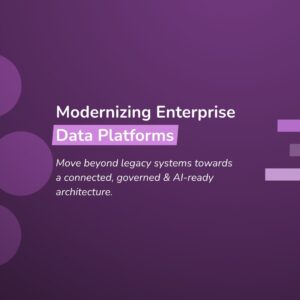
Enterprise Data Platform Modernization addresses this challenge by redesigning how an organisation stores, moves, governs and uses data. The objective is not simply to transfer existing workloads to a new environment. It is to build a platform that supports reliable data flows, reusable pipelines, stronger governance and future analytics and AI requirements.
At Edgematics, we approach modernization as a business-led programme that brings together architecture, data engineering, governance and AI readiness. Our perspective on modernising legacy systems for trusted AI explores why the underlying data foundation matters as much as the destination technology.
For enterprise data leaders, the key is to modernize in phases, prioritise the right workloads and ensure every stage delivers measurable value.
TL;DR
- Modernization is broader than migration. Migration moves data and workloads, while modernization changes the architecture, tools and operating practices.
- Prioritise workloads based on business value, complexity, data risk and reuse potential.
- Build reusable pipelines and a unified architecture to reduce the effort required for every new data source.
- Embed governance, lineage, quality and access controls from the beginning.
- Move in phases, with validation gates, parallel runs and a rollback plan for each cutover.
Data Platform Modernization vs. Data Migration
The terms data migration and data modernization are often used interchangeably, but they describe different activities.
Migration involves moving data or workloads from one environment to another. Modernization is a broader transformation of the underlying infrastructure, architecture, tools and operating practices.
Google Cloud’s guidance distinguishes migration from modernization by the extent of change involved. Databricks similarly describes modernization as a comprehensive transformation rather than a single technology upgrade.
Consider an enterprise moving its existing data warehouse to the cloud. If it transfers the same data structures, brittle ETL processes and disconnected governance practices without changing how the platform operates, it has completed a migration but achieved limited modernization.
The new environment may offer cloud infrastructure, but the organisation still carries many of its previous limitations.
A successful modernization programme examines the architecture, integration patterns, data quality, ownership and governance requirements alongside the migration itself.
Our article, From Legacy to Cloud-Native: Data Modernisation That Delivers Trusted AI, explores how organisations can move beyond replacing infrastructure and build data environments designed for analytics and AI.
What Triggers an Enterprise Data Modernization Programme?
Modernization usually begins when the existing data environment starts limiting business performance, operational efficiency or future technology plans.
Some of the common triggers include:
1. M&A Integration
Mergers and acquisitions often leave enterprises managing multiple systems with overlapping customer, product and network records.
Different platforms may use inconsistent identifiers, data structures and business definitions. Without an agreed source of truth, combining information across the organisation becomes difficult.
This is particularly relevant for enterprises consolidating data estates after acquisitions. Our guide to finding and fixing fragmented data systems examines how organisations can address disconnected sources, inconsistent definitions and fragmented data flows.
2. Fibre Rollout and Network Monetisation
Telecom operators need to connect network, usage and customer information to make timely decisions about infrastructure investment and service monetisation.
When network inventory, billing and customer systems operate independently, teams struggle to build a consistent view of operations.
Modernization helps establish the data architecture needed to connect these environments and support more informed planning and commercial decisions.
3. Enterprise AI Ambitions
AI models and agents depend on data that is current, accessible, governed and reliable.
Legacy platforms may struggle to provide the required data freshness, integration, metadata and governance capabilities. Google Cloud also identifies generative AI, security, compliance, reliability and cost optimisation among the drivers of modernization.
Our guide to building AI-ready data architecture for enterprise AI explores the architectural capabilities required to make enterprise data usable for analytics, machine learning and AI applications.
4. Fragile Data Pipelines
When data teams spend more time repairing pipelines than building new capabilities, the existing architecture becomes an operational constraint.
Undocumented transformations, dependencies on legacy systems and manual interventions make pipelines difficult to maintain and extend.
Edgematics explores this challenge in Modernising Legacy ETL: How AI Is Changing Pipeline Migration, which examines how enterprises can move beyond repetitive pipeline replacement towards structured, AI-assisted migration.
Designing the Target Architecture: Layers That Work Together
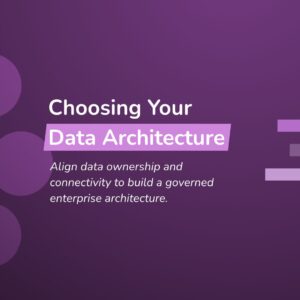
A modern data platform should separate architectural responsibilities so that new sources, processing methods and consumption requirements can be introduced without rebuilding the entire environment.
Reference architectures from AWS and Microsoft Azure commonly include ingestion, storage, processing, cataloguing, consumption, security and governance.
Storage may also be organised into raw, cleaned and curated zones, allowing teams to manage data through different stages of its lifecycle.
For most enterprises, designing the target architecture comes down to five questions:
- How does data arrive? Does the platform support batch ingestion, streaming and change data capture?
- Where does data land? Are raw, standardised and curated data zones clearly defined?
- How is data transformed? Are transformations documented, reusable and consistently managed?
- How is data understood and trusted? Can users discover data through cataloguing, lineage and quality controls?
- How is data consumed? Can the platform serve BI, data science, applications and AI workloads?
Each layer needs to work with the others without creating unnecessary dependencies.
Our detailed guide to Enterprise Data Platform Architecture: From Ingestion to AI Consumption explores how these components fit together within a modern enterprise environment.
For organisations planning more advanced AI workloads, AI-ready data architecture provides further context on the importance of data freshness, context, orchestration and governance.
Choosing Which Workloads to Modernize First
Not every workload should move at the same time. Some should be modernized early, while others require additional assessment or may no longer need to exist.
A practical selection framework evaluates each workload across four criteria.
| Criterion | Move early | Move later |
|---|---|---|
| Business value | Supports a visible business decision or revenue use case | Supports rarely used reporting |
| Complexity | Has relatively few upstream dependencies | Depends on multiple interconnected systems |
| Data risk | Has low sensitivity or well-defined controls | Involves highly regulated data requiring additional design |
| Reuse potential | Uses pipelines or models that other workloads can share | Relies on one-off data extracts |
Prioritising workloads with high business value and manageable complexity allows teams to validate the target architecture before taking on more complicated migrations.
We also recommend including at least one workload that matters to the business in the first phase. Moving only low-value jobs may demonstrate technical capability, but it does not necessarily prove the programme’s business value.
Some workloads may be better retired than migrated. Reviewing jobs, consumers and actual usage can reveal reports and processes that are no longer required.
This is where a structured assessment becomes useful. Edgematics’ Data & AI Maturity Assessment helps organisations evaluate their current capabilities across strategy, people, processes, technology and AI.
A clear Data Strategy also helps connect modernization priorities with business outcomes, ensuring that infrastructure investment supports the right use cases.
Reusable Pipelines and Unified Data Architecture
The economics of modernization depend heavily on reuse.
If every new data source requires a custom pipeline, the modern platform can recreate the same operational backlog that existed in the legacy environment.
Instead, enterprises should build pipelines using parameterised and metadata-driven patterns. This allows teams to onboard new sources through configuration rather than treating every integration as a separate development project.
Orchestration then acts as the control layer, coordinating pipeline execution, dependencies, transformations, quality checks and downstream consumption.
Our article on Enterprise Data Orchestration explains how orchestration connects individual pipelines into a coordinated data operating environment.
A unified data layer can further simplify how applications, analysts and AI workloads access information across different source systems.
At Edgematics, PurpleCube AI supports this unified orchestration approach. It brings data engineering and orchestration capabilities together to help enterprises manage complex data environments through reusable workflows.
Our guide to unified data orchestration platforms explores how this approach supports data integration, automation and activation.
In our experience, this approach can reduce effort by 50% to 60% from data discovery through data preparation to analytics. This is an Edgematics delivery claim, not an industry benchmark, and the outcome depends on how much of the existing environment can be standardised.
For enterprises modernising large ETL estates, our AI-powered data pipeline migration toolkit addresses the challenge of translating and validating legacy pipelines across modern platforms.
Embedding Governance from the First Phase
Governance introduced after migration often creates avoidable rework.
Teams may need to reconstruct lineage, reimplement access rules and identify quality requirements that should have been addressed during platform design.
A modern data platform should include governance as part of its architecture from the beginning.
Key capabilities include:
Automated Cataloguing and Lineage
Data catalogues help teams discover and understand available information. Lineage makes it possible to trace data from its source through transformations to its final consumption.
These capabilities should be maintained as pipelines execute rather than reconstructed manually during an audit.
Our guide to Enterprise Data Dictionaries explains how metadata, definitions and ownership help maintain consistency across enterprise data environments.
Data Quality Controls Within Pipelines
Quality rules should run as part of data processing. When a rule fails, the issue should be routed to an accountable owner rather than remaining hidden until it affects a report or downstream application.
Access Control and Encryption
Access permissions, classification and encryption requirements should be defined before sensitive data moves into the new environment.
Google Cloud’s enterprise data mesh blueprint illustrates how encryption at rest and in transit, alongside deployment controls, can be managed through CI/CD workflows.
Clear Decision Rights
Technology alone cannot establish accountability.
Organisations need to define who owns data, who approves access, who maintains quality standards and who is responsible when issues arise.
Our article on rethinking data governance for the AI era explores how ownership, lineage, quality and automated controls support trusted enterprise data.
For regulated industries, these capabilities have a direct operational benefit. Auditors can trace how information was produced, while teams can demonstrate that governance controls are part of the platform rather than an afterthought.
Migration Risks and How to Contain Them
Even a well-designed target architecture can fail if migration risks are not managed carefully.
| Risk | What it looks like | Mitigation |
|---|---|---|
| Silent data differences | Totals match, but edge cases do not | Reconcile data at row and aggregate levels before cutover |
| Hidden dependencies | An undocumented report or process breaks | Inventory dependencies and usage during assessment |
| Big-bang cutover | One weekend determines the success of the entire migration | Run systems in parallel and maintain a rollback path |
| Cost drift | Cloud expenditure exceeds the business case | Monitor usage and size workloads from the first phase |
| Governance gaps | Sensitive data enters environments without adequate controls | Define classification and access rules before migration |
| Change fatigue | Teams continue using old extracts and processes | Retire legacy feeds on a schedule and train consumers early |
The most effective defence is phased delivery. Each stage should have a defined scope, validation criteria and rollback option.
Our data modernization guide for regulated enterprises provides further context on building governed environments while managing legacy constraints.
A Phased Implementation Path
A structured implementation helps organisations manage complexity while delivering value throughout the programme.
1. Assess
Inventory existing data sources, pipelines, consumers, quality issues and compliance requirements. Define the target state and identify the gaps between the current and desired architecture.
2. Design
Agree on the reference architecture, governance model and workload migration priorities. Establish the standards that future phases will follow.
3. Build the Foundation
Set up the required landing zones, orchestration, catalogue, security controls and reusable pipeline patterns.
4. Move the First Workload Group
Select a valuable but contained set of workloads. Run the new and legacy paths in parallel, validate the results and then complete the cutover.
5. Scale in Phases
Use the patterns established in the first phase to move additional workloads. Retire legacy feeds as consumers transition to the new environment.
6. Optimise
Review performance and cloud costs, improve pipeline efficiency and extend the platform to support additional analytics, AI and agentic use cases.
The timeline depends on the size of the data estate, regulatory requirements and the number of heterogeneous sources involved. A first implementation phase may take several months, while a full enterprise programme can extend across multiple phases.
The right approach is to scope the timeline against the organisation’s actual environment rather than rely on a generic delivery estimate.
Where Edgematics Fits in Enterprise Data Platform Modernization
Enterprise modernization requires more than selecting a cloud platform or replacing legacy technology. It needs a coordinated approach across strategy, architecture, engineering, governance and AI delivery.
Edgematics brings these capabilities together to help enterprises move from fragmented data environments towards governed, reusable and AI-ready platforms.
Our Data Engineering & Governance practice covers architecture design, integration, pipeline modernization, data quality, cataloguing, lineage and compliance frameworks.
Our Data Strategy practice helps organisations prioritise business use cases, assess existing capabilities and define the operating model required to support modernization.
At the platform level, PurpleCube AI supports unified data orchestration across heterogeneous environments. It helps connect data engineering workflows, pipelines and governance capabilities.
For organisations extending their modernized data environment into agentic AI, Axoma supports governed AI workflows with defined controls and accountability.
These capabilities work together rather than as separate technology initiatives. The objective is to create a data environment where information can move reliably, remain governed and support analytics, AI and business operations.
Our Perspective
We see modernization fail when it becomes an infrastructure project owned only by IT. It succeeds when every phase connects to a business outcome, such as faster network monetisation decisions, more reliable regulatory reporting or improved access to trusted enterprise data.
Data flows smoothly only when ownership, quality and lineage are designed into the architecture. The platform is the nervous system; governance is what makes its signals trustworthy enough for AI to act on.
Start smaller than you want to, but build the foundation as if the entire enterprise will use it.
Edgematics Group
If your organisation is evaluating its existing data estate, we would welcome a conversation about where modernization should begin and which first workload group can demonstrate value.
Frequently Asked Questions
What is Enterprise Data Platform Modernization?
Enterprise Data Platform Modernization is the redesign of data infrastructure, architecture, tools, governance and operating practices to create a scalable and secure foundation for analytics and AI. Data migration is one part of the programme. The broader goal is to build a platform that is easier to extend, govern and trust.
What are the key layers of a modern data platform?
Common reference architectures include ingestion, storage, cataloguing and search, processing, consumption, security and governance. Storage is often organised into raw, cleaned and curated zones. Keeping these layers decoupled allows organisations to add new sources and tools without rebuilding the entire platform.
Which workloads should enterprises modernize first?
Start with workloads that support visible business outcomes, have manageable dependencies and carry acceptable data risk. Reusable pipelines that can support future workloads are also strong candidates. More complex or highly regulated workloads can follow once the architecture and governance patterns have been validated.
How can enterprises reduce risk during data platform migration?
Move in phases, reconcile data before each cutover, run legacy and modern systems in parallel and maintain a rollback option for every stage. Define data classification, access and governance requirements before sensitive information moves into the new environment.
How does data platform modernization support AI?
Modern data platforms improve data accessibility, quality, lineage, governance and processing capabilities. These are important for providing AI applications with reliable and relevant information. Modernization also helps enterprises build reusable pipelines and orchestration capabilities that support analytics, machine learning and agentic AI.