TL;DR:
- Developing an enterprise data strategy roadmap involves prioritizing governance, compliance, and foundational data controls before advanced analytics, supported by cross-functional teams and executive sponsorship. A thorough current-state assessment and continuous measurement ensure the roadmap remains aligned with business goals and regulatory requirements. Successful execution depends on embedding governance early and fostering data literacy across the organization to enable sustainable data-driven decisions.
An enterprise data strategy roadmap is a structured plan that sequences data initiatives over time in a measurable, achievable way, setting organizational direction before any technology selection begins. Building an enterprise data strategy roadmap transforms data ambitions into prioritized projects aligned with business goals, governance requirements, and regulatory obligations. For enterprise leaders in regulated industries, including healthcare, financial services, and life sciences, this is not a documentation exercise. It is the cognitive backbone of every data decision your organization will make. Done well, it connects executive vision to engineering execution, with compliance woven in from day one.
What are the foundational components of building an enterprise data strategy roadmap?
The first prerequisite is executive sponsorship. Organizations with top executives responsible for data management outperform peers financially, which means leadership commitment is not a soft requirement. It is a performance driver. Without a named executive owner, roadmap initiatives stall when they compete with operational priorities.
Before a single initiative is scoped, your team needs to conduct structured business interviews across functions. These conversations surface the data decisions that matter most to revenue, risk, and compliance. They also reveal where data is trusted and where it is not, which is equally important.
The structural prerequisites that most organizations underestimate are cultural and operational, not technical:
- A data-literate workforce that can interpret and act on data outputs
- Documented, repeatable business rules that govern how data is defined and used
- Organizational processes that are stable enough to be supported by data systems
- Clear ownership of data domains across business units
DAMA International warns that these prerequisites, not the strategy document itself, are the hardest part for organizations to achieve. A well-written roadmap sitting on top of undocumented processes and low data literacy will not deliver value. It will generate confusion.
Your data strategy foundation must also account for existing gaps: data silos across business units, inconsistent data definitions between systems, limited metadata visibility, and restricted access to critical datasets. These gaps become the inputs to your roadmap, not obstacles to starting it.
How to assess your current data landscape to inform roadmap planning
A thorough current-state assessment is the difference between a roadmap that reflects reality and one that reflects aspiration. TechTarget emphasizes focusing on business goals first, then mapping current environments and gaps including data silos and governance issues. The assessment translates that principle into deliverables.
Your assessment should cover four dimensions:
- Data sources and platforms: Catalog all systems of record, data warehouses, data lakes, and SaaS applications that generate or store data
- Integration and data flows: Document how data moves between systems, where transformations occur, and where lineage breaks down
- Analytics applications: Inventory reporting tools, BI platforms, and any ML models currently in production
- Governance and access controls: Identify who owns which data domains, what policies exist, and where enforcement gaps appear
The deliverables from this assessment typically include a data architecture diagram, a data inventory with quality ratings, and a gap analysis that maps current state against target capabilities. These three artifacts directly inform initiative prioritization in the roadmap.
| Assessment Area | Common Gaps Found | Roadmap Impact |
|---|---|---|
| Data sources | Undocumented shadow IT systems | Increases integration scope |
| Data governance | No defined data owners | Delays initiative sign-off |
| Data quality | Inconsistent field definitions | Requires remediation before analytics |
| Compliance controls | Missing audit trails | Blocks regulated use cases |
The gap analysis is particularly critical in regulated industries. A financial services firm building toward real-time risk reporting, for example, cannot skip the step of confirming that its source systems produce audit-ready data. Discovering that gap after analytics development begins is expensive. Discovering it during assessment is manageable.
What is the step-by-step process for developing and sequencing your roadmap?
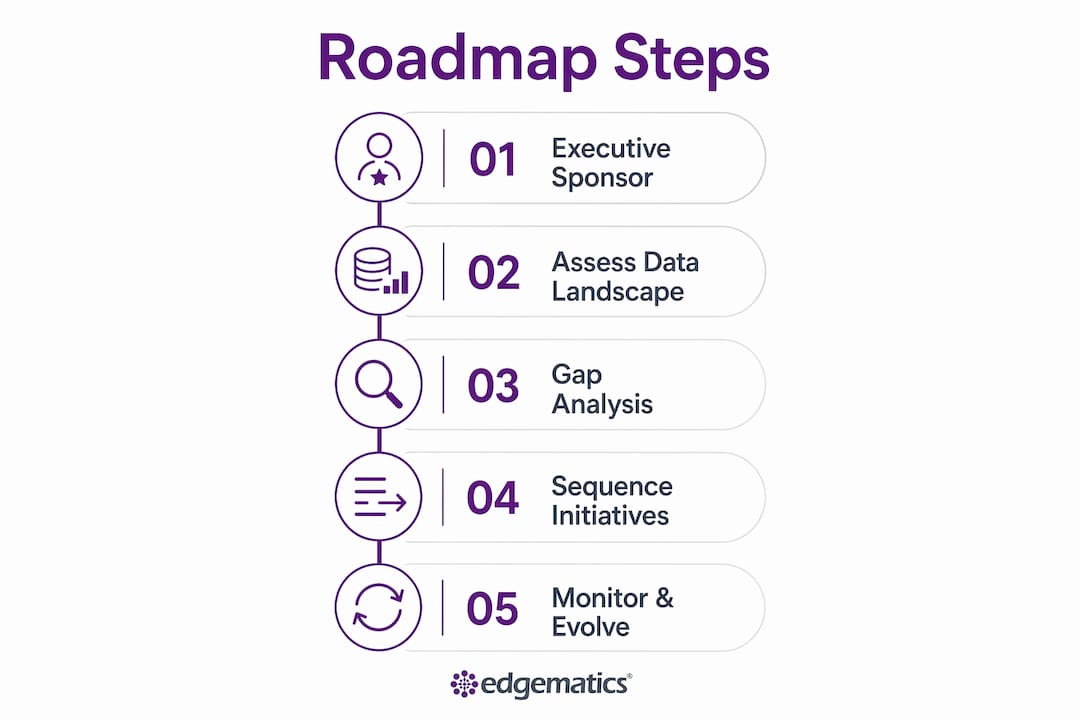
AWS prescriptive guidance recommends starting with executive sponsorship and business interviews, grouping prioritized initiatives into enablement projects based on impact and effort, and designing technical architecture only after the roadmap is established. That sequence matters. Architecture decisions made before business priorities are confirmed tend to be rebuilt.
Here is the process we recommend for regulated enterprises:
- Define business-driven objectives: Translate executive priorities into specific data outcomes. “Improve regulatory reporting accuracy” is a business objective. “Build a data catalog” is not.
- Identify critical data domains: Determine which data domains, such as customer, product, financial, or clinical data, are most central to your objectives. These domains anchor your governance and quality work.
- Group initiatives into enablement streams: Cluster related projects by capability area: data infrastructure, data governance, data quality, analytics, and AI readiness. Each stream has its own sequencing logic.
- Prioritize by value, effort, and dependency: Score initiatives on business impact, implementation effort, and technical dependencies. High-value, low-dependency projects belong in your first phase.
- Sequence compliance and foundational controls first: In regulated industries, sequencing data initiatives by value delivery, dependencies, and risk prevents compliance exposure as analytics scale. This is non-negotiable for life sciences organizations subject to 21 CFR Part 11 or financial firms under BCBS 239.
- Set phased timelines with milestones: A three-phase structure works well: foundation (months 1 to 6), capability build (months 7 to 18), and advanced analytics (months 19 to 36). Each phase should have defined exit criteria.
- Embed governance and security as continuous workstreams: These are not phases. They run in parallel across the entire roadmap lifecycle.
Pro Tip: Resist the pressure to put AI and advanced analytics in phase one. Organizations that build compliance foundations first avoid the costly rework of retrofitting governance onto production models.
| Approach | Governance timing | Analytics readiness | Compliance risk |
|---|---|---|---|
| Governance first | Embedded from day one | Slower initial delivery | Low |
| Analytics first | Retrofitted post-launch | Faster initial delivery | High |
| Parallel workstreams | Continuous | Balanced delivery | Moderate |
For most regulated enterprises, the governance-first approach delivers the most durable outcomes, even when it creates short-term pressure to show results faster.
Which teams are critical to executing the roadmap successfully?
Roadmap execution fails most often not because of poor planning but because of poor team design. AWS details that multifunctional teams including governance, security, engineering, and business roles are required to avoid late-stage rework and compliance gaps. The composition of your execution team is as important as the roadmap itself.
The core team for a regulated enterprise roadmap typically includes:
- Executive sponsor: Maintains organizational commitment and resolves cross-functional conflicts
- Data governance lead: Owns policy development, data stewardship programs, and compliance alignment
- Data engineering team: Builds and maintains pipelines, platforms, and integration layers
- Security and risk team: Defines access controls, encryption standards, and audit requirements
- Business analysts: Translate business requirements into data specifications and validate outputs
- Data scientists or analytics engineers: Design and validate analytical models and reporting layers
- Product or program manager: Coordinates delivery across streams and manages the roadmap timeline
Role clarity prevents the most common execution failure: governance and security requirements discovered late in a sprint cycle, forcing rework that delays delivery by weeks. When these roles are embedded from the start, their requirements shape architecture decisions rather than constrain them after the fact.
Edgematics has seen this pattern repeatedly in financial services clients. Integrating data engineering and governance as a unified team, rather than separate functions that hand off to each other, reduces delivery friction and accelerates compliance sign-off.
How to monitor, measure, and evolve your data strategy roadmap
A roadmap without measurement is a plan without accountability. Salesforce defines KPIs such as data accuracy rates, data adoption levels, and time-to-insight benchmarks as the primary tools for evaluating whether a data strategy is delivering against its objectives. These metrics connect technical outputs to business outcomes.
Your measurement framework should track four categories:
- Data quality metrics: Completeness, accuracy, consistency, and timeliness scores by domain
- Governance activity metrics: Number of active data stewards, policy coverage percentage, and issue resolution rates
- Usage and adoption metrics: Active users of data products, self-service query volumes, and report consumption rates
- Business outcome metrics: Reduction in regulatory findings, improvement in decision cycle time, and revenue or cost impact attributable to data initiatives
Continuous monitoring through dashboards and regular reviews allows teams to refine the strategy as regulations and technologies evolve. Quarterly roadmap reviews are the minimum cadence for regulated industries, where regulatory changes can shift priorities within a single reporting cycle.
Adapting the roadmap is not a sign of failure. It is evidence that the measurement system is working. When a new regulation requires changes to data retention or audit trail requirements, a well-governed roadmap absorbs that change as a scoped initiative rather than an emergency response.
A balanced data strategy maintains centralized governance for consistency while allowing decentralized operational autonomy for flexibility. This balance is especially relevant as organizations scale their data products across multiple business units with different regulatory profiles.
Key takeaways
Building an enterprise data strategy roadmap requires sequencing governance, compliance, and foundational data controls before advanced analytics, with multifunctional teams and executive sponsorship sustaining execution across every phase.
| Point | Details |
|---|---|
| Sequence compliance first | Build data integrity and audit controls before scaling analytics or AI capabilities. |
| Prerequisites determine success | Data literacy, documented processes, and executive sponsorship matter more than the roadmap document itself. |
| Assessment drives prioritization | A gap analysis across sources, governance, and quality directly informs initiative sequencing and realistic timelines. |
| Teams must be cross-functional | Embedding governance, security, and engineering together from day one prevents costly late-stage rework. |
| Measurement sustains relevance | KPIs tied to data quality, adoption, and business outcomes keep the roadmap accountable and adaptable. |
Our perspective on data strategy roadmaps in regulated industries
We have worked with organizations across financial services, healthcare, and life sciences, and the pattern we see most often is this: the roadmap is well-designed, but the execution team is assembled too late. Governance and security are brought in after the architecture is already set, and the result is months of rework that erodes confidence in the entire program.
The organizations that execute well treat governance, security, and data engineering as a single enablement stream from the first sprint. They do not sequence these as separate phases. They run them in parallel, with shared accountability and a shared definition of done.
The cultural dimension is equally underestimated. Data literacy is not a training program you run once. It is an ongoing investment in how your organization thinks about data as a business asset. The enterprises we see sustaining roadmap momentum are the ones that connect data outcomes to individual performance metrics, not just program dashboards.
For regulated industries specifically, the pragmatic advice is to resist the pressure to demonstrate AI capabilities before your data foundation is audit-ready. The compliance exposure from deploying models on ungoverned data is not theoretical. It is a regulatory finding waiting to happen. Build the foundation. Then scale.
How Edgematics can accelerate your data journey
At Edgematics, we specialize in helping regulated enterprises move from data strategy intent to execution. Our data strategy services cover roadmap development, business alignment workshops, and governance framework design tailored to your industry’s compliance requirements. For organizations ready to operationalize their roadmap, our data engineering and governance practice delivers the technical and organizational capabilities that turn strategy into production-grade data products. We have built governance excellence centers for leading financial institutions and supported life sciences firms in establishing audit-ready data foundations. Let’s build yours together.
Not sure where your data foundation stands? Take our free Data Readiness Assessment
FAQ
What is an enterprise data strategy roadmap?
An enterprise data strategy roadmap is a structured plan that sequences data initiatives over time, aligning them with business objectives, governance requirements, and compliance obligations. It sets direction for processes and capabilities before technology selection begins.
How long does it take to build a data strategy roadmap?
Most regulated enterprises complete an initial roadmap in 8 to 12 weeks, covering business interviews, current-state assessment, initiative prioritization, and phased sequencing. The roadmap itself is a living document that evolves through quarterly reviews.
Why does executive sponsorship matter for data strategy?
Organizations with executive-level data ownership outperform peers financially. Without an executive sponsor, roadmap initiatives lose priority when they compete with operational demands, stalling delivery and eroding stakeholder confidence.
What comes first in a regulated industry data roadmap?
Compliance and data integrity controls come first. Sequencing foundational controls before advanced analytics prevents regulatory exposure and avoids the costly rework of retrofitting governance onto production systems.
How do you measure data strategy success?
Success is measured through KPIs tied to data accuracy rates, governance coverage, user adoption, and business outcomes such as reduced regulatory findings or faster decision cycles. Regular reviews against these metrics keep the roadmap relevant as priorities shift.