TL;DR:
- Cloud migration means moving your applications, data, and infrastructure to the cloud while keeping security and compliance intact throughout, and the teams that get this right start with a real inventory of what they have, map every dependency, and understand the regulatory weight of each data type before anything moves, then choose the right mix of lift and shift, re-platforming, and re-architecting, backed by governance that runs the whole way through.
Cloud migration, at its core, is the process of moving enterprise applications, data, and infrastructure from on-premises or legacy environments into the cloud, without losing security, compliance, or operational continuity along the way. In regulated industries, financial services, healthcare, energy, that “without losing” part carries real weight. Governance frameworks, audit trails, and data lineage controls aren’t nice-to-haves you bolt on later. They’re what makes a migration defensible when a regulator asks how a piece of data moved and who touched it.
In our experience running these programs, the difference between a migration that succeeds and one that stalls is rarely the technology. It’s execution discipline. This guide shares what we’ve found matters most before, during, and after a cloud transition, the kind of thing that’s usually learned the hard way, so hopefully you don’t have to.
What prerequisites are essential before starting cloud migration?
If there’s one thing we’d tell any team starting this journey, it’s this: you can’t migrate what you haven’t mapped. The single most valuable early step is building a complete inventory of your current environment, every application, database, and integration point, then scoring each workload for cloud suitability, regulatory sensitivity, and business criticality.
A pre-migration assessment we would consider thorough covers:
Infrastructure and application inventory:
Document every server, service, and data store, including the shadow IT assets that rarely make it into official records. They’re almost always there.
Dependency mapping:
Identify which applications talk to each other, and in what order. Undocumented dependencies are, in our experience, the leading cause of cutovers that go sideways.
Compliance and data governance impact analysis:
Classify data by regulatory category (PII, PHI, financial records) and map each to its control requirement. This connects directly to how we think about data governance for regulated environments more broadly, the principles are the same whether the data sits on-premises or in the cloud.
Cloud suitability scoring:
Not every workload belongs in the cloud on day one. Latency-sensitive or tightly coupled legacy systems sometimes need re-architecting first.
Rollback procedures:
Validated and approved before anything moves. Non-negotiable in regulated environments, and worth insisting on even when timelines are tight.
Which migration strategies suit regulated enterprises best?
There are three primary strategies, and which one fits depends on the workload in front of you, not on which vendor is doing the talking.
Lift and shift (rehosting):
Move workloads with minimal changes. Fastest path, works well for stable, non-critical systems. Simple migrations of 10-20 servers typically wrap in 2-4 weeks.
Re-platforming:
Targeted changes that let you take advantage of cloud-managed services, swapping a self-managed database for a managed cloud equivalent, for instance, without rewriting application logic.
Re-architecting:
Redesigning applications to be cloud-native. Highest long-term value, but it asks the most of your time and budget. Complex enterprise migrations using this approach usually run 3-6 months.
For regulated industries, we’ve found wave-based migration planning to be the most reliable execution model. Group workloads into waves by risk level and dependency cluster, then move each wave through the same sequence: assess, prepare, migrate, validate, operate. Pairing this with rollback playbooks and KPI-driven governance gates tends to keep both risk and stakeholder nerves in check.
Hybrid and multi-cloud setups are common in regulated sectors, and for good reason. A bank might keep core transaction processing on-premises while moving analytics workloads to public cloud. That split just needs careful network segmentation and governance policies that stay consistent across both environments.
How do you maintain compliance and governance during migration?
Compliance isn’t a checkpoint you hit at the end, it’s a control that runs through every phase, continuously. The migration frameworks we trust most have clear decision rights, resource tagging standards, and chargeback controls that keep scope and cost visible the whole way through.
This is really where cloud migration consulting earns its keep, ongoing delivery oversight and governance that manages scope, risk, and security as the program moves, not after. Without it, migrations drift in scope, costs go untracked, and audit exposure builds up in ways that can take months to unwind.
The core governance controls we’d consider essential:
- Encryption in transit and at rest – Applied from the first workload moved, aligned to your regulatory framework, not retrofitted later.
- Network segmentation – Isolate workloads by sensitivity tier. A PII-bearing application should never share a network segment with a dev environment.
- Audit logging – Every configuration change, access event, and data movement logged and retained in a format your regulator will accept.
- Continuous compliance validation – Automated policy-as-code tools checking every deployed resource against your compliance baseline in real time. Manual audits simply can’t keep pace with cloud deployment speed anymore.
- FinOps alignment – Tag every resource at deployment so cost allocation maps to business units and regulatory domains. This is what keeps “cloud sprawl” from quietly eroding both budget and governance visibility
Security and compliance architecture works best when it’s built in from day one, encryption, segmentation, validation, all of it. Retrofitting these controls after the fact tends to cost more and leaves an exposure gap you’d rather not explain to an auditor.
What are best practices for post-migration optimization and handoff?
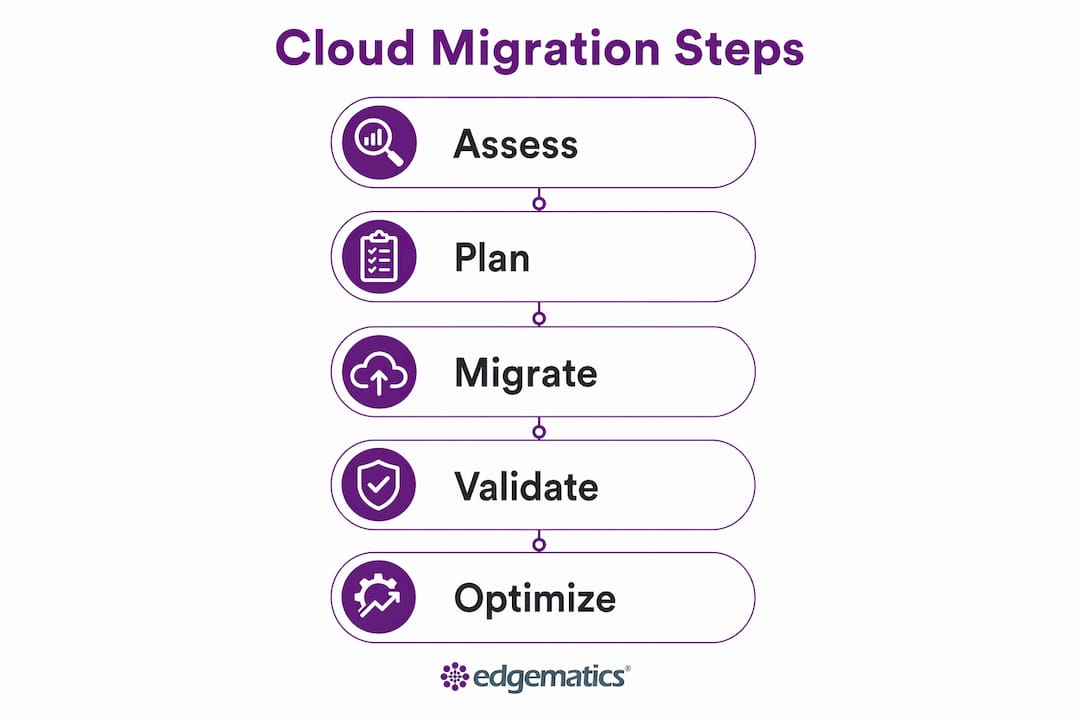
Finishing a migration and succeeding at one aren’t the same thing. Most operational issues surface in the weeks right after cutover, and how that window is managed tends to determine whether the migration actually delivers what it promised.
We’d point to a structured hypercare period of 30-90 days as the standard, a window where the migration team and operations team run in parallel, with clear escalation paths and daily performance reviews.
The activities that matter most during this stretch:
- Performance benchmarking – Compare cloud performance against pre-migration baselines for every critical workload, and close latency or throughput gaps before hypercare ends.
- Cost optimization – Costs often spike in the first 30 days while teams right-size instances and clear out over-provisioned resources. A FinOps review cadence from day one helps a lot here.
- Operational runbooks – Written for the operations team who’ll live with this environment day to day, not for the migration team who’s about to hand it off.
- Knowledge transfer – Structured handover sessions on architecture decisions, known issues, and escalation paths. Documentation is useful, but it doesn’t replace the conversation.
- Ongoing governance and monitoring – Automated alerting for compliance drift, cost anomalies, and performance degradation, set up before hypercare closes, not after.
Something we’d genuinely encourage: treat the post-migration period as a starting point, not a finish line. The organizations that get the most out of their cloud investment are the ones that use the new environment to progressively adopt managed services, event-driven architectures, and AI-ready data pipelines, rather than stopping once the lights are green.
It’s worth understanding how AI adoption in regulated industries connects to cloud readiness early, so the next phase of modernization is already part of the plan before hypercare even ends.
Key Takeaways
Successful cloud migration in regulated industries requires governance controls, dependency mapping, and a structured hypercare period to deliver compliance, stability, and long-term value.
| Point | Details |
|---|---|
| Assess before you migrate | Complete dependency maps and validated rollback procedures must exist before any workload moves. |
| Match strategy to workload | Lift and shift suits stable systems; re-architecting suits workloads that need cloud-native capabilities. |
| Governance is continuous | Encryption, audit logging, and compliance validation must be active from the first migration wave, not added later. |
| Plan for post-migration stability | A 30–90 day hypercare period with daily performance reviews prevents operational issues from becoming business incidents. |
| Migration enables modernization | Cloud infrastructure is the foundation for AI-ready data architecture and future operational capabilities. |
What we have learned from migrations in regulated sectors
The most common failure mode we’ve seen isn’t technical, it’s organizational. Cloud initiatives stall when stakeholders can’t agree on go/no-go decision rights before workloads move. Technology is rarely the bottleneck. More often, it’s a governance structure built for on-premises operations that never got updated for cloud velocity.
The second pattern we notice again and again: teams treat migration as a one-time project instead of a foundation. Organizations that see cloud transition as a destination tend to replicate their existing architecture in the cloud and stop there, moving the tech debt instead of addressing it. The ones who get the most from the investment treat migration as chapter one of a longer modernization story, one that connects AI-ready data architecture to the new cloud foundation from the outset.
If we had one recommendation, it’s this: build the governance model before you build the migration plan. Define who owns each decision, what the compliance checkpoints are, and how cost accountability will work once you’re in the cloud. That structure makes every phase after it faster and more predictable, and it gives your regulator a clear audit trail, which takes a fair amount of pressure off examination time.
How Edgematics supports regulated enterprises through cloud migration
At Edgematics, we work with regulated enterprises across North America, the UK, and the Middle East to design and execute cloud migrations that meet the governance and compliance standards their industries require. Our approach starts with a structured readiness assessment covering data classification, dependency mapping, and compliance gap analysis, before a single workload moves. We connect migration execution directly to our data engineering and governance frameworks, so the cloud environment you land in is already structured for AI readiness and audit defensibility.
If you’re planning a migration or taking stock of your current cloud strategy, we’d welcome the conversation. Take a migration readiness assessment to get started.
FAQ
What are cloud migration services?
Cloud migration services are the planning, execution, and governance activities that move enterprise applications, data, and infrastructure from on-premises or legacy systems to cloud platforms while maintaining security and compliance.
How long does a cloud migration take?
Timeline depends on scale and complexity. Simple migrations of 10–20 servers take 2–4 weeks, mid-market environments finish in 6–10 weeks, and complex enterprise migrations take 3–6 months.
What is the most important governance control during migration?
Audit logging and continuous compliance validation are the most critical controls. Every configuration change and data movement must be logged in a format that satisfies your regulator’s retention and access requirements.
What is a hypercare period in cloud migration?
A hypercare period is a 30–90 day post-migration window during which the migration team and operations team run in parallel to monitor performance, resolve issues, and complete knowledge transfer before full operational handoff.
How does cloud migration support AI adoption?
Cloud infrastructure provides the managed compute, storage, and data pipeline capabilities that AI and machine learning workloads require. Migrating with a governance-first architecture means your data is already structured for AI use cases when you are ready to build them.