TL;DR:
- Data trust is the organizational confidence that data is accurate, secure, and ethically governed to enable reliable decisions and AI outcomes. It relies on transparency, data quality, institutional signals, and governance structures to reduce risks and support compliance and AI initiatives. Building and operationalizing data trust enhances data sharing, regulatory readiness, and AI model integrity across complex, regulated industries.
Data trust is defined as the organizational confidence that data is accurate, secure, compliant, and ethically governed well enough to drive reliable decisions and AI outcomes. For business leaders in regulated industries, this confidence is not a soft aspiration. It is the operational foundation that determines whether your compliance programs hold up under audit, whether your AI models produce defensible outputs, and whether your customers continue sharing the data you need to grow. The Cisco 2026 privacy benchmark found that 99% of organizations report measurable benefits from privacy investments. That figure signals one clear reality: building data trust is now a direct input to business performance, not a back-office obligation.
What are the key components of data trust?
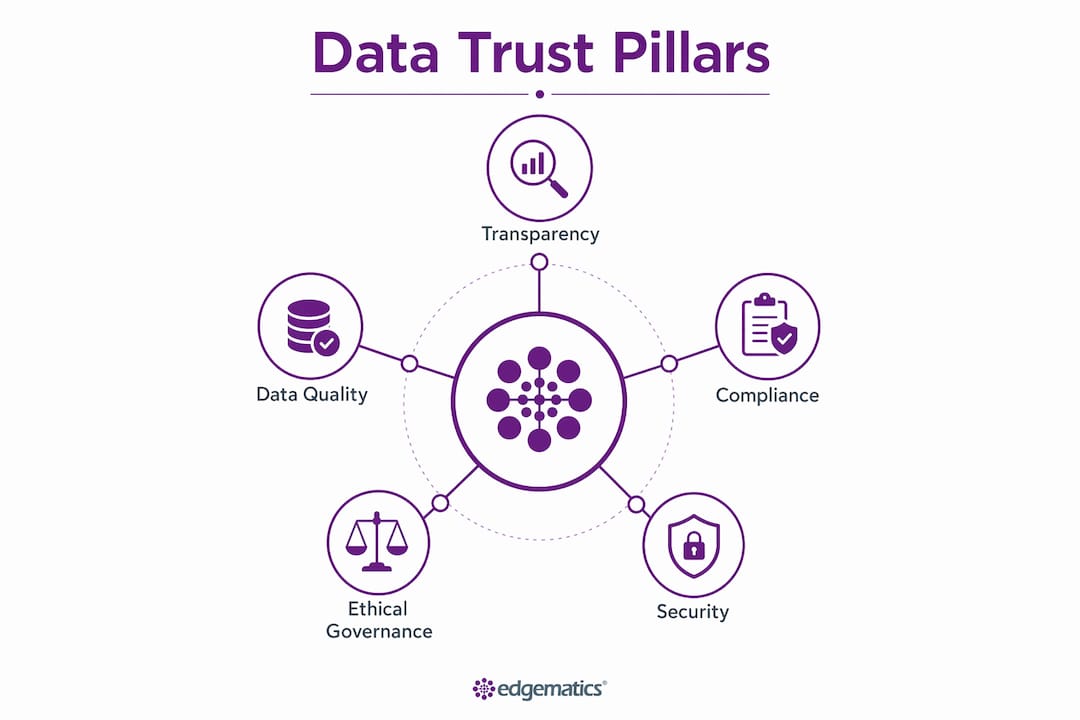
Data trust, known in governance circles as trustworthy data management, rests on four interconnected pillars: transparency, data quality, institutional signals, and governance structure. Each one reinforces the others. Weakness in any single pillar creates compounding risk across the rest.
Transparency is the most visible pillar. 46% of organizations identify clear communication about data usage as the top driver of customer trust, ranking above compliance and breach prevention. Transparency means publishing data collection policies in plain language, disclosing how data flows between systems, and giving users meaningful visibility into what is collected and why.
Data quality covers the dimensions of accuracy, completeness, timeliness, and consistency. Poor quality data does not just produce bad analytics. It creates liability. In regulated sectors like banking and healthcare, a single inaccurate record in a compliance report can trigger regulatory scrutiny.
Institutional trust signals matter more than most leaders realize. An empirical study of 400 users using PLS-SEM analysis found that experienced data users rely more on security certifications and corporate reputation than on transparency disclosures alone. ISO 27001 certification, SOC 2 Type II reports, and clear data warranties carry more weight with sophisticated stakeholders than a well-written privacy policy.
Governance structure determines how accountability is distributed. The choice between centralized and federated models has real consequences:
- Centralized governance sets enterprise-wide standards but creates bottlenecks when domain teams need to move fast.
- Federated (distributed) stewardship assigns accountability to domain experts who understand their data best, preventing bottlenecks while maintaining central policy alignment.
- Vendor governance is a frequently overlooked gap. Only 55% of organizations have contractual terms defining data ownership and liability with third-party vendors. That leaves nearly half exposed to supply chain data risk.
Pro Tip: Before selecting a governance model, map your data domains first. Organizations with more than five distinct data domains almost always benefit from federated stewardship over a single centralized team.
How does data trust impact compliance in regulated industries?
Compliance and data trust are not parallel tracks. They are the same track. Organizations that treat them separately end up with governance programs that look good on paper but fail under real audit conditions.
The compliance case for trustworthy data management comes down to operational linkage. Consider what happens during a DSAR (Data Subject Access Request) or an erasure request under GDPR or CCPA. If your consent records, document management system, and data usage logs are not unified, fulfilling that request requires manual cross-referencing across multiple systems. Fragmented data ecosystems make compliance costly and error-prone. The fix is not more staff. It is architectural: unified consent management linked directly to data lineage and usage tracking.
Here is how data trust directly supports four core compliance workflows:
- Audit readiness. Trusted data with documented lineage gives auditors a clear chain of custody. You can demonstrate what data was used, when, and under what consent.
- Regulatory reporting. Accurate, complete data reduces the risk of material errors in filings submitted to bodies like the FCA, OCC, or CMS.
- Erasure and portability requests. Unified consent and usage logs make it possible to locate and act on all instances of a data subject’s records without manual searches.
- Cross-border data flows. 81% of organizations still struggle to balance data localization demands against cost and security risks. A clear data residency policy, backed by trustworthy data management practices, is the only way to navigate this without constant legal review.
“Privacy regulation boosts consumer willingness to share data by increasing trust, acting as a growth engine rather than a hurdle.” — Harvard Business School research
That finding reframes the compliance conversation entirely. Regulations like GDPR and CCPA are not just cost centers. They are trust signals that, when met with genuine organizational commitment, increase the volume and quality of data customers are willing to share.
What role does data trust play in unlocking AI value?
Trusted data is the prerequisite for every AI initiative worth funding. AI models trained on inaccurate, incomplete, or poorly governed data do not just underperform. They produce biased outputs, create regulatory exposure, and erode the organizational confidence needed to scale adoption.
The MIT Technology Review 2026 report frames this clearly: privacy-led user experience treats consent as an ongoing relationship rather than a one-time checkbox. That distinction matters for AI. Continuous, granular consent means your AI models are trained on data that users have actively agreed to share for specific purposes. The result is higher data quality and a defensible audit trail for model governance.
The risks of skipping this foundation are concrete:
- Model bias from unrepresentative or historically skewed training data, particularly in credit scoring, insurance underwriting, and clinical decision support.
- Regulatory exposure when AI outputs cannot be explained back to a documented data lineage, as required under the EU AI Act’s high-risk system provisions.
- Consent violations when personalization engines use data beyond the scope of original consent, triggering enforcement action.
AI-powered data masking at ingestion is one of the most effective technical controls available. By masking personally identifiable information before it enters analytical pipelines, organizations protect sensitive data by default rather than by exception. This approach, highlighted in BFSI sector practice, reduces the blast radius of any downstream breach or misuse.
The interplay between trust, data, and AI is explored in depth in the Trust, Data and AI podcast from Edgematics, which unpacks how organizations can close the gap between AI ambition and governance reality. You can also watch the full conversation on
YouTube.
Pro Tip: Treat your AI governance framework as an extension of your data governance program, not a separate workstream. The lineage, quality, and consent controls you build for compliance are the same controls that make your AI outputs defensible.
What steps build and operationalize data trust?
Operationalizing data trust requires alignment across people, processes, and technology. The organizations that get this right do not build parallel governance bureaucracies. They embed stewardship into existing workflows, making trust a byproduct of how work gets done rather than an additional layer of overhead.
The following comparison shows where most organizations start versus where mature programs operate:
| Dimension | Early-Stage Programs | Mature Programs |
|---|---|---|
| Governance ownership | Central IT or compliance team | Federated domain stewards with central policy |
| Consent management | One-time collection at onboarding | Continuous, granular, linked to usage logs |
| Data quality monitoring | Manual spot checks | Automated quality rules in pipeline |
| Vendor accountability | Informal agreements | Contractual data ownership and liability terms |
| Success measurement | Audit pass/fail | Quality scores, efficiency metrics, compliance rates |
To move from early-stage to mature, follow this sequence:
- Secure executive sponsorship. Data trust programs without a C-suite champion stall at the first cross-functional conflict. The CDO or CTO must own the mandate publicly.
- Map your data domains. Identify which teams produce, consume, and are accountable for each critical data asset. This is the foundation for federated stewardship.
- Unify consent and lineage tracking. Connect your consent management platform to your data catalog and usage logs. Tools like OneTrust, Collibra, and Alation each address parts of this architecture.
- Automate quality controls. Embed data quality rules directly into ingestion pipelines using platforms like Great Expectations or Monte Carlo. Manual checks do not scale.
- Measure outcomes, not activities. Track data quality scores, DSAR fulfillment time, audit findings, and AI model accuracy. These metrics tell you whether your program is working.
Key takeaways
Data trust is the foundational requirement for compliance, AI adoption, and sustainable data value in regulated industries, and it is built through transparency, federated governance, and unified consent management.
| Point | Details |
|---|---|
| Transparency drives trust | 46% of organizations cite clear data usage communication as the top trust driver, above breach prevention. |
| Federated governance scales | Distributing stewardship to domain experts prevents bottlenecks and improves accountability across complex data ecosystems. |
| Compliance and trust are linked | Unified consent, lineage, and usage logs are the operational backbone for DSAR fulfillment and audit readiness. |
| AI requires trusted data | Privacy-led UX and AI-powered masking at ingestion protect data quality and model defensibility from the start. |
| Vendor gaps create risk | Only 55% of organizations have contractual terms defining data ownership with third parties, leaving significant exposure. |
Data trust as a growth signal, not just a compliance checkbox
We have worked with organizations across banking, healthcare, and financial services long enough to recognize a pattern. The teams that treat data trust as a compliance obligation consistently underinvest in it until something goes wrong. The teams that treat it as a growth signal build programs that compound in value over time.
The Harvard Business School finding that privacy regulation increases consumer data sharing is the clearest evidence we have seen that this reframing is correct. Customers share more data with organizations they trust. More data means better AI models, more accurate personalization, and stronger competitive positioning. The causal chain is direct.
What we find most underappreciated is the role of sustained transparency. Most organizations disclose their data practices once, at onboarding, and consider the job done. But trust is not a one-time event. It is a continuous signal. Organizations that communicate data usage changes proactively, that give users ongoing control, and that treat consent as a relationship rather than a transaction consistently outperform peers on data quality metrics.
The hardest problem we see is fragmented data ecosystems, particularly in organizations that have grown through acquisition. When consent records live in one system, usage logs in another, and document management in a third, the cost of compliance is structural. AI-powered masking and unified data catalogs are not nice-to-have investments in that context. They are the only path to a defensible governance posture at scale.
Federated stewardship, paired with central policy standards, is the model we consistently recommend. It scales with organizational complexity in a way that centralized teams simply cannot. And as AI complexity increases, the need for domain experts who understand both the data and the business context will only grow.
Build data trust with Edgematics
If the frameworks in this article resonate with challenges you are working through, Edgematics has the depth to help you move from concept to operating program. Our data engineering and governance solutions cover the full architecture: consent management integration, data lineage, quality automation, and federated stewardship design. We have built governance centers of excellence for regulated institutions, including a pan-American bank navigating complex cross-border data requirements. For a deeper look at how trust, data, and AI connect in practice, our expert podcast series is a good starting point. If you would like to explore what a data trust program could look like for your organization, we would welcome that conversation.
FAQ
What is data trust in simple terms?
Data trust is the confidence that data is accurate, secure, and used in ways that are compliant and ethical. It is the foundation that makes data reliable enough to support decisions, AI models, and regulatory reporting.
Why does data trust matter for AI initiatives?
AI models trained on poorly governed or inaccurate data produce biased outputs and create regulatory exposure. Trusted data, backed by documented lineage and consent, is the prerequisite for defensible AI at scale.
How do privacy laws affect data trust?
Harvard Business School research shows that privacy regulation increases consumer willingness to share data by building trust. Compliance with laws like GDPR and CCPA functions as a trust signal that drives more and better data sharing.
What is federated data governance?
Federated governance distributes data stewardship responsibility to domain experts while maintaining central policy standards. This model prevents bottlenecks and improves accountability in organizations with complex, multi-domain data ecosystems.
How do you measure data trust program success?
Mature programs measure outcomes rather than activities. Key metrics include data quality scores, DSAR fulfillment time, audit findings per cycle, and AI model accuracy rates tied to data lineage documentation.