Your CRM shows one customer record. Billing shows another. Network inventory uses a different address, and the finance report tells a different story.
When enterprise systems cannot agree on the same information, teams spend valuable time reconciling records instead of using data to make decisions. Reports conflict, integration projects become harder to maintain, and AI initiatives struggle to access reliable business context.
These problems rarely come from one broken application. They develop over time as organizations add platforms, acquire businesses, migrate workloads and build separate data processes across departments.
Edgematics helps enterprises address these challenges by connecting data engineering, governance and orchestration. Rather than replacing every system, the approach focuses on making existing environments work together, standardizing critical data and establishing the controls needed for reliable analytics and AI.
Through its work across telecommunications, banking and other enterprise environments, Edgematics combines integration architecture, data quality, metadata, lineage and automation to address fragmentation at its source.
The goal is not simply to connect more systems. It is to make enterprise data consistent, traceable and useful across the business.
TL;DR
-
- Fragmented data systems create duplicate records, conflicting reports, manual reconciliation and delays in business decisions.
- Edgematics addresses fragmentation through data strategy, data engineering, governance and unified data orchestration.
- Shared identifiers, consistent definitions, governed pipelines and data lineage help connect systems without requiring an immediate replacement programme.
- PurpleCube AI supports data orchestration, quality and integration across complex enterprise environments.
- Edgematics’ enterprise delivery experience demonstrates how standardized data models, automated validation and traceable pipelines can reduce integration friction.
- The right starting point is to identify where fragmentation affects business outcomes, then connect and govern the most important data flows first.
What Are Fragmented Data Systems?
Fragmented data systems occur when applications, databases and pipelines hold related business information separately, without enough shared definitions, identifiers, integration or governance to make that information work together.
A customer record might appear in a CRM, billing platform and support application. Each system serves a valid business purpose, but the enterprise may lack a reliable way to connect those records and establish a consistent customer view.
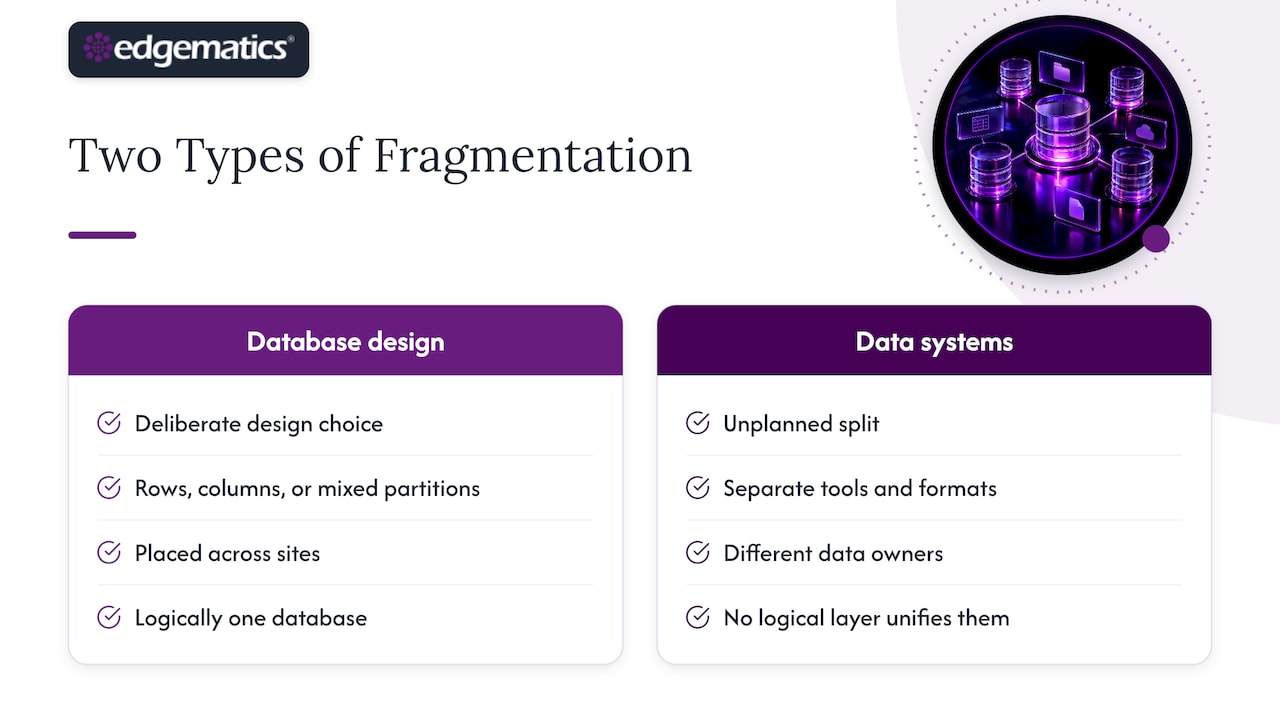
It is important to distinguish this problem from database fragmentation. Database engineers can deliberately partition data across locations while preserving one logical database. Enterprise data fragmentation is different: separate systems often evolve independently, leaving the business to reconcile their differences.
Data silos are one common result. They limit how readily departments can share information, reuse trusted datasets and answer cross-functional questions.
The challenge becomes more serious as enterprises add cloud platforms, acquire businesses, modernize legacy systems and introduce AI applications that need context from several sources.
How Fragmented Data Systems Affect Enterprise Operations
Fragmentation usually appears as a business problem before anyone identifies the underlying architecture issue.
Duplicate records and conflicting identifiers
Different applications may assign separate identifiers to the same customer, product, account or network asset. Without agreed matching rules, teams struggle to determine which records belong together.
For a fibre operator, this can affect network inventory, address validation, customer onboarding and acquisition integration. The business may need to reconcile records manually before it can make an operational decision.
Inconsistent reports
Finance and commercial teams may report different revenue figures because they use different definitions, filters or refresh schedules. Both reports may be internally correct, yet neither provides a consistent enterprise view.
Meetings then focus on reconciling numbers instead of deciding what to do next.
Manual data preparation
Analysts often export records, match identifiers in spreadsheets and request corrections from multiple teams. This work consumes time, introduces new errors and makes results difficult to reproduce or audit.
In regulated environments, undocumented reconciliation can also weaken confidence in reporting controls.
Delayed business decisions
Cross-functional questions become expensive when each answer requires a new data pull. Leaders may struggle to evaluate customer value, investigate revenue leakage, identify risk or assess operational performance in time to act.
Edgematics explores this broader challenge in its article on unified data orchestration and the enterprise integration crisis. The central issue is not simply the number of tools an organization owns. It is the lack of coordination between them.
How Fragmentation Affects Enterprise Performance
The impact becomes visible when business teams need information from more than one system.
Duplicate customer, product or asset records make it difficult to establish a consistent view. Different definitions and refresh schedules produce competing reports. Manual exports and spreadsheet reconciliation introduce errors and make results harder to reproduce.
These problems also increase the effort required to launch new analytical products. Teams must first determine which source to use, reconcile discrepancies and document the transformations before they can begin analysis.
For telecom operators, fragmentation can complicate network inventory management, customer analysis and acquisition integration. Banks face similar challenges when they need consistent customer, transaction and risk information across business units or jurisdictions.
Edgematics’ work addresses these connected challenges through data integration, standardized models, automated quality controls and governance. The focus is on reducing the manual effort required to make information usable while maintaining the traceability that enterprise teams need.
Why Enterprise Data Systems Become Fragmented
Understanding the causes helps organizations choose the right response.
Separate teams create separate data models
Business units often select applications and define processes around their individual priorities. Over time, they may use different identifiers, formats and definitions for the same business entity.
A new integration tool will not resolve these differences on its own. Teams need shared definitions, clear data ownership and agreed rules for managing changes.
Legacy platforms create complex dependencies
Long-running enterprises often depend on systems built at different times with different technologies. Point-to-point integrations can solve immediate requirements, but every additional connection creates dependencies that teams must maintain.
Edgematics’ Data Engineering & Governance practice brings together architecture, integration, pipeline engineering, metadata, lineage and quality management to help enterprises address these dependencies systematically.
Mergers and acquisitions introduce new data environments
Acquisitions bring different inventory models, identifiers, applications and operating processes into the same organization. Without a repeatable integration approach, the acquired environment may remain disconnected long after the transaction closes.
Edgematics has addressed this challenge in fibre network environments by developing automated migration pipelines and a conformed data model that standardizes incoming acquisition data before it reaches the target operational system. This work demonstrates how enterprises can separate source-system complexity from the systems that consume the resulting data.
The AI-powered inventory migration engagement is one example of how Edgematics applies integration engineering, validation and lineage to a complex enterprise problem.
Cloud migration can preserve existing silos
Moving data to the cloud does not automatically create a connected environment. If organizations copy inconsistent definitions, unclear ownership and disconnected pipelines into a new platform, the same problems continue.
A successful modernization programme needs to address the data model, integration patterns and governance controls alongside infrastructure.
How Edgematics Finds and Addresses Integration Gaps
Edgematics begins with the business problem and works back through the data flows that support it. This helps teams identify where disconnected systems, inconsistent definitions or manual processes create the greatest friction.
Identify the business questions that matter
Start with a few questions that depend on data from multiple systems. These might involve customer profitability, revenue leakage, network expansion or risk reporting.
Edgematics’ data strategy work helps organizations connect these priorities with their data architecture and operating model. Instead of integrating every available source at once, teams can focus on the information needed to deliver specific business outcomes.
Trace the data from source to decision
Map the systems, transformations, identifiers and manual handoffs involved in answering each question. Look for places where definitions change, records fail to match or teams maintain separate versions of the same information.
This reveals whether the main obstacle comes from technology, data quality, governance or unclear ownership.
Standardize the data before connecting it
A reliable integration needs a shared understanding of the information moving between systems. That includes common identifiers, consistent business definitions and validation rules that check incoming records.
Edgematics uses conformed data models and governed integration patterns to separate differences in source systems from the structures required by downstream applications. This approach helps organizations integrate new sources without rebuilding the entire target environment for every connection.
Automate validation and traceability
Manual checks become difficult to maintain as data volumes and integration dependencies grow. Automated validation can identify missing fields, inconsistent formats and invalid identifiers before they affect downstream reporting or operations.
Metadata and lineage provide another layer of control by recording where data came from and how it changed. Together, these capabilities help teams investigate problems and understand the impact of changes across the environment.
Measure the result
The assessment should establish a baseline for reconciliation effort, time to answer business questions, data quality issues and pipeline reliability.
Edgematics can then help prioritize improvements based on business value, risk and technical dependencies. This keeps the work focused on measurable progress rather than the number of systems connected.
Connecting Enterprise Data Through PurpleCube AI
Fragmentation becomes harder to manage when every pipeline, platform and consumer follows a different integration pattern. Teams need a way to coordinate data movement while maintaining quality, metadata and governance.
PurpleCube AI is Edgematics’ unified data orchestration platform. It supports the coordination of data workflows across heterogeneous enterprise environments, helping connect integration, transformation, validation and downstream delivery.
Rather than treating every data flow as an isolated connection, enterprises can work toward a more consistent approach to managing how data moves through their systems.
This matters when organizations need to integrate new sources, modernize legacy environments or prepare trusted information for analytics and AI. The objective is to create a governed way to access and use data without requiring every source to move into one physical repository.
Edgematics explores this approach in its guide to automating enterprise data operations with AI, which discusses how automation, validation and governance can work together across data workflows.
What Edgematics’ Enterprise Work Demonstrates
Edgematics’ delivery experience reflects a consistent approach to fragmentation: standardize the data, automate the integration and maintain control over the information as it moves.
In fibre network environments, this has involved creating repeatable processes for integrating acquired network inventory, validating records and maintaining traceability into operational systems. The published inventory migration engagement reports four times faster onboarding of accurate inventory data, alongside automated loading and end-to-end lineage.
Edgematics has also applied data quality and governance capabilities in banking environments, where teams need consistent, compliant and auditable information across complex operations. Its work includes establishing a Data Governance and Quality Centre of Excellence and applying validation at ingestion to identify anomalies before they reach downstream systems.
In retail, Edgematics has addressed data duplication and accuracy challenges across a product catalogue containing more than one million items. These challenges reinforce the importance of consistent definitions and quality controls, not just technical connectivity.
Across these engagements, the same capabilities come into play: data modelling, integration engineering, automated quality checks, governance and traceability. Their combination helps enterprises reduce the manual work required to reconcile information and establish a more dependable view across systems.
Explore Edgematics’ enterprise case studies to see how these capabilities apply across different industries and data environments.
Why Fragmented Data Becomes a Bigger Challenge for AI
AI applications depend on the information they can access and the context they receive. When customer records conflict, business definitions differ or data remains trapped in separate systems, AI outputs can become incomplete or misleading.
Agentic AI introduces another requirement: systems must respect the permissions and policies that govern the information they retrieve. Enterprises need to know which sources an agent can access, how it interprets business terms and how teams can review its activity.
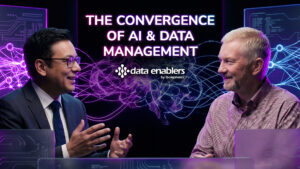
These issues featured in Edgematics’ Data Enablers discussion, Rethinking Your Data Strategy in 2026 and Beyond, where CEO Bharat Phadke and COO Rushikesh Kulkarni discuss the role of fragmented data, operational friction and governance in enterprise AI adoption.
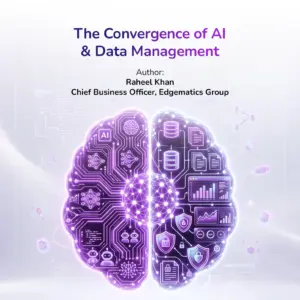
The same theme appears in The Convergence of AI and Data Management. The conversation explores why organizations need to connect AI initiatives with data management rather than treating them as separate priorities.
For Edgematics, the implication is practical: enterprises need to connect and govern their data before they can expect AI applications to use it reliably. Integration, data quality, metadata and controlled access are therefore part of AI readiness, not separate tasks to postpone until later.
A Practical Approach to Fixing Fragmentation
Enterprises can address fragmented data in stages while keeping critical operations running.
1. Prioritize high-value use cases. Identify the business questions that require data from multiple systems and select the most important integration gaps.
2. Agree on identifiers and definitions. Establish consistent keys for customers, accounts, products and assets. Assign ownership for business terms and data quality.
3. Connect priority data flows. Build governed pipelines that move and transform the required information while applying appropriate validation and access controls.
4. Establish metadata and lineage. Make data origins, transformations, owners and quality indicators visible so teams can investigate issues and understand downstream impact.
5. Create a unified access layer. Give applications, analysts and AI workloads a consistent way to access governed data while allowing underlying systems to continue operating.
6. Modernize in phases. Retire or replace legacy systems when business needs and technical readiness justify the change, rather than making a complete replacement the starting point.
7. Monitor and improve. Track data quality, pipeline reliability, reconciliation effort and the time required to answer priority business questions.
Edgematics’ approach combines these steps through data strategy, engineering, governance and orchestration. This helps organizations improve connectivity while maintaining the controls needed for reliable enterprise data.
Edgematics Perspective: Connect Before You Consolidate
Fragmentation does not always require a wholesale platform replacement. In many environments, enterprises can make meaningful progress by connecting priority systems, standardizing critical data and embedding governance into the integration process.
Edgematics brings together the architecture, engineering and governance capabilities needed to make this possible. PurpleCube AI supports orchestration across data workflows, while the Data Engineering & Governance practice addresses integration, quality, metadata, lineage and compliance. Data strategy connects these technical choices with business priorities.
This approach helps enterprises move away from isolated fixes toward a more consistent way of managing data across systems. It also provides a stronger base for analytics and AI because teams can trace information, understand its meaning and apply appropriate controls.
The priority is not to connect every system for its own sake. It is to remove the integration barriers that slow decisions, increase risk and prevent the business from using its data effectively.
Where Edgematics Can Help
If your teams regularly reconcile conflicting reports, maintain manual data pipelines or struggle to connect information across legacy and cloud systems, the issue may extend beyond individual applications.
Edgematics helps enterprises identify integration gaps, design connected data architectures, build governed pipelines and coordinate data workflows through PurpleCube AI.
The Data Engineering & Governance practice provides support across architecture, integration, quality, metadata, lineage and governance. For organizations that need to establish priorities first, the Data & AI Maturity Assessment offers a starting point for identifying capability gaps.
The outcome is a more connected data environment where information can move between systems with consistent meaning, appropriate controls and clear traceability.
Frequently Asked Questions
What are fragmented data systems?
Fragmented data systems are applications, databases and pipelines that hold related information separately without enough shared identifiers, definitions, integration or governance. This makes it difficult to combine data and establish a consistent enterprise view.
How does Edgematics help fix fragmented data systems?
Edgematics combines data strategy, data engineering, governance and unified data orchestration. Its work includes integration architecture, standardized data models, automated validation, metadata, lineage and PurpleCube AI to help enterprises connect data across complex environments.
Do enterprises need to replace legacy systems to fix fragmentation?
No. Organizations can connect priority data flows, standardize definitions and introduce governance before deciding which legacy platforms to retire. A phased approach helps reduce migration risk and keeps critical operations running.
What role does unified data orchestration play?
Unified data orchestration coordinates data movement, transformations, validation and delivery across different systems. It helps enterprises manage connected workflows rather than maintaining each integration as an isolated process.
Why does fragmented data affect AI?
AI systems need relevant, consistent and reliable information. Fragmented data can create conflicting answers, missing context and unreliable outputs. Shared definitions, governed access and traceable data flows help improve AI readiness.
How can an enterprise measure progress?
Track the time required to answer cross-domain questions, manual reconciliation effort, data quality issues, pipeline reliability, lineage coverage and the share of critical datasets with clear ownership. These measures help connect technical improvements to business outcomes.