Introduction
Most enterprises do not have a shortage of dashboards.
They have a shortage of trusted, contextual, actionable insight.
Organisations invest in business intelligence platforms, expand their reporting environments, and create dashboards for every function. Yet business users still spend time reconciling numbers, asking where a metric came from, finding the right dataset, and waiting for data teams to answer questions that should already be self service.
That creates a frustrating contradiction.
The enterprise has more BI than ever, but getting from a business question to a confident answer can still take hours or days.
The problem is often not the BI platform.
It is the environment underneath it.
Data ownership, quality, semantics, lineage, discoverability, integration, and operating models determine whether BI can actually deliver insight. The source material for this article points to the same pattern: data teams and analysts lose time searching for trusted metrics, reconciling conflicting definitions, revalidating datasets, and finding the business context behind fields.
This is where the conversation needs to move beyond dashboards.
TL;DR
- BI tools can only be as useful as the data, definitions, and context they sit on top of.
- Governance, ownership, semantics, lineage, and data quality are often the real causes of slow or conflicting insight.
- Self service BI can increase inconsistency when users are given access without certified datasets and shared business definitions.
- A stronger enterprise data architecture can make data easier to discover, trust, reuse, and activate.
- Edgematics brings together Data Strategy, Data Engineering & Governance, AI and Machine Learning, Intelligent Process Automation, and Agentic AI to address the layers underneath BI.
- The next step beyond dashboards is not necessarily replacing BI. It is creating an environment where trusted data can support analytics, AI, and action.
Why Your BI Still Isn’t Delivering the Insights You Need
The first mistake is assuming that more visualisation automatically means more intelligence.
A dashboard can present revenue by region, customer churn by segment, pipeline by stage, or operational performance by business unit. But the visualisation does not tell you whether the underlying numbers are complete, current, consistently defined, or correctly governed.
A business user might see a revenue figure of ₹50 million in one report and ₹47 million in another.
The obvious question is which dashboard is wrong.
The more important question is why the enterprise allowed two dashboards to define revenue differently in the first place.
That is not a dashboard problem.
It is a data problem.
The Data Behind the Dashboard Is Often the Real Bottleneck
Enterprise data is rarely located in one clean environment.
Customer information can exist across CRM platforms, operational systems, billing applications, data warehouses, and support platforms. Financial metrics may depend on several source systems and different transformation processes. Operational information may arrive through APIs, databases, event streams, or unstructured sources.
BI brings these datasets into a user facing experience.
It does not automatically make them consistent.
The source highlights several recurring causes of poor insight generation: undefined metrics, missing business context, weak ownership, incomplete lineage, unstructured data that remains difficult to use, and batch processes applied to questions that need more current information.
This means the real BI question is not:
Which dashboard should we build?
It is:
Can the underlying data support a trusted answer?
Data Quality Is Not Just an Accuracy Problem
Data quality is often discussed as whether a field contains the right value.
That is only one part of the issue.
A dataset can technically contain accurate values and still be difficult to use because it lacks ownership, context, freshness, lineage, or a clear definition.
Consider a metric called “active customer.”
Does that mean a customer who purchased in the last 30 days?
A customer with an open account?
And a customer who logged in during the quarter?
A customer with an active subscription?
All four definitions can be technically valid.
Only one may be valid for the business question being asked.
This is why data quality needs to be treated as a business capability, not simply as a technical validation exercise. Edgematics’ approach connects quality to ownership, semantic definitions, data products, pipelines, observability, and measurable business outcomes.
The goal is not merely cleaner data.
It is data that can be confidently used to make a decision.
Ownership Gaps Quietly Destroy Trust
Data governance becomes ineffective when nobody owns the definition of the data.
Technology teams can enforce schemas and maintain pipelines, but they cannot independently determine what a business metric should mean.
That is a business ownership question.
When ownership is unclear, the same metric begins to evolve differently across functions.
Finance may define revenue one way.
Sales may define it another.
Marketing may use a third version.
The BI layer then becomes the place where those disagreements become visible.
The source identifies conflicting metrics, undocumented changes, unclear field origins, and even versioned spreadsheets being treated as sources of truth as common signs of ownership breakdown.
A strong BI environment therefore needs more than a technical owner.
It needs domain ownership.
Why the Semantic Layer Matters
One of the biggest gaps between raw enterprise data and useful insight is semantics.
A semantic layer gives business meaning to data.
It establishes what metrics mean, how dimensions relate to one another, which definitions are approved, and how those definitions should be consistently understood across analytical consumers.
Without that layer, every report or analytics team has to interpret the underlying data independently.
That creates duplication.
It also creates disagreement.
The source describes the semantic layer as the mechanism that sits between raw data and downstream reporting, giving terms such as “active user” or “qualified pipeline” a consistent meaning.
For modern enterprises, the semantic layer also becomes increasingly relevant to AI.
A human analyst can ask a colleague what “revenue” means.
An AI system cannot rely on that conversation every time.
It needs machine readable definitions and context.
Edgematics’ recent work on AI ready data architecture explores this broader requirement, including the role of metadata, lineage, semantic layers, and contextual information in making enterprise data usable for AI.
Lineage Turns a Number Into Evidence
Trust requires more than a definition.
It requires traceability.
When a business leader sees a figure in a dashboard, they should be able to understand where that number came from.
Which source systems contributed to it?
Which transformations were applied?
When was the data last refreshed?
Which rules changed it?
Who owns the source?
Lineage provides that visibility.
Without it, every unexpected number creates an investigation.
With it, the user can trace the number back through its transformation path.
This is especially important as analytics becomes increasingly connected to automation and AI. A business user may want to verify a report, while an AI system may need to understand whether a dataset is authoritative and how recently it changed.
The need is the same.
The data must carry its own trust signals.
More Self Service Does Not Automatically Mean More Insight
Self service BI is often positioned as the answer to an overloaded analytics team.
Sometimes it is.
But self service without governance can simply distribute the problem.
The source identifies two recurring failure patterns.
In one, every request continues to pass through a central governance or data team, recreating the original bottleneck.
In the other, business users create their own datasets, metrics, and dashboards, leading to multiple competing versions of the truth.
The answer is not to remove self service.
It is to give self service a governed layer to operate on.
Certified datasets, shared definitions, searchable metadata, clear ownership, and automated lineage allow business users to work independently without reinventing the underlying data logic.
That is where self service becomes useful rather than chaotic.
Why Replacing the BI Tool Often Misses the Point
A new BI platform can deliver better visualisation, faster query performance, improved collaboration, or stronger user experience.
Those things can matter.
But none of them define what a metric means.
None of them assign a data owner.
And none of them repair missing lineage.
None of them resolve a duplicate customer record.
None of them turn an undocumented transformation into a governed business rule.
The source makes this distinction explicitly: platform changes should follow improvements in governance, ownership, semantics, and lineage, rather than being used as a substitute for them.
That does not mean legacy technology never becomes the constraint.
It means enterprises should identify the actual constraint before changing the tool.
What the Modern Data Environment Behind BI Should Provide
A stronger BI environment needs several capabilities working together.
Trusted Data
Critical datasets should have defined quality controls, freshness expectations, ownership, and certification.
Consistent Meaning
Business terms and metrics should have shared definitions that can be reused across reporting, analytics, and AI.
Discoverability
Users should be able to find the right dataset without knowing which system physically stores it.
Lineage
The origin and transformation history of important data should be visible.
Governed Self Service
Business users should be able to explore and use data without creating uncontrolled copies of business logic.
Automation and Observability
Data pipelines should be monitored for quality, freshness, failures, schema changes, and anomalies rather than relying on manual checks.
These capabilities turn BI from a presentation layer into part of a broader data operating environment.
Where Edgematics Fits
This is where Edgematics approaches the problem differently from a dashboard first conversation.
The focus is on improving the data environment that produces the insight.
Data Strategy
Edgematics’ Data Strategy capability connects data initiatives with business priorities.
Instead of beginning with a technology selection, the work starts with the business questions that need better answers and the data capabilities required to support them.
That distinction matters.
A data strategy should not exist as a document separate from implementation.
It should define what data capabilities the organisation needs to make better decisions.
Data Engineering & Governance
The next layer is the infrastructure and governance required to make those decisions possible.
Edgematics’ Data Engineering & Governance capability spans data pipelines, integration, quality, cataloguing, lineage, governance, and compliance.
This addresses the underlying issues that BI platforms cannot solve on their own.
The objective is to make trusted data consistently available to the consumers that depend on it.
AI and Machine Learning
Once data is governed and usable, organisations can move beyond descriptive analytics.
Edgematics’ AI and Machine Learning capabilities support predictive and AI driven use cases built on the same governed data environment.
That progression is important.
The enterprise should not need to create one data architecture for BI and another disconnected environment for AI.
Intelligent Process Automation
Insights become more valuable when they influence processes.
Edgematics’ Intelligent Process Automation capability connects data and analytics to operational workflows so the organisation can move from understanding an event to responding to it.
This is where the distinction between insight and action becomes important.
Agentic AI
The next step is governed autonomous execution.
Axoma brings agentic AI into enterprise workflows where systems may need to interpret context, determine next steps, invoke approved actions, and maintain traceability.
That requires stronger data foundations than a traditional reporting environment.
The data needs to be trusted.
The context needs to be understandable.
The action needs to be governed.
And the workflow needs to be observable.
From Dashboards to Decisions
This is where the role of BI starts to evolve.
Dashboards are not disappearing.
They remain useful for monitoring, exploration, comparison, and communicating performance.
But they are no longer necessarily the endpoint of enterprise intelligence.
The shift is from asking:
What happened?
to:
Why did it happen?
then:
What should we do?
and increasingly:
Can the system help execute the approved action?
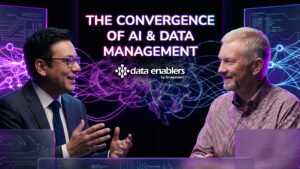
This transition is explored directly in Data Enablers Episode 7, “Are Dashboards Dead? Not Quite. But Close.” The conversation examines how AI is changing the role of dashboards and moving enterprise systems from presenting information toward helping organisations act on it.
That makes the future of BI less about replacing dashboards and more about connecting them to a broader intelligence architecture.
What Edgematics’ Data Enablers Perspective Adds
The Data Enablers podcast is particularly relevant here because it frames the shift as an evolution from insight to intelligent action, not as a simple technology replacement.
That connects naturally with Edgematics’ broader platform philosophy.
A trusted data environment supports analytics.
Analytics creates insight.
AI adds predictive and contextual intelligence.
Automation connects insight to workflows.
Agentic AI can take the next step by executing governed actions.
The value does not come from any one layer.
It comes from how the layers work together.
What This Looks Like in Practice
The difference becomes clearer through enterprise use cases.
Banking
A leading Pan-American bank needed accurate, compliant, and audit ready data across complex cross border operations.
The challenge was not the absence of data.
It was consistency, ownership, and lineage across jurisdictions.
Edgematics established a Data Governance Centre of Excellence, including data contracts, ownership structures, and lineage tracking, creating a trusted data environment for the organisation.
The full Data Governance Centre of Excellence case study demonstrates how the underlying data environment can directly influence compliance readiness and analytical confidence.
UAE Banking
For a leading UAE based banking enterprise, Edgematics introduced Analytical MDM, Customer Journey Analytics, and a Data Governance framework to support AI driven personalisation and more informed decision making. Predictive analytics and automation were then applied to generate real time insights for customer engagement.
The UAE banking case study illustrates an important point for BI leaders.
The objective was not simply to create better dashboards.
It was to create a governed data environment that could support analytics and AI driven action.
Enterprise Data Quality
The same principle applies outside banking.
Edgematics’ work with a leading retail enterprise addressed duplicate and inaccurate product data across a catalogue of more than one million products. Edgematics’ case study portfolio also includes data quality transformation for a major US wireless carrier and trusted data infrastructure for a leading UK fibre provider.
These use cases reinforce the same lesson.
Better insight depends on better data operations underneath the analytical layer.
PurpleCube AI and the Orchestration Layer
Fragmented enterprise data creates another challenge.
Even when individual datasets are governed, they may still remain distributed across systems that were never designed to work together.
That is where orchestration becomes important.
PurpleCube AI brings together data orchestration, metadata, quality, lineage, and automation across heterogeneous enterprise environments.
Rather than asking every analytical or AI consumer to connect independently to every source system, orchestration provides a more consistent way to move and manage data.
This aligns with Edgematics’ broader unified data layer perspective: the goal is not to eliminate the systems an enterprise already owns, but to create a more consistent layer through which data can be governed, accessed, reused, and activated.
Why AI Raises the Standard for Data Quality
A human analyst can sometimes work around poor data.
They can ask a colleague for clarification.
Also, they can compare two reports.
They can investigate an unexpected value.
An AI system operating automatically has fewer opportunities for that kind of informal correction.
This makes context, metadata, lineage, and data quality more important.
The question is no longer simply whether data is good enough for a dashboard.
It becomes whether the data is good enough for a machine to reason over and, eventually, act on.
Edgematics’ work on automating enterprise data operations with AI reflects this broader shift: data operations increasingly need to combine automation with intelligence, while quality, governance, observability, and remediation remain part of the same operating model.
The Leadership Question Is Not “Which BI Tool?”
The more strategic question is:
What does our enterprise need to make a trusted decision quickly?
That could require a better semantic layer.
It could require cleaner customer or product data.
Also, it could require more reliable pipelines.
It could require stronger lineage.
And it could require a unified data layer.
It could require embedded analytics.
Then it could eventually require AI or agentic workflows.
The correct answer depends on the decision and the architecture behind it.
This is why replacing the dashboard often feels like progress without resolving the underlying frustration.
The organisation changed the interface.
The data problem remained.
What Enterprises Should Fix First
Before investing in another analytics layer, leadership should examine whether the current data environment can answer a few basic questions.
Who owns the critical metrics?
Which datasets are certified?
Are business definitions consistent?
Can users find the right data without relying on tribal knowledge?
Can lineage be traced from source to report?
How quickly can data quality issues be detected?
Can the same trusted datasets support both BI and AI?
Can insights be connected to business workflows?
These questions reveal whether the organisation has a BI problem or a data operating model problem.
The Future of BI Is Not Less Intelligence. It Is More Context.
The enterprise BI landscape is changing because the role of data is changing.
Dashboards remain useful.
But the value of enterprise data increasingly comes from what happens before and after the dashboard.
Before the dashboard, data needs to be connected, governed, defined, validated, and made discoverable.
After the insight, the organisation needs to determine what action should follow.
That is the broader opportunity Edgematics addresses.
Data Strategy defines the business outcome.
Data Engineering & Governance makes the data trustworthy.
AI and Machine Learning make it more intelligent.
Intelligent Process Automation connects insight to workflow.
PurpleCube AI orchestrates the data environment.
Axoma enables governed agentic action.
Together, these capabilities create an environment where BI is no longer isolated from the rest of the enterprise data architecture.
Conclusion
When BI fails to deliver useful insights, the instinct is often to replace the dashboard, add another reporting layer, or give more users access to self service analytics.
Those actions may help in specific situations.
But the deeper issue is often elsewhere.
Undefined metrics create disagreement.
Weak ownership creates drift.
Poor data quality reduces trust.
Missing lineage makes numbers difficult to verify.
Fragmented systems make data difficult to access.
Unstructured information remains disconnected from the analytical environment.
And without a semantic layer, even technically accurate data can lack the context needed to become useful insight.
Edgematics approaches this from the data layer outward.
Through Data Strategy, Data Engineering & Governance, AI and Machine Learning, Intelligent Process Automation, Agentic AI, and platforms such as PurpleCube AI and Axoma, the objective is to create an environment where data can move from source to insight to action with greater trust and control.
The future is not about building more dashboards.
It is about making the data behind them more trusted, contextual, reusable, and actionable.
That is what turns business intelligence into business value.
FAQ
Why Is My BI Not Delivering Useful Insights?
The issue is often not the BI tool itself. Common causes include poor data quality, unclear ownership, inconsistent definitions, weak lineage, fragmented source systems, and missing business context.
Does Buying a Better BI Tool Solve Data Problems?
Not necessarily. A BI platform can improve visualisation and query capabilities, but it does not automatically solve data ownership, semantics, governance, or lineage problems.
What Is a Semantic Layer and Why Does BI Need One?
A semantic layer defines shared business meanings for metrics and dimensions so different users and analytical tools work from consistent definitions rather than interpreting raw data independently.
How Does Self Service BI Create More Problems?
Without certified datasets, governance, and common definitions, self service can lead to multiple versions of the same metric and uncontrolled analytical assets. A governed semantic and data layer allows self service without sacrificing consistency.
Are Dashboards Becoming Obsolete?
Dashboards remain useful for monitoring, exploration, and communicating performance. The change is that AI and automation are increasingly extending the enterprise intelligence layer beyond passive reporting toward contextual insight and action. Edgematics explores this transition in Data Enablers Episode 7, “Are Dashboards Dead? Not Quite. But Close.”
How Does Edgematics Help Improve Business Intelligence?
Edgematics addresses the layers underneath BI through Data Strategy, Data Engineering & Governance, AI and Machine Learning, Intelligent Process Automation, Agentic AI, and orchestration capabilities delivered through PurpleCube AI and Axoma.
Can the Same Data Architecture Support BI and AI?
Yes. A governed data architecture can provide trusted, contextual, and reusable data for both analytical consumers and AI workloads. The key is to design around shared governance, metadata, quality, lineage, semantics, and access rather than creating disconnected environments.
About Edgematics
Edgematics Group helps enterprises turn fragmented data environments into governed, usable, and intelligent data ecosystems.
Its capabilities span Data Strategy, Data Engineering & Governance, AI and Machine Learning, Intelligent Process Automation, Agentic AI, and Data Enterprise Applications, supported by platforms including PurpleCube AI and Axoma.
The focus is not simply on delivering another analytics layer. It is on creating the data and AI environment required for enterprises to move from trusted information to better decisions and intelligent action.
Book a Discovery Call
Explore how Edgematics can help address the data, governance, architecture, and AI capabilities behind your BI environment.