TL;DR:
- Data is the backbone of digital transformation, turning operational signals into decisions and competitive advantages.
- Successful data-driven strategies rely on strong governance, modern architecture, real-time analytics, and executive ownership to build lasting value.
Data is the cognitive backbone of digital transformation, converting raw operational signals into decisions, predictions, and competitive advantage. Enterprises that treat data as a strategic asset rather than a byproduct of IT operations consistently outperform those that don’t. The role of data in digital transformation extends across every function: from supply chain optimization and fraud detection to personalized customer experience and AI-driven automation. Yet only 24% of enterprises report being truly data-driven, despite 91% of Fortune 500 leaders identifying data as a top priority. That gap is where transformation either accelerates or stalls.
What operational and financial benefits does data-driven transformation deliver?
A data-first approach produces measurable returns that justify the investment at the board level. Large enterprises adopting structured data quality programs report $2.1M in savings from improved data quality and process improvements, alongside $1.6M reductions in resource requirements. These are not theoretical projections. They reflect what happens when data pipelines are clean, governed, and connected to operational workflows.
The productivity gap between data-active and data-passive organizations is equally striking. Enterprises that actively collect and analyze data report nearly double the rates of product and service improvement (47% versus 22%) and internal efficiency gains (43% versus 17%). That differential compounds over time. Organizations that build data collection into their operating model create a feedback loop that continuously improves products, reduces waste, and sharpens decision-making.
The financial case for measuring digital transformation ROI becomes clearer when data quality is treated as a prerequisite, not an afterthought. Consider what these returns look like across key enterprise dimensions:
- Cost reduction: Cleaner data eliminates duplicate processing, reduces manual reconciliation, and cuts the overhead of managing unreliable reports.
- Revenue growth: Accurate customer data enables precise segmentation, better product recommendations, and faster go-to-market cycles.
- Risk mitigation: Governed data reduces compliance exposure, audit failures, and the cost of regulatory penalties.
- Operational speed: Integrated data systems reduce decision latency across procurement, logistics, and customer service.
The impact of data on digital transformation is not confined to analytics dashboards. It reshapes how work gets done at every layer of the enterprise.
What are the five pillars of a data-driven digital strategy?
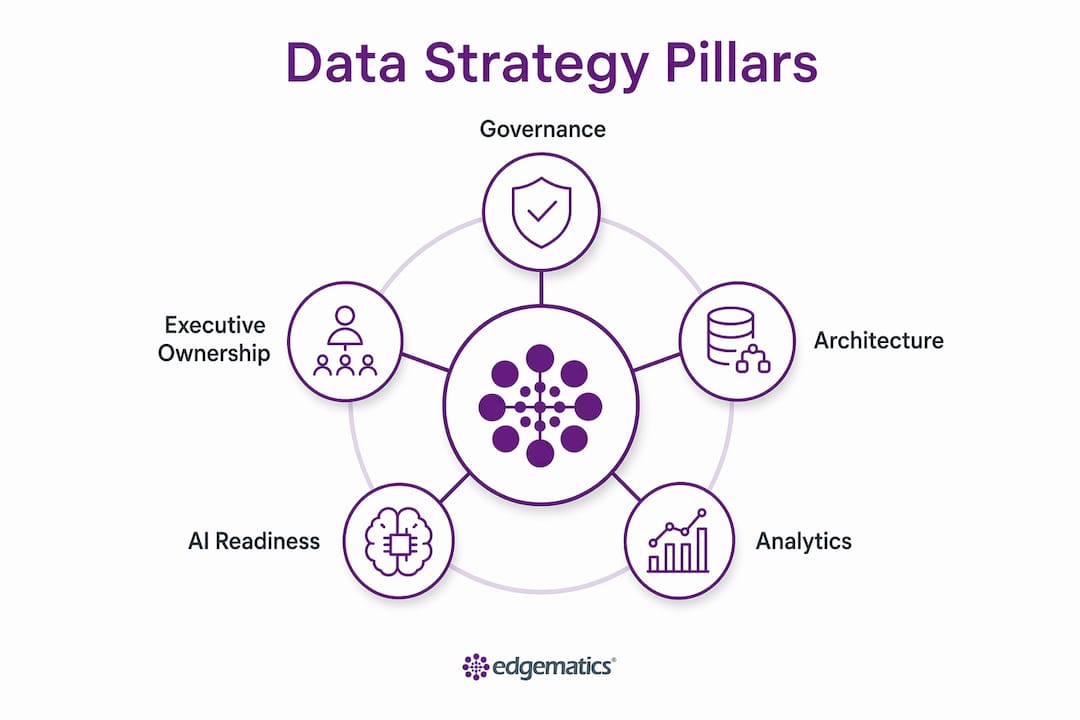
Successful data-driven digital strategy rests on four interdependent pillars: data governance, modern data architecture, real-time analytics, and AI readiness. Each one reinforces the others. Weakness in any single pillar limits the entire program.
Data governance defines who owns data, how it is classified, and what policies govern its use. Mature governance programs increase confidence in AI model outputs by 58% compared to organizations without formal governance structures. Governance is not a compliance checkbox. It is the mechanism that makes data trustworthy enough to act on.
Modern data architecture determines how data is stored, moved, and accessed. Enterprises are moving beyond traditional data warehouses toward data lakes, lakehouses, and federated architectures that support both structured and unstructured data. Metadata catalogs and data lineage tools are now standard components of any architecture designed for scale.
Real-time analytics separates reactive enterprises from proactive ones. Organizations using real-time data pipelines respond to market signals nearly five times faster than those relying on batch processing. For use cases like fraud detection, dynamic pricing, and personalized customer journeys, batch analytics is simply not fast enough.
AI readiness is the pillar most enterprises underestimate. 82% of organizations scaling AI report failures directly tied to insufficient data readiness, including inconsistent labeling, unreliable pipelines, and absent governance. AI does not fix bad data. It amplifies it.
Pro Tip: Before investing in any AI or machine learning platform, conduct a formal data readiness assessment across your key data domains. Map data ownership, quality scores, and pipeline reliability. This single exercise will surface the gaps that would otherwise derail your AI program six months in.
Building a data-driven culture requires more than technology. It demands data literacy programs, executive sponsorship, and clear accountability structures that make data quality everyone’s responsibility, not just the data engineering team’s.
How does data fabric change enterprise data management?
Data fabric is defined as an architecture that provides a unified, context-aware layer across all data environments, whether on-premises, cloud, or hybrid. It goes beyond aggregation. A data fabric preserves business context, semantics, and governance policies as data moves across systems, making it usable by both humans and AI agents without losing meaning.
The components of a mature data fabric include intelligent compute layers, knowledge pools, semantic harmonization using knowledge graphs, and federated governance that enforces access policies at the data level rather than the application level. This is the architecture that enables scalable enterprise AI and automation, because AI agents need data that carries context, not just values.
The business case is already visible. More than two-thirds of enterprises deploying data fabric report improved data visibility, accessibility, and control, which directly enables better AI coordination and automation outcomes. The contrast with traditional architectures is significant:
| Dimension | Traditional data lake/warehouse | Data fabric |
|---|---|---|
| Context preservation | Minimal; data stripped of business meaning | Full; semantics and policies travel with data |
| Governance enforcement | Application-level, manual | Data-level, automated |
| AI suitability | Requires extensive preparation | Designed for AI and agent consumption |
| Cross-system connectivity | Siloed by design | Federated and interoperable |
Deploying data fabric in a large enterprise is not a weekend project. It requires semantic harmonization across legacy systems, federation of diverse data environments, and governance frameworks that can enforce policies at scale. The organizations that get this right create what amounts to an intelligent nervous system for the enterprise, where data flows with context intact from source to decision.
Pro Tip: Start data fabric deployment with a single high-value domain, such as customer data or financial reporting, rather than attempting enterprise-wide rollout. Prove the model, measure the outcomes, then expand. This reduces risk and builds internal credibility for the broader program.
Why does executive leadership determine data transformation outcomes?
Data transformation is primarily a leadership challenge, not a technology challenge. The most common reason enterprise data programs stall is not a shortage of tools. It is a shortage of executive ownership and realistic timelines.
Caterpillar’s CEO committed three years to building an enterprise data platform and deliberately elevated data ownership to senior executives rather than leaving it with IT. That decision changed the trajectory of the program. When data governance sits inside IT, it competes with infrastructure tickets and release cycles. When it sits at the executive level, it becomes a strategic function with budget, authority, and accountability.
Elevating data ownership from IT to senior leadership reframes data as an enterprise asset rather than technical infrastructure. This shift has practical consequences:
- Data quality issues get escalated and resolved faster because they carry executive visibility.
- Cross-functional data sharing becomes easier because senior leaders can override departmental silos.
- Investment in data platforms is protected through budget cycles because the sponsor sits at the table where budgets are set.
- AI and analytics initiatives are aligned to business outcomes rather than technology capabilities.
“Data transformation is the CEO’s business. Delegating it entirely to IT is the single most reliable way to ensure it never reaches its potential.” — MIT Sloan Management Review
The cultural dimension is equally important. Technology adoption without change management produces shelfware. Enterprises that invest in data literacy programs, cross-functional data councils, and transparent data quality metrics build the organizational muscle that sustains transformation beyond the initial deployment phase. How data fuels digital change at the enterprise level is ultimately a function of how seriously leadership treats data as a core competency, not a support function.
Key takeaways
Data-driven digital transformation succeeds when governance, architecture, real-time analytics, and executive ownership are built together as a unified program, not deployed as isolated technology projects.
| Point | Details |
|---|---|
| Data quality drives financial returns | Enterprises with strong data quality programs save $2.1M and cut $1.6M in resource costs. |
| Real-time analytics create speed advantage | Organizations using real-time pipelines respond to market signals nearly five times faster than batch-reliant peers. |
| AI readiness requires data foundations first | 82% of AI scaling failures trace back to poor data readiness, not model quality. |
| Data fabric enables context-aware AI | A data fabric preserves semantics and governance across systems, making data safe and usable for AI agents. |
| Executive ownership is non-negotiable | Caterpillar’s three-year CEO-led data platform commitment demonstrates that transformation requires senior accountability, not IT delegation. |
Our perspective on data-driven transformation
We have worked with enterprises across telecommunications, finance, government, entertainment and beyond, and the pattern is consistent. Organizations that struggle with digital transformation are almost never short on ambition or budget. They are short on data foundations. They invest in AI platforms before their data pipelines are reliable. They deploy analytics tools before their governance policies are defined. They expect machine learning models to compensate for years of inconsistent data collection.
The unglamorous truth is that data hygiene and governance must come before AI. Cleaning legacy data, establishing ownership, and building reliable pipelines is not exciting work. But skipping it produces failed AI initiatives despite sophisticated tooling. We have seen this repeatedly, and it is entirely preventable.
What we advocate for is treating data transformation as a continuous enterprise program, not a one-time technology project. That means honest assessment of data readiness before committing to AI or analytics investments. It means building a governance center of excellence with senior sponsorship, not just an IT working group. It means measuring data quality as a business KPI alongside revenue and margin.
The enterprises that get this right do not just transform digitally. They build a durable competitive advantage that compounds with every new data source, every new AI capability, and every new market signal they can act on faster than their competitors.
How Edgematics helps enterprises build data foundations that last
At Edgematics, we specialize in the foundational work that makes digital transformation real. Our data engineering and governance practice helps enterprises build trustworthy data platforms, establish governance centers of excellence, and create the pipelines that AI and analytics tools actually need to perform. We do not start with the AI. We start with the data.
Our enterprise data strategy engagements align your data architecture, governance model, and AI readiness to your specific business outcomes, whether that means reducing operational costs, accelerating product development, or improving customer experience at scale. And when your foundations are ready, our AI and ML solutions are built to activate them. Let’s build something that lasts. Let’s chat about where your data program stands today.
FAQ
What is the role of data in digital transformation?
Data serves as the strategic foundation of digital transformation, enabling enterprises to make faster decisions, automate processes, and deliver personalized customer experiences. Without reliable, governed data, AI and analytics tools cannot produce trustworthy outputs.
Why do most digital transformation programs fail to become data-driven?
Only 24% of enterprises are fully data-driven despite 91% of Fortune 500 leaders prioritizing data. The gap stems from weak governance, poor data quality, and the absence of executive ownership over data programs.
What is data fabric and why does it matter for AI?
Data fabric is an architecture that preserves business context, semantics, and governance policies as data moves across systems. More than two-thirds of enterprises deploying it report improved data visibility and control, which is the prerequisite for reliable AI deployment.
How long does enterprise data transformation realistically take?
Caterpillar’s CEO committed three years to building an enterprise data platform, which reflects a realistic timeline for large organizations. Expecting transformation in months without that commitment typically produces incomplete results.
What should enterprises prioritize before deploying AI?
Enterprises should complete a data readiness assessment covering pipeline reliability, data quality scores, labeling consistency, and governance coverage before scaling AI. 82% of AI failures at scale are caused by data readiness gaps, not model limitations.