Introduction
Enterprise data environments are becoming harder to manage manually. Information moves across databases, cloud platforms, applications, APIs and operational systems. Every new source introduces another integration requirement, every pipeline creates another point to monitor, and every data quality issue adds to the effort required before information can be trusted.
The answer is not to automate everything at once. It is to identify the repeatable activities that consume the most time, introduce the most errors and create unnecessary operational dependencies.
Automating data management starts with tasks such as ingestion, validation, cleansing, deduplication, metadata capture and pipeline scheduling. These activities follow defined rules and occur repeatedly, making them practical candidates for automation.
However, automation without governance can move errors faster. Quality rules, ownership, access controls and lineage need to operate alongside the pipelines from the beginning. Otherwise, organizations risk creating faster processes without improving reliability or accountability.
For regulated enterprises, this distinction matters. Banks, insurers, healthcare providers and telecommunications operators need to know not only whether their data processes run successfully, but also what changed, who owns the information and whether every transformation can be traced.
This guide explains what data management automation covers, why it makes business sense, how the supporting architecture works and how enterprises can introduce it through a practical five-step rollout.
TL;DR
- Start with repeatable, rule-based tasks such as ingestion, validation, cleansing, deduplication and metadata capture.
- Embed governance, quality rules and lineage into the pipelines rather than introducing them after deployment.
- Begin with one high-value data domain and a measurable business outcome, then expand.
- Use AI for tasks that go beyond fixed rules, including anomaly detection, entity matching and classification.
- Keep people involved in exceptions, approvals and decisions that affect customers or carry significant business risk.
- Edgematics’ approach is designed to reduce effort by 50 to 60% across data discovery, preparation and analytics. Actual outcomes depend on the enterprise environment and scope.
1. What Does Automating Data Management Actually Cover?
Data management spans the full lifecycle of enterprise information. It includes how data is created, collected, stored, integrated, secured, maintained, backed up, archived and eventually deleted.
Automation applies software and predefined processes to perform these activities with less manual intervention. Instead of relying on people to trigger every job, check every record and document every change, organizations can embed repeatable controls directly into their data environment.
Industry analysts at ISG identify governance, integration and data quality as areas where traditional processes can be complex and manual, making them suitable candidates for AI-driven automation.
Dataversity groups some of the key opportunities into four areas:
| Area | What gets automated |
|---|---|
| Data quality | Profiling, cleansing, record matching and reconciliation against an authoritative source |
| Metadata management | Metadata extraction, classification and identification of sensitive records |
| Master data management | Maintaining consistent customer, product and other core entities across systems |
| Data integration | Connecting and unifying information from systems with different formats and standards |
These capabilities often work together.
For example, a telecom operator integrating an acquired fibre network may need to reconcile customer and network inventory records across different systems. Automated extraction and transformation move the information, validation checks identify inconsistencies, deduplication resolves repeated records and lineage captures how the data reaches its destination.
A bank may have a different requirement. It may need to maintain consistent customer and transaction information across heterogeneous systems while ensuring that data transformations remain traceable for regulatory reporting.
In both situations, automation reduces repetitive work while governance provides the controls needed to trust the result.
2. Why the Economics of Data Management Automation Hold Up
Manual data operations create costs that extend beyond the time spent by engineering teams.
Repeated reconciliation, disconnected quality checks, manual metadata updates and inconsistent integration processes delay the availability of usable information. These issues also increase the effort required to investigate errors and prepare data for analytics.
The economic case for automation becomes clearer when we examine two areas: data integration and governance.
The cost of manual integration
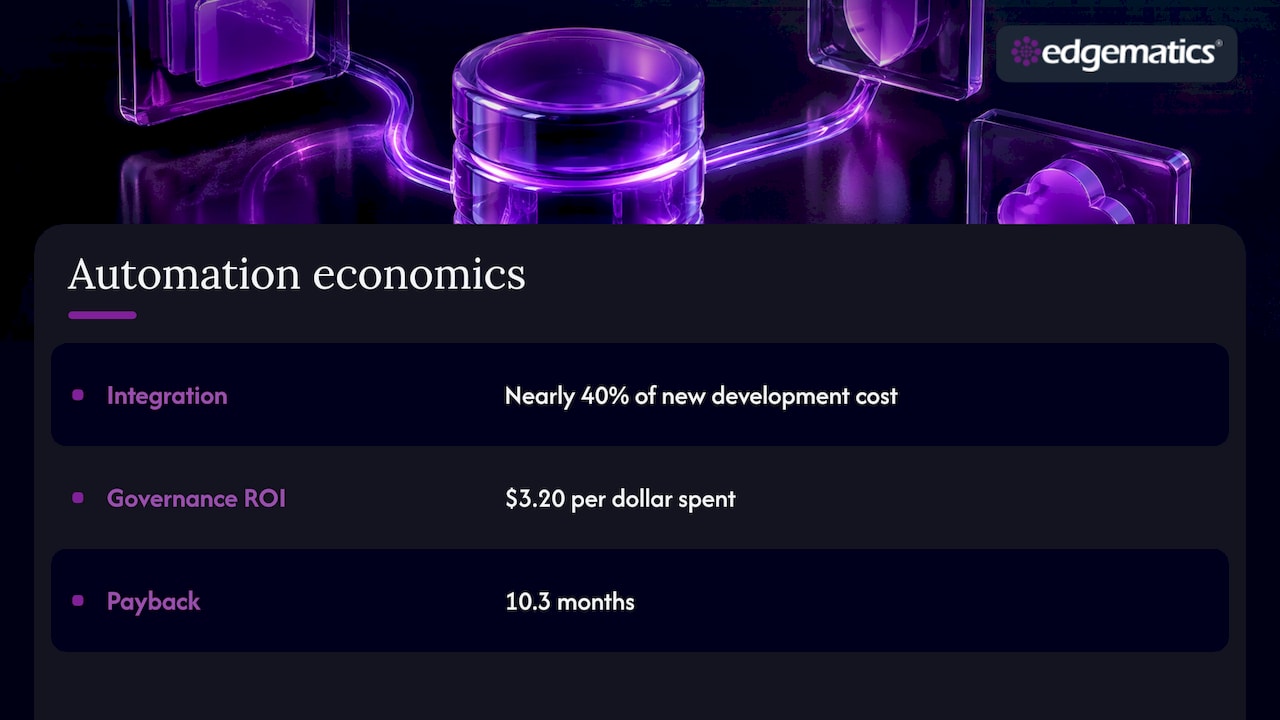
TDWI’s Data Strategy Assessment Guide reports that nearly 40% of the cost of new development goes towards data integration activities.
This highlights an important source of operational effort. When teams repeatedly build connections, reconcile formats and resolve differences between systems, a substantial portion of development resources goes towards making information usable rather than creating new business capabilities.
Automated integration and reusable pipelines can reduce repeated engineering work, particularly in environments with multiple source systems or frequent changes.
The return from data governance
Nucleus Research reported an average return of $3.20 for every dollar invested in data governance technology, with a payback period of 10.3 months. The research draws on case studies from the preceding three years.
These figures should be treated as reference points, not guaranteed outcomes. Actual returns depend on an organization’s current operating model, data maturity, implementation costs and the amount of manual work it needs to remove.
The broader point is that governance has a measurable economic role. Better data quality, clearer ownership and improved traceability can reduce reconciliation effort, support faster reporting and make information easier to reuse.
For enterprises, the business case should therefore consider more than pipeline speed. It should include reduced manual intervention, fewer recurring data issues, faster access to usable information and lower effort during audits.
Existing visual asset: Why the economics hold up
3. The Architecture Behind Automated Data Management
Tools alone do not create a mature automation programme. Organizations need an architecture that connects integration, quality, metadata, governance and operational monitoring.
Gartner’s data integration guidance considers several dimensions of a mature practice: strategy, organizational model, integration styles and architecture, technology and tools, governance, and metadata. These dimensions need to work together rather than develop as isolated initiatives.
At an operational level, four layers provide a practical starting point.
1. Ingestion and transformation
Data needs to move reliably from its source systems into the platforms where it will be processed and consumed.
Automated extract, transform and load (ETL) or extract, load and transform (ELT) pipelines can run on schedules, respond to specific events or process streaming data.
They should also account for schema changes, transformation dependencies and failed jobs.
As data estates evolve, many organizations are shifting towards ELT architectures that bring processing closer to modern cloud data platforms. Our guide to ELT modernisation explains why this architectural shift matters for modern analytics and AI workloads.
2. Data quality controls
Quality checks should operate as data enters and moves through the pipeline.
This includes required-field validation, format checks, schema consistency, duplicate detection and anomaly identification.
The objective is to catch problems close to their source rather than discovering them after they have affected reports, dashboards or downstream applications.
Our guide to enterprise data quality best practices explores how organizations can connect validation rules and quality measurement with business outcomes.
3. Metadata, cataloguing and lineage
Automation should capture technical metadata as data moves between systems.
This can include source information, data types, table and column definitions, transformation relationships and available ownership information.
A searchable catalogue helps teams discover relevant datasets, while lineage shows where information originated and how it changed.
For regulated organizations, this is particularly important. When an auditor asks where a value came from, teams should be able to trace the relevant pipeline and transformations rather than reconstruct the answer manually.
4. Orchestration and monitoring
The final layer coordinates pipeline execution and makes operational activity visible.
Teams need one place to understand which jobs ran, which failed, what changed and which downstream processes may be affected.
Monitoring should identify pipeline failures, unexpected delays, quality exceptions and changes in data availability. Orchestration then coordinates retries, notifications and remediation according to defined rules.
Together, these layers create a connected operating environment. They reduce fragmented responsibilities and make it easier to manage the data lifecycle as one system.
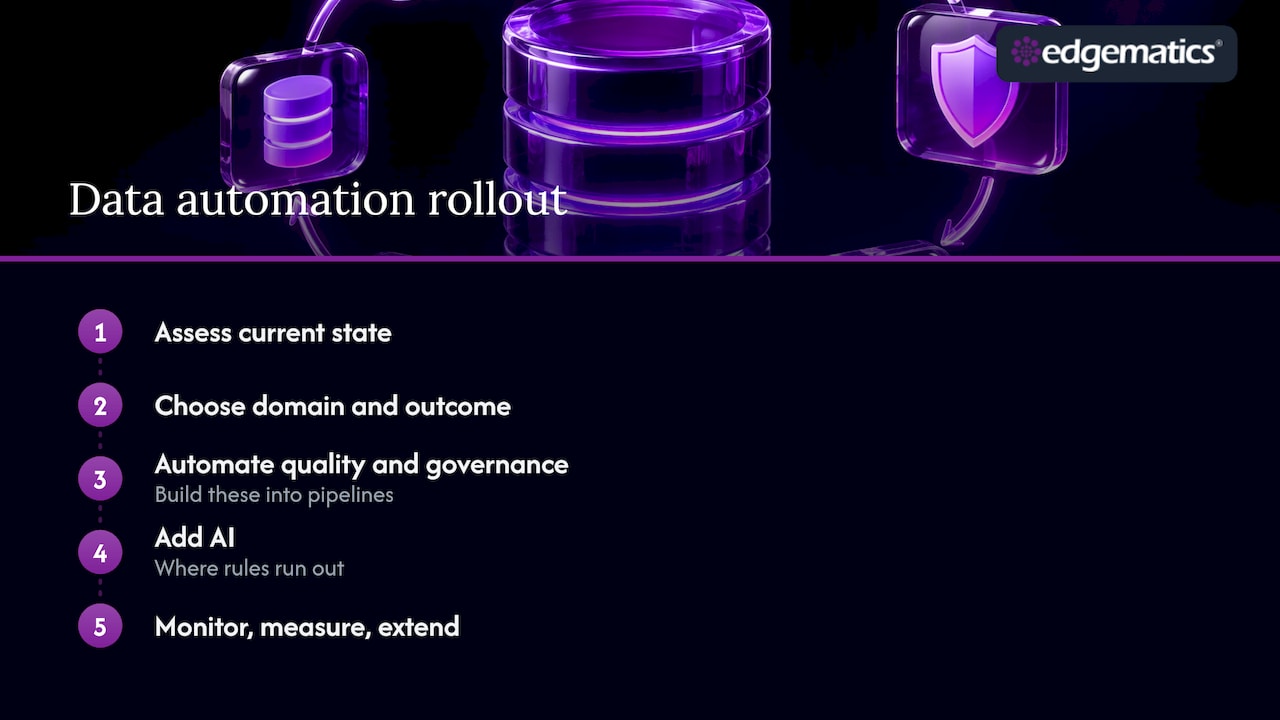
4. A Five-Step Rollout for Enterprise Data Management Automation
A successful rollout should start with a clear business problem rather than a platform-wide technology deployment.
The following five steps provide a practical way to move from manual data operations towards governed automation.
Existing visual asset: Five stages of data management automation
Step 1. Assess the current state
Start by understanding how data moves through the organization today.
Inventory the important source systems, pipelines, owners and manual touchpoints. Identify where analysts and engineers spend the most time.
Look specifically at:
- Data discovery and access requests.
- Manual preparation and cleansing.
- Reconciliation between source systems.
- Repeated validation and correction.
- Pipeline monitoring and incident resolution.
- Metadata and lineage documentation.
Establish a baseline for these activities. Measure the time required, the frequency of errors and the amount of manual intervention.
The DAMA Data Management Body of Knowledge (DAMA-DMBOK) provides a widely used reference framework for organizing this assessment.
One common mistake is trying to catalogue every system and activity before taking action. That can delay the programme without improving its starting point. Focus first on the processes and data domains that create the most operational friction or regulatory exposure.
Step 2. Choose one domain and one measurable outcome
Avoid beginning with an enterprise-wide automation rollout.
Select a business domain where the problem is clear and where improvement can be measured. Suitable starting points include customer master data, product information, fibre network asset records or regulatory reporting inputs.
Define the outcome before selecting the technology.
For example:
- Reduce manual customer-record reconciliation.
- Improve data quality at ingestion.
- Shorten the time required to prepare regulatory reporting inputs.
- Reduce duplicate product or asset records.
- Improve the availability of trusted data for analytics.
Your data strategy should connect this use case to business priorities, ownership and the wider architecture.
Our Data Strategy capabilities help organizations define priorities, select high-value use cases and establish the operating model needed to extend automation across the enterprise.
A focused first implementation also makes it easier to demonstrate value and build support for the next stage.
Step 3. Automate quality and governance with the pipelines
Once the domain is selected, build its quality and governance requirements into the pipeline.
Define the validation rules, assign ownership and capture metadata and lineage as data moves. Do not wait until the pipeline is live to document its transformations or identify the people responsible for quality issues.
This is where many programmes encounter difficulty. Governance introduced after go-live can require changes to existing pipelines, create documentation gaps and increase the effort required to demonstrate compliance.
A better approach is to establish quality checks and governance controls alongside ingestion and transformation.
For more detail on the technical implementation, see our guide to automated data quality management.
Step 4. Add AI where fixed rules reach their limits
Rules are effective when the expected patterns are known. They become less effective when data is inconsistent, unstructured or changes in ways that predefined conditions cannot fully anticipate.
This is where machine learning and AI can extend data management automation.
Useful applications include:
- Anomaly detection across large datasets.
- Entity matching when records contain inconsistent identifiers.
- Automated classification of data based on observed patterns.
- Identifying unusual changes in quality or distribution.
- Recommending corrections for recurring data issues.
However, AI-generated results should not automatically be treated as authoritative. Low-confidence matches, sensitive records and changes with significant downstream impact should enter a review queue.
The practical objective is to let automation handle high-volume, predictable work while people focus on exceptions that require context or judgment.
Our article on automating enterprise data operations with AI explores how AI can support anomaly detection, incident investigation, quality management and governed remediation.
The relationship between data management and AI is also discussed in Data Enablers Episode 6, The Convergence of AI and Data Management. The conversation examines why organizations can no longer treat AI innovation and data management as separate enterprise priorities.
Step 5. Monitor, measure and extend
Once the first workflow is operational, measure its performance against the baseline established during the assessment.
Useful measures include:
| Metric | What it tells you |
|---|---|
| Pipeline failure rate | How reliably automated jobs execute |
| Data quality score | Whether records meet defined quality requirements |
| Manual intervention hours | How much repetitive work automation removes |
| Data preparation time | How quickly information becomes usable |
| Duplicate record rate | Whether matching and reconciliation are improving |
| Issue resolution time | How quickly data problems are identified and corrected |
| Lineage coverage | Whether critical data flows remain traceable |
Use these results to decide whether the process is ready to expand.
A successful first use case should create a repeatable approach to ownership, validation, monitoring and remediation. That pattern can then be applied to another domain without rebuilding the operating model from scratch.
The objective is not to automate every system immediately. It is to establish a reliable approach that can be extended without losing control.
5. The Problems Enterprises Will Encounter
Data management automation does not eliminate the structural problems within an enterprise data environment. In some cases, it exposes them more clearly.
Research on data interoperability identifies recurring challenges such as fragmented systems, inconsistent formats, data silos, limitations in legacy technology and organizational resistance.
These issues require a combination of technical and organizational responses.
| Enterprise challenge | Practical response |
|---|---|
| Fragmented source systems | Establish reusable integration patterns and consistent data models |
| Inconsistent data formats | Define transformation standards and validation rules |
| Duplicate or conflicting records | Identify authoritative sources and apply governed matching processes |
| Legacy scalability limitations | Modernize integration in phases rather than replacing everything at once |
| Unclear data ownership | Assign accountable data owners and stewards |
| Resistance to new processes | Involve business teams early and demonstrate measurable operational benefits |
For regulated organizations, one additional discipline matters: automation that affects customers or uses sensitive information must remain explainable and subject to appropriate human oversight.
Privacy, data protection and AI requirements vary by country, industry and use case. Organizations should confirm the applicable obligations with their legal and compliance teams before automating decisions that affect individuals.
What this looks like in enterprise environments
The value of connecting automation with governance becomes clearer when applied to actual enterprise requirements.
For a leading Pan-American bank, Edgematics established a Data Governance and Quality Centre of Excellence using PurpleCube AI’s Data Quality Studio to enforce quality at ingestion. The work included standardized formats, ID validation, anomaly flagging, custom connectors and migration strategies designed to maintain regulatory compliance. The bank reported faster fraud detection, stronger compliance reporting and lower operational costs. Read the Pan-American Bank data governance case study.
A leading North American retail giant faced duplicate product information and data accuracy challenges across a catalogue of more than one million products. Edgematics implemented a structured data governance and deduplication framework alongside AI-powered asset management analytics. The work supported greater operational efficiency, improved customer engagement and faster decision-making. See the retail data quality case study.
In the UK fibre sector, Edgematics developed a repeatable integration pipeline to migrate acquisition data into an operational support system. The solution used a conformed data model, automated API integration and closed-loop metadata management. It eliminated manual data loading and delivered four-times-faster onboarding of accurate inventory data, with traceability from source systems to active records. Explore the AI-powered inventory migration case study.
These examples involve different industries and business requirements, but they point to the same principle: automation creates more value when data quality, integration, governance and traceability are designed together.
6. What We Have Learned About Automation and Governance
Automation without governance moves errors faster. We therefore design the two together.
That means building pipelines, quality rules, cataloguing and lineage as connected capabilities rather than treating them as separate projects. Every automated step should have a defined purpose, accountable ownership and an appropriate record of what happened.
The sequence matters as much as the technology. Organizations modernizing legacy estates, consolidating platforms or integrating acquired businesses often need to establish consistent data models and governance controls before introducing more advanced AI capabilities.
This is the thinking behind PurpleCube AI, Edgematics’ unified data orchestration platform, and Axoma, its enterprise agentic AI orchestration platform.
PurpleCube AI supports the data management layer through ingestion, integration, pipeline orchestration, metadata, cataloguing, lineage, observability and data quality capabilities. Axoma extends automation into governed agentic workflows, where AI can support reasoning, triage and actions within defined controls.
Our aim is to reduce the effort between data discovery and analytics by 50 to 60%. The route to that outcome is less manual preparation and repeated reconciliation, while retaining the quality and governance controls that make information trustworthy.
This principle also connects with Data Enablers Episode 5, Trust, Data & AI: Closing the Gap. The discussion explores why access to data is not enough and why organizations need confidence in the information and intelligence behind their decisions.
Episode 3, Rethinking Data Governance in the Gulf Region, brings another important perspective: governance works best when it is embedded into business processes and organizational practices rather than imposed as a separate compliance activity.
Where Edgematics Can Help
Edgematics works with enterprises on data architecture, data management, governance and AI readiness across complex technology environments.
Our Data Engineering & Governance practice covers data integration, ETL and ELT engineering, automated pipelines, metadata, lineage, data quality and enterprise governance.
Our wider solutions portfolio also includes AI and machine learning, agentic AI and data strategy. For organizations assessing their current capabilities, our data and AI assessments provide a starting point for understanding priorities and identifying areas for improvement.
The right place to begin is the process creating the most friction today. Identify the manual effort, establish the controls and prove the value in one domain before extending the approach across the enterprise.
If you are evaluating where to begin, we would welcome a conversation.
Frequently Asked Questions
1. What should enterprises automate first in data management?
Start with high-volume, rule-based activities such as data ingestion, validation, cleansing, deduplication and metadata capture. These processes are repetitive and measurable, making them practical starting points for automation. They also provide a way to establish quality and governance controls early.
2. Do enterprises need to replace legacy systems before automating data management?
Not necessarily. Automated integration can connect systems that use different formats and standards. A governed data layer can operate across legacy and modern platforms while modernization takes place in phases. The sequence should reflect business priorities, system dependencies and regulatory requirements.
3. How can automated data management remain compliant?
Embed quality rules, lineage, access controls and ownership into the data pipelines. Maintain traceable records of transformations and automated actions, and define human review for exceptions or decisions that affect customers. Organizations should also verify the privacy and regulatory requirements that apply in each jurisdiction.
4. Where does AI fit into data management automation?
AI extends rule-based automation into areas such as anomaly detection, entity matching, data classification and remediation recommendations. It can help identify patterns that fixed rules may miss. Rules remain important for predictable tasks, while human review should remain available for ambiguous or high-impact cases.
5. How should organizations measure the success of data management automation?
Measure pipeline reliability, data quality, duplicate rates, preparation time, issue resolution time, lineage coverage and hours of manual work removed. Compare these measures against a baseline before expanding automation to additional domains.