Introduction
Where your data is stored matters. But knowing the location of a database does not necessarily tell you which laws govern it, who can access it or whether your organization can demonstrate compliance.
For enterprises operating across countries, cloud environments and regulatory frameworks, data sovereignty turns a legal principle into an architecture decision. Leaders must understand where data originates, how it moves, which jurisdictions apply and who can access it throughout its lifecycle.
These questions become more complex during cloud migrations, mergers and acquisitions, and the adoption of AI. A dataset may move through several applications, integration pipelines and third-party platforms before reaching a report or model. Without clear visibility into those movements, even a well-intentioned data residency policy can be difficult to enforce.
Enterprise data sovereignty is therefore not just about where data sits. It is about jurisdiction, control, accountability and the ability to demonstrate that the right safeguards are in place.
This guide explains the difference between data sovereignty, residency and localization, examines key regulatory considerations, and outlines a practical approach to building sovereign data architectures without unnecessarily restricting legitimate data use.
TL;DR
- Data sovereignty concerns the laws and jurisdictional controls that apply to data. Physical storage location is only one part of the picture.
- Data residency describes where data is stored, while data localization refers to requirements that certain data remain within a specified jurisdiction.
- A sovereign cloud label does not, by itself, establish compliance. Enterprises must examine provider jurisdiction, encryption key control, administrative access and data handling practices.
- Data cataloguing, classification, lineage and policy automation help turn sovereignty requirements into enforceable controls.
- Excessive localization can fragment data environments and restrict useful cross-border analytics. The objective is to meet applicable obligations while preserving permitted data use.
- Sovereignty decisions should be part of architecture and migration planning, not a control added after deployment.
What Is Enterprise Data Sovereignty?
Data sovereignty is the principle that data is subject to the laws and governance of the country or region with jurisdiction over it. The applicable rules depend on the nature of the data, where it is processed, the organizations handling it and the relevant legal framework.
In international law, sovereignty concerns a state’s authority within its territory. Governments also apply sovereignty principles to cyberspace and digital infrastructure. For example, Global Affairs Canada’s position on international law in cyberspace discusses territorial sovereignty in relation to cyber activity and critical infrastructure.
For an enterprise, the implications are practical. A customer record, financial transaction or network inventory entry may be subject to multiple legal and contractual obligations as it moves between systems and service providers.
Data leaders therefore need to answer four questions:
- Where is the data? Identify its source, storage locations, processing environments, backups and copies.
- Which rules apply? Determine the relevant jurisdictional, regulatory and contractual obligations.
- Who can access it? Understand the rights of internal users, service providers, administrators and other parties.
- Can compliance be demonstrated? Maintain evidence of data movements, access decisions, safeguards and policy enforcement.
These questions connect legal interpretation with data architecture. Legal and compliance teams determine the obligations, while data and technology teams implement the controls needed to meet them.
Data Sovereignty vs. Data Residency vs. Data Localization
The terms data sovereignty, data residency and data localization often appear together, but they describe different aspects of data control.
| Concept | What it means | Key question |
|---|---|---|
| Data residency | The geographic location where data is stored or processed, depending on the stated requirement | Is this dataset stored in the required region? |
| Data sovereignty | The jurisdictional laws and controls that apply to data | Which authorities and legal frameworks may govern or compel access to this data? |
| Data localization | A requirement to keep specified data within a particular country or jurisdiction | Must this category of data remain in-country? |
Residency is primarily a question of location. Sovereignty is a broader question of jurisdiction and control. Localization is a specific policy or legal requirement that may apply to certain data categories.
Consider a telecom operator that stores subscriber records in a domestic cloud region. That arrangement may satisfy a storage-location requirement. However, the organization must still assess the provider’s jurisdiction, administrative access arrangements, contractual obligations and any applicable foreign-access laws before determining whether its wider sovereignty requirements are met.
The distinction matters because a single infrastructure setting cannot establish compliance with every obligation. Enterprises need a clear view of both where data resides and the legal and operational conditions under which it is handled.
The Global Regulatory Landscape
There is no single global data sovereignty rulebook. Requirements vary by jurisdiction, industry, data category and transfer arrangement. Enterprises operating internationally need to distinguish general data protection requirements from sector-specific localization obligations and other national rules.
European Union: Data Protection and Risk-Based Controls
The EU’s General Data Protection Regulation (GDPR) governs the processing of personal data and establishes requirements for transfers to countries outside the European Economic Area.
The EU Data Act has applied since September 12, 2025, introducing additional obligations, including provisions relevant to switching between data processing services and safeguards against unlawful third-country governmental access in specified circumstances.
European law does not impose a general requirement to localize all enterprise data within the EU. Instead, applicable transfer rules, sector-specific obligations and risk assessments shape the controls organizations need.
As discussed in Orrick’s analysis of data localization and sovereign cloud, sovereignty decisions require more than selecting a cloud region. Enterprises must evaluate their specific legal obligations and the safeguards available from their providers.
International Data Transfers: Contracts Are Not the Whole Answer
The Court of Justice of the European Union’s Schrems II judgment invalidated the EU-US Privacy Shield adequacy decision while leaving Standard Contractual Clauses available as a transfer mechanism, subject to the required assessments and safeguards.
Organizations transferring personal data internationally may need to evaluate whether the destination country’s laws and practices affect the protection available to that data. Contractual measures can be important, but they may not be sufficient on their own.
Technical and organizational safeguards, including appropriate encryption, access restrictions and customer-controlled key arrangements where suitable, can help address identified risks. The right combination depends on the transfer, the data and the applicable legal requirements.
For additional context, see Google Cloud’s guidance on safeguards for international data transfers.
A Global Direction: Data Flows With Trust
Governments want to benefit from digital trade, analytics and AI while addressing privacy, national security and other public policy concerns. The OECD’s work on data flows and governance explores the challenge of enabling trusted data flows across jurisdictions.
For multinational enterprises, this creates a practical balancing act. Data architecture must support legitimate cross-border operations while applying the restrictions and safeguards that each relevant jurisdiction requires.
The Gulf Region: Governance as a Strategic Priority
Across the Gulf, data governance is becoming an increasingly important part of digital government and enterprise modernization. Organizations need to understand the rules that apply to their sectors, data categories and operating locations rather than assume that a single regional approach covers every requirement.
Edgematics explores this context in its article on the UAE’s federal data governance priorities.
The key takeaway is that sovereignty requirements must be translated into specific controls for each operating environment. A policy designed for one country or business unit may not be appropriate for another.
The Business Trade-Off: Control Without Unnecessary Fragmentation
Data sovereignty aims to strengthen legal compliance, security and control. However, implementing these requirements can introduce cost and operational complexity.
Separating platforms, data stores and analytics environments by country may increase infrastructure and maintenance costs. It can also restrict access to data needed for group-level reporting, fraud detection, network optimization and cross-border business operations.
Research and commentary on the EU Data Act, including this analysis from KU Leuven, highlight broader concerns around the balance between regulatory objectives, commercial interests and interoperability.
The answer is not to minimize controls regardless of risk, nor to localize everything by default. It is to understand which restrictions actually apply and design the least restrictive architecture that meets those obligations.
Depending on the use case, that may involve keeping identifiable records in a required jurisdiction while sharing approved aggregates, using federated analytics, restricting administrative access or applying additional safeguards to cross-border transfers.
The decision should follow a documented assessment of legal obligations, data sensitivity, business needs and technical feasibility.
Sovereign Cloud: Look Beyond the Label
The term sovereign cloud is used to describe cloud environments designed to meet particular sovereignty, residency, security or operational control requirements. However, it is not a universal certification that automatically proves legal compliance.
A provider may offer local data centres while relying on a parent organization, support team or operational model subject to other jurisdictions. The actual controls matter more than the marketing label.
Before selecting a provider, enterprises should assess four areas.
1. Data Residency and Processing
Confirm where primary data, replicas, backups, logs and support-related copies are stored and processed. Check whether the provider’s contractual commitments cover all relevant data categories and operations.
2. Encryption and Key Management
Determine who controls encryption keys, who can use them and under what circumstances. Customer-controlled keys can provide additional control in appropriate architectures, but their effectiveness depends on implementation, access arrangements and the threat being addressed.
3. Provider Jurisdiction
Understand the legal entities providing the service, their corporate structure and the laws that may apply to them. Review contractual commitments and the process for responding to government or law enforcement requests.
4. Operational Access and Auditability
Establish who can administer the environment, from which locations, under what approval process and with what logging. Privileged access should be restricted and auditable, with responsibilities clearly assigned.
Data integrity is another essential consideration. NIST’s definition of data integrity emphasizes protecting data against unauthorized or accidental alteration, destruction or loss. Integrity controls should cover data in storage, in transit and during processing.
Backup and disaster recovery arrangements must also respect applicable sovereignty requirements. Recovery copies, replication locations and recovery operations should be included in the assessment, not treated as exceptions to the primary architecture.
Governance Is What Makes Data Sovereignty Enforceable
A policy that states, “Customer data must remain within a specified jurisdiction,” is difficult to enforce if the organization cannot identify every relevant dataset, trace its movement or control who can access it.
Sovereignty requires governance capabilities that connect policy to actual data operations.
Data Cataloguing and Classification
An enterprise needs an inventory of its data assets, including their owners, sources, locations, sensitivity and applicable restrictions.
Classification helps teams determine which datasets require particular controls. Jurisdictional metadata can then support decisions about where data may be stored, processed, replicated or shared.
Data Lineage and Traceability
Lineage shows how data moves from source systems through transformations into reports, analytics platforms and AI applications.
This visibility supports impact analysis, investigations and compliance evidence. It also helps identify downstream systems that may contain copies of data subject to specific restrictions.
Policy Automation
Sovereignty requirements should be translated into controls wherever possible. These may include access policies, region restrictions, masking, approval workflows and restrictions on data movement.
Embedding these controls into data pipelines and orchestration processes reduces reliance on manual checks and makes policy enforcement more consistent.
Audit Evidence and Accountability
Organizations need to demonstrate how controls operate, who is accountable and whether exceptions have been approved. Audit trails, access logs, lineage records and documented assessments help provide that evidence.
Edgematics’ overview of the layers of data governance explains how these capabilities work together. Its guide to building trusted data foundations in regulated industries examines their relevance to banking, insurance, healthcare and telecom.
These governance capabilities are also relevant to AI. Models and agents that consume data with unclear provenance or permissions can inherit the risks associated with that data. Organizations need to establish which information an AI system may access, where it can be processed and how its use is monitored.
Data Sovereignty and Enterprise AI: What Data Enablers Episode 8 Explores
As enterprises adopt generative AI, AI agents and interconnected data platforms, sovereignty becomes a question of how information moves between systems, services and models.
A model may retrieve information from a governed data platform, call an external service or use tools to complete a task. Each interaction can raise questions about data location, access permissions, processing arrangements and the boundaries of the environment.
This is why sovereignty should be considered alongside the wider design of an enterprise data stack, rather than treated only as a cloud procurement decision.
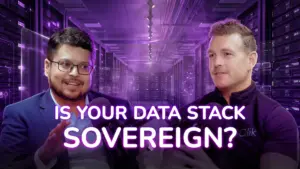
In Data Enablers Episode 8, “Is Your Data Stack Sovereign, Adaptive, Future-ready?”, Rushikesh Kulkarni of Edgematics Group and Kyle Jourdan of Qlik discuss data sovereignty in the context of enterprise AI and modern data architecture.
The conversation explores themes including secure data environments, data residency, MCP and semantic layers. These topics connect sovereignty with a broader architectural question: how can enterprises make data useful to AI while maintaining the context, controls and boundaries required for responsible use?
Watch Data Enablers Episode 8: Is Your Data Stack Sovereign, Adaptive, Future-ready?
For enterprise leaders, the central lesson is that AI readiness and sovereignty are not separate architecture exercises. Data classification, lineage, access controls and clearly defined business meaning help teams determine not only whether data can be used, but also where and under what conditions it can be used.
A Practical Sequence for Enterprise Data Teams
Turning sovereignty requirements into operational controls requires collaboration between legal, security, data governance, infrastructure and engineering teams. The following sequence provides a practical starting point.
Step 1: Map the Data Environment
Inventory critical datasets, source systems, owners, storage locations, processing environments and third-party services. Include backups, replicated data, extracts and copies held by vendors.
The inventory should identify how data moves between jurisdictions, not merely where the primary database resides.
Step 2: Classify Data by Obligation
Apply data classification alongside a jurisdictional assessment. Distinguish data subject to mandatory localization from data that can move under specified transfer conditions and data without the same restrictions.
The legal and compliance teams should validate the interpretation of relevant obligations. Do not assume that every dataset in a particular country has identical requirements.
Step 3: Assess Providers and Cross-Border Transfers
Document the legal basis, contractual commitments and technical safeguards for relevant data transfers. Review provider jurisdiction, access arrangements, encryption and incident response processes.
Record the rationale for each material decision so that it can be reviewed when regulations, contracts or the architecture change.
Step 4: Design the Architecture Around the Requirements
Choose an appropriate pattern for each data domain. Options may include regional storage, controlled cross-border transfers, federated processing or sharing approved derived outputs instead of raw records.
The architecture should reflect actual legal and business requirements rather than apply the same restriction indiscriminately to all data.
Step 5: Embed Controls Into Data Operations
Implement relevant policies within data pipelines, orchestration, identity and access management, and platform configuration. Where appropriate, automate region restrictions, masking, validation and approval processes.
Automated controls should be tested to confirm that they enforce the intended policy and handle exceptions correctly.
Step 6: Maintain Evidence and Review Controls
Keep metadata, lineage, access logs and compliance assessments current. Assign owners for monitoring changes in provider terms, regulations and business processes.
Review the controls periodically and whenever significant changes occur, such as a new cloud service, a migration, an acquisition or the introduction of an AI use case.
Why Migration Is a Critical Moment
Sovereignty requirements are easier to address before a new architecture goes live. During a cloud migration, legacy consolidation or fibre rollout, data may be copied, transformed and routed through new systems. If jurisdictional restrictions are identified late, teams may need to redesign pipelines, move datasets or rework access arrangements.
Edgematics’ guidance on cloud migration services for regulated enterprises explores the planning required for complex migration environments.
Treat sovereignty as a design requirement from the beginning. This helps organizations avoid costly remediation and build controls into the target architecture.
Our Perspective: Answer the Data Question Before the Legal Question
A common weakness in sovereignty programs is that teams establish a policy before they have sufficient visibility into their data. They may know which jurisdiction a dataset is supposed to remain in, but lack a complete view of where copies exist, how information moves or which downstream applications consume it.
We believe the more effective starting point is to establish the data facts first.
Build the catalogue. Understand lineage. Classify sensitive information. Identify ownership and quality gaps. Then translate the applicable legal requirements into technical and operational controls that can be tested and evidenced.
This is the thinking behind Edgematics’ work in data engineering and governance. By connecting architecture, metadata, data quality and governance, enterprises can make sovereignty part of normal data operations rather than a separate compliance exercise.
We also believe sovereignty should not become a binary choice between complete isolation and unrestricted data movement. The more useful question is which risks exist, which controls can mitigate them, and what evidence demonstrates that the remaining data flows meet the organization’s obligations.
The objective is controlled data use: information should move where it is permitted, remain protected where restrictions apply, and carry enough context for the organization to explain and defend its decisions.
Edgematics Group
How Edgematics Can Help
Edgematics helps enterprises strengthen data architecture and governance through data engineering, metadata management, data lineage, data quality and compliance capabilities.
Our Data Engineering & Governance practice supports organizations looking to improve visibility across complex data environments and connect governance requirements with operational controls.
For organizations reviewing their current capabilities, the Data & AI Maturity Assessment can help identify areas that require attention as data and AI initiatives evolve.
The goal is to give enterprise teams the visibility and control they need to manage data responsibly, demonstrate compliance and preserve the value of data-driven operations.
Frequently Asked Questions
What is the difference between data sovereignty and data residency?
Data residency describes where data is physically stored or processed. Data sovereignty concerns the jurisdictional laws and controls that apply to it. Keeping data in a domestic region does not, by itself, resolve every question about provider jurisdiction, access or legal obligations.
Does data sovereignty mean an enterprise cannot use a foreign cloud provider?
Not necessarily. The answer depends on the data, applicable laws, sector-specific obligations, provider arrangements and transfer safeguards. EU law does not impose a general localization requirement on all enterprise data, but particular situations may require restrictions or additional protections. Organizations should assess their specific obligations rather than assume that all foreign cloud use is prohibited or automatically permitted.
What should enterprises check before choosing a sovereign cloud?
Review storage and processing locations, backup arrangements, provider jurisdiction, encryption key management, privileged access, operational support, contractual commitments and auditability. Verify the controls against the organization’s actual legal and security requirements rather than relying on the sovereign cloud label alone.
How does data sovereignty affect AI adoption?
AI applications may retrieve, process or transfer information across multiple services and systems. Enterprises need to understand which data an AI application can access, where processing occurs and what restrictions govern its use. Classification, lineage, access controls and documented processing arrangements help manage these risks.
How can an enterprise make data sovereignty enforceable?
Start with a reliable inventory of data assets and their jurisdictions. Link classification, ownership and lineage to policy requirements, implement controls in relevant pipelines and platforms, and retain evidence of access and data movement. Regular reviews help ensure that controls remain aligned with changes in systems and obligations.
What are the CARE Principles for Indigenous data sovereignty?
The CARE Principles stand for Collective Benefit, Authority to Control, Responsibility and Ethics. Developed by the Global Indigenous Data Alliance, they emphasize Indigenous Peoples’ rights and interests in how their data is collected, managed and used. They complement the FAIR principles by bringing people, governance and ethical considerations into data management.
How can enterprises protect data integrity?
Data integrity controls help prevent unauthorized or accidental alteration, destruction or loss. Organizations should apply appropriate safeguards to data in storage, in transit and during processing, supported by access controls, monitoring, audit trails and reliable backup and recovery arrangements.